
Kashmir through the looking glass
PRAVEEN SWAMI
‘Its very good jam,’ said the Queen.
‘Well, I don’t want any today, at any rate.’
‘You couldn’t have it if you did want it,’ the Queen said. ‘The rule is jam tomorrow and jam yesterday but never jam today.’
‘It must come sometimes to "jam today",’ Alice objected.
‘No it can’t,’ said the Queen. ‘It’s jam every other day; today isn’t any other day, you know.’
‘I don’t understand you,’ said Alice. ‘It’s dreadfully confusing.’
Lewis Carroll,
Through the Looking Glass, 1871
DIALOGUE on peace in Jammu and Kashmir has passed through the mirror between the real world and into that strange place Lewis Carroll called Wonderland. Here all participants must submit to the tyranny of meaninglessness. At once, they are overcome by a compulsive urge to decode the babble that passes for dialogue, and to search for sense in even the most trivial and insignificant text.
Six months ago Prime Minister Atal Behari Vajpayee announced in Srinagar that ‘spring will return to the beautiful Valley soon, the flowers will bloom again and the nightingales will return, chirping.’ So far, the only chirping to be heard is that of the Kalashnikov – but heard from within Wonderland, it would seem, the ugly staccato rattle of gunfire contains within it the muted strains of birdsong.
Inside Wonderland, as Carroll told us, many impossible things are possible. A most extraordinary consensus has evolved – uniting everyone from paid-up hawks in the Bharatiya Janata Party’s policy establishment to South Delhi liberals who normally break out in a rash at the mere mention of the party’s name – that Vajpayee’s effort to secure peace in Jammu and Kashmir is valourous, brave and pure. Pakistan, high officials preen, has been shamed worldwide by the sheer generosity of the prime minister; in the Kashmir valley, the veil has fallen from the eyes of people long held in thrall by the evil temptress across the border; and Lo! soon it will be summer and crowds of dollar-laden tourists will throng the clear waters of the Chasm-e-Shahi.
It isn’t hard to understand the desperation for peace within and outside Jammu and Kashmir. Over thirty thousand people – civilians, security personnel, and yes, terrorists – have died in the decade and a half of carnage there. And yet, it has always seemed that peace, like the Queen’s jam, is something always around the corner or just lost; something that could have been achieved yesterday or could be achieved tomorrow, but somehow never today. Now peace, of course, is a good thing. No one can seriously dispute this unless, as Morris Chafetz famously said, ‘One wishes to be considered against motherhood or for sin.’
Yet, very serious questions about both the content and assumptions of the ongoing peace process need to be addressed. First, do the participants in dialogue actually have the capability to deliver its stated objective, a significant or even de-escalation of hostilities? Second, is the dialogue structured in a way that makes such an outcome likely? Third, what consequences might the dialogue process have for the legitimacy of those who choose to place themselves outside it? Fourth, and perhaps most important, can the dialogue process address the interest of key participants in sabotaging any movement towards peace that excludes them?
Raising these questions may be considered a little impolite, like belching at a banquet. Nonetheless, the questions do need to be answered if anyone is indeed serious about making available jam today. While I will argue that the peace initiative of October 2003 is irredeemably flawed, serious peace making is indeed possible. It needs to be premised, however, on the making of rational choices and distinctions, not sentimentality.
I
nto the mirror: On the face of it, the peace initiative marks a sharp break with months of publicly stated policy, one that is all the more mystifying since it comes on the eve of elections where a soft line on Jammu and Kashmir could cost the Hindu right dearly.On 25 September 2003 speaking before the United Nations General Assembly in New York, Vajpayee had made the blunt assertion that no dialogue was possible unless Pakistan backed terrorism ended. ‘When cross-border terrorism stops,’ the Indian prime minister had said, ‘or when we eradicate it, we can have a dialogue with Pakistan on the other issues between us.’
A
day later, he seemed equally pessimistic on the prospects of a dialogue with the Kul Jamaat Hurriyat Conference (All Parties Hurriyat Conference: APHC). The APHC, he said, ‘wants a special invitation, which I cannot understand’ [my emphasis]. The Union government had already extended, he pointed out, ‘a general invitation to all.’ Evidently, understanding dawned on the prime minister sometime in the weeks after his New York visit. The new peace initiative was announced on October 22; we know from the public testimony of former Jammu and Kashmir Chief Minister Farooq Abdullah that informal consultations on the issue started some two weeks earlier.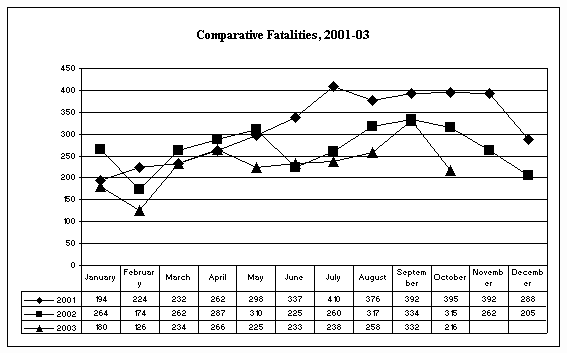
Source
: Union Ministry of Home Affairs. Figures include civilian, security force and terrorist fatalities.
Several explanations have been offered for this sudden turnaround. Some observers believe there was intense United States of America pressure to give their war on terrorism ally, General Pervez Musharraf, some legitimacy-inducing concession on Jammu and Kashmir. This school of thought points to a dramatic reduction in fatalities in Jammu in Kashmir in October, which fell to a record low compared to the same month in 2001 and 2002 – and, indeed, to a level not seen after March this year.
I
f one makes the supposition that this unprecedented reduction was the consequence of a decision by Pakistan’s military and intelligence establishment, Musharraf can interpret the fall to be a part meeting of India’s no-terrorism precondition. Notably, Musharraf had earlier seemed to suggest that he would use his influence with terrorist groups to secure a de-escalation of violence if dialogue began. Prime Minister Vajpayee had responded to this offer in New York by asserting that India refused ‘to let terrorism become an instrument of blackmail.’Advocates of the United States-pressure thesis point to several other pieces of evidence. On 29 October, deposing before a House Sub Committee on International Relations, United States Assistant Secretary of State Christina Rocca singled out Musharraf for effusive praise. ‘Despite sceptical public opinion and bitter criticism from a coalition of opposition parties,’ she said, ‘President Musharraf has maintained Pakistan’s policy of supporting U.S. operations, with practical results.’
P
akistan, she continued, was doing what it could on Jammu and Kashmir. ‘We look to Pakistan to do everything in its power to prevent extremist groups operating from its soil from crossing the Line of Control,’ she said. ‘The Government of Pakistan has taken many steps to curb infiltration, but we are asking it to redouble its efforts.’ Rocca proceeded to call for ‘dialogue and peaceful solutions to disagreements in the region,’ including with ‘militants in Kashmir.’ Answering questions, she held India and Pakistan equally responsible for what she described as an ‘impasse’.Rocca’s use of the terms ‘extremists’ and ‘militants’ are instructive, particularly since several of these figure on the United States government’s own list of foreign terrorist organizations. Notably, however, the United States did throw India a bone on the eve of the 22 October Cabinet Committee on Security meeting in New Delhi, with its Treasury Department designating Mafioso Dawood Ibrahim Kaskar a terrorist. The Treasury Department gave out a Karachi telephone number for Dawood Ibrahim, affirming Indian claims that the principal Mumbai serial bombing accused was indeed in Pakistan.
None of this, of course, was news in India; any self-respecting Mumbai crime reporter could have provided the telephone number, along with those of Dawood Ibrahim’s key aide, ‘Chhota’ Shakeel Ahmad Babu. Nor does the Treasury Department’s action compel Pakistan to hand over Dawood Ibrahim to India. None the less, the action may have given pro-United States ministers the leverage they needed within the Cabinet, since Deputy Prime Minister L.K. Advani had made something of a fetish of the issue in the past.
F
inally, other dots on the map also suggest considerable behind the scenes United States intervention. In mid-November 2003, the Pakistan government announced a sudden renewal of its forgotten 2001 proscription of the Jaish-e-Mohammad. The first ban was made in response to United States fiat after the attack on India’s Parliament building in New Delhi. Soon afterwards, however, supposedly banned groups resumed operations with considerable freedom, both in Punjab and Pakistan-administered Kashmir.Considerable open source literature, notably Mohammad Amir Rana’s encyclopaedic account, Jihad-e-Kashmir Aur Afghanistan, and investigative articles by the journalist Mohammad Shehzad, show the Lashkar-e-Taiba and Jaish-e-Mohammad continued to run training camps, recruit cadre and gather funds with not-so-tacit official sponsorship after the first ban. That the Pakistan government seems unable, at the time of writing, to apprehend Jaish-e-Mohammad chief Masood Azhar, suggests this ban may not be wholly serious. None the less, the gesture is significant: the United States, it could be argued, is keen to ensure that a pre-2001 threshold is observed to rule out the risk of a bruising South Asia escalation at a time when it seems inextricably mired in Iraq.
A
second major line of explanation also, however, exists for Jammu and Kashmir policy-making. Prime Minister Vajpayee, this school of thought runs, is deeply concerned with his place in history – or, cynics contend, a Nobel Peace Prize – and genuinely wishes to push ahead with a negotiated settlement on Jammu and Kashmir.There is little doubt Vajpayee has shown an extraordinary – critics within his party would say, suicidal – urge to push for peace in Jammu and Kashmir. The contours of his policy thrust became evident in the winter of 2000, just a year after India’s military triumph in the Kargil war. Hoping to strengthen pro-dialogue elements within the Hizb-ul-Mujaheddin led by dissident commander Abdul Majid Dar, Vajpayee initiated the five-month Ramzan ceasefire. Indian troops were ordered not to initiate offensive combat operations, while New Delhi began a covert dialogue with Dar and APHC centrists. Although official India is profoundly reluctant to admit the facts on this issue, the ceasefire was a profoundly unhappy experience.
Union Ministry of Home Affairs data shows that measured by almost any conceivable index, terrorist violence in Jammu and Kashmir actually escalated during this time. Paradoxically for an effort intended to end killings, the Ramzan ceasefire actually ended claiming more lives than in the corresponding months of previous years. The ceasefire eventually collapsed, but Planning Commission Chairman K.C. Pant was appointed as the Union government’s first official interlocutor to continue the dialogue process.
Pant formally invited the APHC to join the dialogue soon after his appointment in April 2001. It never responded to the letter. Geelani, then part of the APHC, demanded that it be allowed to visit Pakistan as a precondition to dialogue. Others, like Abdul Gani Lone, were more sympathetic to the Pant mission, but could not carry the organization with them. Shabbir Shah, a secessionist leader outside the APHC umbrella, also received a letter, and responded by asking for several clarifications. A desultory dialogue followed, with few results.
P
ant, insiders say, came to believe that Shah might be interested in joining the election process under the right conditions, but nothing of the kind eventually happened. Vohra replaced Pant this year and issued a press release inviting all interested parties to dialogue. Ansari, soon after his appointment to office, dismissed the invitation out of hand, described Vohra as a ‘clerk’ and demanded direct dialogue with the prime minister. Vohra is known to have met both Advani and Vajpayee in the days before the CCS meeting, at which he is present. Sources say the hard-nosed bureaucrat made clear his mission had reached a dead-end, and that any further progress would require the government to make larger concessions to the APHC centrists.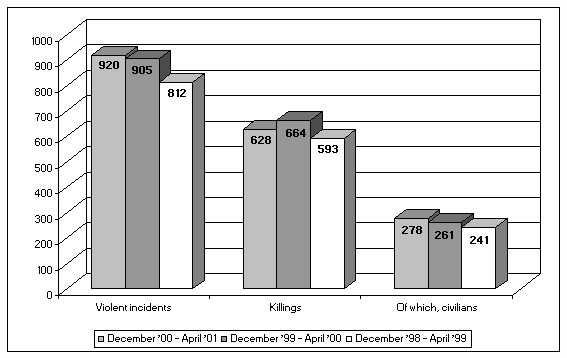
Despite Vohra’s frustrations, however, the government and APHC had in fact remained in contact. Principal Secretary to the Prime Minister Brajesh Mishra, and Officer on Special Duty A.S. Dullat, are believed to have held a series of covert meetings with top APHC figures. Former Union Minister Ram Jethmalani, in turn, conducted a parallel dialogue process through his own Kashmir Committee, which functioned as a sounding board for new ideas.
W
hen Vajpayee visited Srinagar this April, his renewed calls for dialogue added impetus to this quiet peace dialogue. The next month, Ansari revived the idea of visiting Pakistan, much to the ire of the Islamists around Geelani, who felt they would be kept out of such an initiative. Meanwhile, the APHC itself split down the middle, and the Prime Minister’s Office came to believe it needed to make fresh concessions in order to strengthen the centrists. During a meeting of the Inter-State Council in August, Advani offered the APHC an ‘informal dialogue’ that bypassed Vohra. If the APHC ‘desired to come to Delhi,’ Advani said, ‘the Centre would have no objection to keep the door open for talks informally.’ From here to the October peace offering was just a small step – if policy makers chose to pretend the New York episode had never happened.
W
e may never really know just what provoked the decision to launch a fresh peace initiative – at least, that is, until those who participated in it write their memoirs. We do not know why Deputy Prime Minister L.K. Advani was charged with negotiating with the APHC, or what road-map the Union Government had in mind for the talks. The CCS is believed to have discussed the peace initiative for a little over half an hour; no voices of dissent were raised.Despite the magical illusion of a dramatic breakthrough, however, there appears to be no clear plan for transforming dialogue with the APHC into a material reality. APHC Chief Maulvi Abbas Ansari, who was present in New Delhi when the CCS meeting took place, at first welcomed the announcement. ‘Advani’s appointment has come a little late but it is a good step,’ said Ansari. Soon afterwards, however, the APHC centrists began a process of in-house consultation, which insiders say could last up to a month.
Yasin Malik’s faction of the Jammu and Kashmir Liberation Front opposed a two-way dialogue with India just this August, while the breakaway parallel APHC formation led by Islamist hardliner Syed Ali Shah Geelani seems hostile to any repast commencing on a table at which it has not been invited to be present. To top it all off, New Delhi has yet to respond to the APHC’s demand for a formal invitation to dialogue. While the APHC wants written confirmation that the dialogue would address its demands for secession, the Union government has obvious concerns about making any such emphatic admission. No consensus exists within the government, too, on the demands by the mainstream APHC to visit Pakistan to hold a dialogue with secessionist and terrorist groups based there.
Advani himself seemed keen to circumscribe the limits of the dialogue agenda well before it begins. On 24 October, he insisted that ‘the unity, integrity and sovereignty of the country cannot be compromised,’ an obvious reference to the APHC’s insistence that secessionist demands be brought to the table. Instead, he suggested an alternative limitation for dialogue, well short even of the demands made for federal autonomy by several mainstream parties in Jammu and Kashmir. ‘We don’t want that all the powers remain confined to Delhi or for that matter to the state capitals alone,’ Advani said. ‘We favour decentralization and are prepared to take steps for that.’
I
t is possible that this formulation was addressed as much to the Prime Minister as to the APHC. On 8 May, Vajpayee had suggested the prospect of an ‘alternate arrangement’ on Jammu and Kashmir, a term that some read to mean one that in some fashion significantly diluted India’s current structure of sovereignty. On the twelve-step proposals for Pakistan, Advani was even more emphatic: ‘Our stance is the same, that Pakistan has to stop cross-border terrorism, destroy the terrorist infrastructure and build a congenial atmosphere before any talks can begin.’Before taking the next step forward, however, New Delhi might have to carefully sweep the area for hidden mines. First, past experiences with public domain peacemaking have not been heartening. Groups like the Jamait-ul-Mujaheddin, Hizb-ul-Mujaheddin and Jaish-e-Mohammad have already made clear their dislike for the nascent dialogue with the APHC. This should surprise no one, for jihadi groups will not be present at the table; they have an interest in ensuring that the banquet is disrupted. Pakistan, which also has limited leverage over the centrists, will do its best to ensure that a dialogue which does not include it goes nowhere. Its frank recognition of the Islamist faction of the APHC is indicative of things to come.
W
hile Pakistan’s links to the political establishment that represents – but does not control – terrorism in Jammu and Kashmir may have been severed, a new kite is now flying, firmly anchored to hands in Islamabad. Then, as National Conference leader Omar Abdullah has pointed out, New Delhi’s failure to invite extremists like Geelani to the table may prove costly. Should the dialogue prove unable to secure peace, or yield no short-term results, the Islamists will be strengthened, and the centrists de-legitimised.Pakistan itself, second, has no clear incentives to de-escalate violence in Jammu and Kashmir. Its best-case scenario is, of course, that India will one day, sooner or later, tire of waging a war without end, and make concessions that will allow the Pakistani military establishment to perpetuate itself as the institution that realized the unfinished business of Partition. Its worst-case scenario, however, isn’t half as bad from a purely pragmatic point of view – that three entire Indian Army corps will be tied down in low-intensity warfare duties, with no significant costs to Pakistan itself. At least some observers in Pakistan have argued that recent efforts to contain the jihad in Jammu and Kashmir are merely tactical; that the military and mujaheddin are in fact allies, despite the invective they routinely direct at each other.
As the journalist Mohammad Shehzad has noted: ‘On Saturday [November 15], the government on Musharraf’s direction raided the offices of KI [Khuddam-ul-Islam], formerly Jaish-e-Mohammad in major cities like Karachi, Lahore and Rawalpindi and sealed them. It is to be noted that the government did not arrest any worker of Jaish [my emphasis]. The government has put JD [Jamaat-ud-Dawah, the renamed Lashkar-e-Taiba] on the watch-list. The widespread feeling in Pakistan is that such raids and sealing of offices of jihadi outfits is just a farce. Jihadis are natural allies of the establishment as they provide the establishment cheap labour to bleed India.’
M
ost dangerous of all, though, is the assertion by both Vajpayee and Union Defence Minister George Fernandes that the ongoing peace effort is a last throw of the dice. Unlike in, say, Nagaland, the Union government isn’t talking to the principals. The APHC has no influence with the armies of the jihad and cannot give New Delhi the reduced violence it needs. Conversely, New Delhi is, on election-eve, in no position to give the APHC the sweeping concession it requires for its own fragile legitimacy to survive. Pakistan, in turn, has no real incentive to reign in terror unless it gets what it wants. Meanwhile, the Hindu right is incensed with what it sees as official pandering of Pakistani recalcitrance. Unless there is some truly careful thinking, then, the prospects for disaster are enormous. This is after all Wonderland: each step towards peace could at once be bringing India and Pakistan closer to war.