Intra-state parity and selection of reserved seats
MOHD. SANJEER ALAM
THE Indian electoral system is based on a single member constituency. In principle, under a single member constituency based electoral system, constituencies so far as possible must be equal in terms of size of electorate so that people voting in one place do not have greater weightage over the result than those voting in another place.
1 This fundamental requirement of equality of franchise periodically necessitates delimitation of constituencies. Hence, carrying out the delimitation exercise within a stipulated time period is of particular importance. The Constitution of India lays down para-meters within which delimitation of constituencies is to be carried out, though it is for the Parliament to decide and determine its nature and scope.Originally, as per the provisions of the Constitution, readjustment and delimitation of constituencies was to take place after every decennial census. Accordingly, Delimitation Commissions were constituted in 1952, 1963 and 1972. However, the Parliament by passing the 42nd Constitutional Amendment Act 1976 (which amended Articles 82 and 170) imposed a moratorium on the number of seats allocated and the territorial boundaries of constituencies as determined by Delimitation of Parliamentary and Assembly Constituencies Order 1976 until the publication of the population figures of 2001 Census. Accordingly, the Fourth Delimitation Commission was set up under the Delimitation Act 2002 after a gap of as many as 30 years.
A moratorium on delimitation and consequent stability of the territorial extent of constituencies for about three decades, while offering an opportunity to those interested in electoral studies for keeping a tab on changes in political attitudes and behaviour of people, also created fundamental distortions (huge inter-constituency inequalities in terms of size of electorate), thus undermining the basic principle of equal value of vote of every citizen. During the last three decades, factors such as prevalence of different demographic regimes across the country, migration induced urbanization, changes in administrative geography and so on, seriously disturbed both inter and intrastate parity in representation. Thus if the present strength of the Lok Sabha is held constant and the population figures of 2001 Census are employed as the basis of reallocation of seats, it would appear that many states are over-represented and others under-represented. In general, the four southern states that experienced a distinctive demographic regime characterized by lower fertility rate (nearing NRR) stand over-represented. In contrast, the so-called BIMARU states experiencing higher rate of population growth would appear to be under-represented.
2 While this is a subject of intense debate, this paper will focus on two basic questions: (a) how intra-state disparity in the size of electorates has grown since the last delimitation exercise and how well the latest one has addressed this problem; and (b) how the principles pertaining to selection of reserved constituencies have been applied in different states.
T
able 1 presents growth and the extent of variation in size of electorates within states. Since the last delimitation exercise held in 1972-76, the average number of electorate per seat (parliamentary) or constituency has nearly doubled. The increasing size of electorates has also given rise to inequalities in size of electorates among constituencies, both within the state and across the country, depending upon what may be called ‘demographic events’. Even within the state some constituencies have become so large as to contain two or three times more voters than other constituencies. For example, Outer Delhi, in terms of size of electorate, became about ten times bigger than the Chandni Chowk seat in Delhi, and Thane five times bigger than Mumbai South in Maharashtra by 2004. Examples of such disproportionately large constituencies abound across the country.
A
quick glance at Table 1 enables us to identify the states where inter-constituency variations have grown more rapidly than elsewhere. The coefficient of variation, a measure of relative variation, has steadily grown over the years across states. In particular, states like Maharashtra, Gujarat, Karnataka and Tamil Nadu reflect greater variation and lower consistency. Further, the coefficient of variation in these states witnessed a jumping off from one point of time to another.|
TABLE 1 Intra-State Disparity in Size of Electorates of Lok Sabha Constituencies (1977-2004) |
||||||||
|
State |
Year |
Electo-rate (in lakh) |
Ave-rage electo-rate /seat (in lakh) |
Coeffi-cient of varia-tion (in %) |
Variation in size of electorate |
|||
|
Less than 10% |
10-20% |
20-30% |
30% & above |
|||||
|
Andhra Pradesh |
1977 |
275.6 |
6.50 |
7.0 |
32 |
9 |
1 |
0 |
|
1984 |
335.5 |
8.00 |
7.5 |
33 |
9 |
0 |
0 |
|
|
1991 |
426.1 |
10.14 |
10.3 |
28 |
12 |
2 |
0 |
|
|
1998 |
491.3 |
11.60 |
14.5 |
26 |
11 |
3 |
2 |
|
|
2004 |
513.5 |
12.20 |
18.4 |
22 |
10 |
6 |
4 |
|
|
Bihar |
1977 |
349.9 |
6.48 |
8.0 |
37 |
17 |
0 |
0 |
|
1984 |
433.4 |
8.00 |
9.6 |
39 |
12 |
3 |
0 |
|
|
19911 |
504.5 |
9.70 |
8.4 |
40 |
9 |
3 |
0 |
|
|
1998 |
587.6 |
10.88 |
9.9 |
44 |
6 |
2 |
2 |
|
|
20042 |
673.7 |
12.47 |
12.6 |
37 |
12 |
3 |
2 |
|
|
Gujarat |
1977 |
141.0 |
5.42 |
7.8 |
22 |
4 |
0 |
0 |
|
1984 |
186.3 |
7.16 |
12.3 |
18 |
3 |
5 |
0 |
|
|
1991 |
248.8 |
9.57 |
16.4 |
14 |
8 |
2 |
2 |
|
|
1998 |
287.7 |
11.00 |
23.2 |
12 |
7 |
5 |
2 |
|
|
2004 |
336.7 |
12.90 |
25.2 |
10 |
9 |
5 |
2 |
|
|
Karnataka |
1977 |
167.6 |
5.98 |
5.0 |
23 |
5 |
0 |
0 |
|
1984 |
211.0 |
7.53 |
9.3 |
22 |
5 |
1 |
0 |
|
|
1991 |
288.3 |
10.29 |
11.7 |
24 |
1 |
2 |
1 |
|
|
1996 |
330.9 |
11.80 |
16.6 |
21 |
5 |
0 |
2 |
|
|
2004 |
385.9 |
13.70 |
23.5 |
16 |
9 |
1 |
2 |
|
|
Kerala |
1977 |
114.6 |
5.73 |
3.0 |
20 |
0 |
0 |
0 |
|
1984 |
142.7 |
7.13 |
3.9 |
19 |
1 |
0 |
0 |
|
|
1991 |
196.5 |
9.80 |
4.9 |
19 |
1 |
0 |
0 |
|
|
1998 |
211.8 |
10.50 |
6.7 |
17 |
3 |
0 |
0 |
|
|
2004 |
211.2 |
10.50 |
8.4 |
17 |
3 |
0 |
0 |
|
|
Madhya Pradesh |
1977 |
227.8 |
5.69 |
7.0 |
32 |
8 |
0 |
0 |
|
1984 |
281.4 |
7.03 |
8.2 |
31 |
9 |
0 |
0 |
|
|
1991 |
377.0 |
9.42 |
9.6 |
28 |
10 |
2 |
0 |
|
|
1996 |
446.0 |
11.10 |
11.7 |
27 |
10 |
2 |
1 |
|
|
20042 |
521.0 |
13.00 |
13.0 |
24 |
11 |
4 |
1 |
|
|
Maharashtra |
1977 |
288.5 |
6.01 |
8.0 |
38 |
9 |
1 |
0 |
|
1984 |
363.5 |
8.65 |
10.6 |
33 |
12 |
3 |
0 |
|
|
1991 |
486.3 |
10.13 |
19.4 |
27 |
12 |
6 |
3 |
|
|
1998 |
562.0 |
11.70 |
30.8 |
19 |
15 |
6 |
8 |
|
|
2004 |
630.1 |
13.10 |
31.2 |
20 |
15 |
5 |
8 |
|
|
Rajasthan |
1977 |
152.4 |
6.09 |
6.0 |
20 |
5 |
0 |
0 |
|
1984 |
201.1 |
8.04 |
9.0 |
18 |
6 |
1 |
0 |
|
|
1991 |
265.1 |
10.61 |
12.0 |
19 |
4 |
1 |
1 |
|
|
1998 |
297.5 |
11.90 |
13.0 |
17 |
6 |
0 |
2 |
|
|
2004 |
347.1 |
13.90 |
13.9 |
15 |
8 |
0 |
2 |
|
|
Tamil Nadu |
1977 |
271.8 |
6.97 |
8.0 |
34 |
3 |
2 |
0 |
|
1984 |
309.5 |
7.93 |
9.4 |
35 |
3 |
1 |
0 |
|
|
1991 |
399.1 |
10.23 |
11.1 |
31 |
5 |
1 |
2 |
|
|
1998 |
455.7 |
11.60 |
17.9 |
24 |
11 |
2 |
2 |
|
|
2004 |
472.5 |
12.10 |
18.2 |
19 |
17 |
0 |
3 |
|
|
Uttar Pradesh |
1977 |
525.0 |
6.10 |
5.1 |
81 |
4 |
0 |
0 |
|
1984 |
596.2 |
7.33 |
5.7 |
79 |
6 |
0 |
0 |
|
|
1991 |
794.5 |
9.45 |
6.5 |
75 |
8 |
1 |
0 |
|
|
1998 |
1019.0 |
11.99 |
8.9 |
70 |
12 |
3 |
0 |
|
|
20042 |
1161.0 |
13.70 |
9.7 |
56 |
23 |
4 |
2 |
|
|
West Bengal |
1977 |
251.2 |
5.98 |
7.0 |
35 |
7 |
0 |
0 |
|
1984 |
329.5 |
7.84 |
8.6 |
34 |
6 |
2 |
0 |
|
|
1991 |
413.5 |
9.85 |
10.7 |
30 |
10 |
1 |
1 |
|
|
1998 |
468.4 |
11.10 |
12.9 |
29 |
9 |
2 |
2 |
|
|
2004 |
474.3 |
11.30 |
13.3 |
32 |
4 |
4 |
2 |
|
|
Source : Calculated from the Statistical Report to General Elections (relevant years), Election Commission of India.Notes: 1. Results were not declared for Patna and Purnea. 2. Bihar, Madhya Pradesh and Uttar Pradesh include Jharkhand, Chhattisgarh and Uttaranchal respectively. |
||||||||
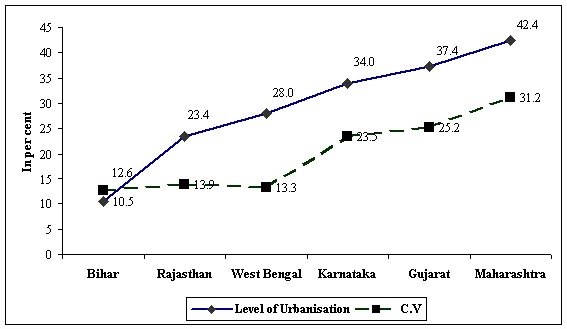
What accounts for the large variations in these states? One plausible explanation is the rapid urbanization in these four states during the last three decades. Figure 1 shows that levels of urbanization and levels of variation in size of electorate go hand in hand – the higher the level of urbanization, the greater the inter-constituency variation in the state. Since urbanization in India is largely a function of rural to urban migration, and that too directed primarily towards select big cities, constituencies located in these cities can become relatively, if not in some cases super, large. It is the presence of such constituencies which contributes to the overall large variations within the state.
H
ow successfully has the Fourth Delimitation Commission addressed the issue of intrastate parity? How satisfactorily has the commission redistributed population and readjusted territories in order to equalize the constituencies in terms of size of electorate without circumventing other principles such as geographical contiguity/compactness, geographical features, facilities of communications and public convenience? But before one looks into the question of intrastate parity one needs to confront the ‘internal decision’ of the commission to allow for a plus or minus 10 per cent variation from the state/district average.
|
FIGURE 1 Level of Urbanization and Variation in Size of Electorate
Note : Proportion of urbanization pertains to 2001 Census. Figures of C.V. for 2004 General Elections to Lok Sabha. |
While it is almost impossible to envelop an equal number of people in each constituency, the question one might ask is: do the laws pertaining to delimitation empower/permit the commission to decide an acceptable extent of variation? Again, one might ask: what is the rationale behind picking up the magic figure of 10 per cent? Why not 5 per cent? Ideally, such a decision should be taken by the Parliament and the extent of permissible variation clearly spelt out in the laws rather than leaving it to the discretion of the commission.
L
et us for the moment leave aside the question of validity/legality of the commission’s decision and come to the larger point. A closer examination of the range of deviation, thanks to the RTI (Right to Information) Act through which working paper VI and VII of the Delimitation Commission became available, suggests that the commission has failed even to respect its own norms for the sake of convenience. There are certain constituencies in which deviation is above the permissible range of 10 per cent. For instance, the population of Bangalore Central parliamentary constituency is about 12 per cent less than the average population of a constituency in Karnataka. The population of Nalanda and Begusarai constituencies in Bihar is higher than the state average for a parliamentary constituency by about 14 and 13 per cent respectively. Such discrepancies can be pointed out in other states too. The persistence of such anomalies clearly indicates that the commission has failed to adequately address the issue of intrastate parity, even if for the moment we leave aside the charge of lack of transparency, disregarding the suggestion of associate members and ignoring other principles that the commission had promised to address during the process of delimitation.In a society as diverse as India, understanding the human geography of an area is critical for delimiting as well as categorizing constituencies. A failure to do so runs the risk of dividing people who in effect may lose their representation or voice in the legislature. Even as the Delimitation Commissions are seen as independent, impartial and judicious in their exercise of delimiting constituencies, they have remained far from being non-controversial,
3 particularly in the selection of reserved constituencies for Scheduled Castes. In the past, as Guru (1986) has pointed out, the seats reserved for Scheduled Castes in Maharashtra were used as a ‘dumping ground’ for areas that did not support the Congress.4The Sachar Committee (2006) also took a serious note of the way constituencies with a sufficiently large number of Muslims were reserved for SCs. Citing examples from three states, the committee noted that constituencies which were reserved for SCs by the Delimitation Commission (1972-76), were by and large those where Muslims were in greater numbers, often more than 50 per cent, and their proportion in the population was higher than that of SCs. On the other hand, there were a large number of other constituencies within the respective states where the share of SCs is large, often close to or even more than one half, but which were declared as ‘unreserved’. In a nutshell, the selection of reserved seats is a sensitive issue demanding adequate care.
T
hough the Constitution Act 2001 and 2003 (84th Amendment Act 2001 and 87th Amendment Act 2003) retained the freeze on expanding the strength of the Lok Sabha, it was however decided that reserved seats for SCs and STs were to be allotted in each state on the basis of the 2001 Census, implying that the number of reserved seats would increase at the expense of general seats. In the process of delimitation, while some general seats were to be declared as reserved, a large number of existing reserved constituencies for SCs were also de-reserved with major or minor territorial variation. If we exclude one seat from Assam, out of the 78 existing SC seats, 35 retained their SC status, some with and others without some territorial variation or simply with name changed. However, at the same time, about a third of existing SC seats lost their SC status to become general seats.
|
TABLE 2 Changing Status of SC Constituencies |
||
|
Status of SC constituencies (Delimitation 1972-76) |
||
|
I. |
Number of SC constituencies now become general |
29 |
|
II. |
Number of SC constituencies omitted in Delimitation 2002-08 |
14 |
|
III. |
Number of existing SC constituencies retained in Delimitation 2002-08 |
35 |
|
Total (I +II+III) |
78 |
|
|
SC constituencies as per Delimitation 2002-08 |
||
|
IV. |
Number of general constituencies (old) now become SC |
36 |
|
V. |
Number of SC constituencies drawn afresh/carved out of one or more than one constituency |
13 |
|
VI. |
Old SC seats retained as SC |
35 |
|
Total (IV+V+VI) |
84 |
|
|
VII. |
Net gain of SC constituencies |
6 |
|
Note : Compiled by the author. The analysis only pertains to Lok Sabha constituencies and excludes Assam. |
||
W
hich seats are to be reserved? In the case of reserved constituency for Scheduled Tribes, the selection criterion is straightforward and, therefore, comparatively easy. As per Section 9(1) (d) of the Delimitation Act 2002, seats for STs are to be reserved in those constituencies in which their proportion to total population is the largest. By and large the ST population is concentrated in a particular geographical area. However, the guidelines with regard to selection of constituencies for SCs are slightly different. The Delimitation Act 2002, Section 9(1) (c) stipulates that constituencies for SCs are to be distributed in different parts of the state and seats are to be reserved for SCs in those constituencies where the percentage of their population to the total population is comparatively large.
T
he idea behind ‘geographical spread of SC constituencies’ in different parts of the state emanates from the fact that unlike STs, the population of SCs is unevenly distributed across states, and those living in areas of lower concentration should not be deprived of reserved seats. While the criteria used for selecting reserved constituencies for SC at assembly constituency level is relatively easy, application of the same criteria for selecting parliamentary constituencies is more complicated. Hence the selection of a reserved constituency (parliamentary) for SCs warrants meticulous exercise.Seen in the light of the above constitutional position and guidelines, the Delimitation Commission seems to have erred in the selection of reserved seats for SCs in many cases. Consider for example the case of Gopalganj parliamentary constituency in Bihar. Though Scheduled Castes account for about 12 per cent of total population in the delimited Gopalganj constituency, it has been reserved for SCs. In contrast, constituencies with a SC population that is more than one-fifth of the total population like Aurangabad, Nawada and Jehanabad stand as general seats.
Even if it is argued that Gopalganj fits in the scheme of geographical spread, and that selection of Nalanda or for that matter of Aurangabad would have led to clustering of SC constituencies, the very argument could be debunked by the fact that Hajipur and Samastipur Lok Sabha constituencies (both reserved) exist cheek by jowl. Second, there is no reserved constituency in the eastern half of Bihar. The entire Kosi region remains devoid of SC seats despite the existence of many constituencies where the proportion of SC population is sufficiently large to be reserved. Seen in this context, declaring Gopalganj as a SC seat appears to be a case of arbitrariness on the part of the commission.
A
nother instance of the commission’s deviation from the principles/norms pertaining to selection of reserved seats for SCs is seen in Maharashtra and Karnataka. The number of reserved seats for SCs in Maharashtra has increased from three to five. Of the three old SC constituencies, two have now become general with some territorial variation and one has been merged with what is now known as Madha constituency, which too is a general constituency. In other words, all the three old SC constituencies have been de-reserved. While de-reserving Buldhana seems to be justified, as it now has a much lower proportion of SC population than many other constituencies, it is difficult to understand why Osmanabad should have been de-reserved. Even in its new shape, Osmanabad happens to be one of those constituencies with a significantly higher proportion of SC population.If one plots current distribution of SC seats on the parliamentary constituency map of Maharashtra, one finds that except for Shirdi, the remaining four constituencies appear in pairs. Perhaps the commission was devoid of choice, but even so, the pairing of SC constituencies appears to be wrong. Sholapur and Latur, for instance, are reserved constituencies and share boundaries. Nanded constituency, which exists alongside Latur, is the second largest constituency in terms of percentage of SC population to total population. But it stands as a general seat, which is intriguing. Moreover, if principles were to be strictly adhered to, Aurangabad instead of Shirdi should have been chosen as a SC constituency. In Karnataka, constituencies like Gulbarga, Bijapur and Bidar share borders with one another. The proportion of SC population in these constituencies are 22.6, 18.5 and 21.8 per cent respectively. While Gulbarga and Bijapur have been reserved for SCs, Bidar remains a general constituency. If the commission had no choice and only two out of three constituencies were to be reserved, going by principles, Bidar and Gulbarga should have been reserved and Bijapur left open.
T
o conclude, the outcome of the delimitation exercise can at best be described only as a partial success. There is no gainsaying the fact that intrastate parity in size of electorate has to a great extent been achieved. Yet anomalies continue to persist. The way reserved constituencies for Scheduled Castes have been selected reflects even more laxity and lackadaisical functioning on the part of the commission. Unfortunately, the spectre of incorrect decisions made by the Delimitation Commission will haunt us for as long as three decades, as their orders are immutable and beyond any judicial purview and scrutiny.
Footnotes:
1. David Butler et. al., India Decides: Elections 1952-95, Books and Things, New Delhi, 1995.
2. K.C. Sivaramakrishnan, ‘North South Divide and Delimitation Blues’, Economic and Political Weekly 35(35 & 36), 2000, pp. 3093-97; and Allistair McMillan, ‘Delimitation, Democracy and End of Constitutional Freeze, Economic and Political Weekly, 8 April 2000, pp. 1271-76.
3. R.P. Bhalla, Elections in India (1950-72), S Chand and Company, New Delhi, 1973; Bruce Bueno de Mesquita, ‘Redistricting and Political Integration in India’, Comparative Political Studies 11(2), 1978, 279-88.
4. G.N. Gawa Guru, Party Politics in Reserved Constituencies. Unpublished PhD Thesis, Jawaharlal Nehru University, Delhi, 1985.