The currency of character
AARTI SETHI
HISTORIES of cinema tell us a great deal about the 20th century histories of urban modernity in the colonial world. This paper specifically relates to understanding the site of the cinema hall as an urban site – located and contiguous with a spatial politics of the city. In what follows I attempt to locate the figure of the black marketeer as he emerges around cinema halls in 1950s Delhi.
The concern is not to search the streets for the ‘real’ representative of the cinematic trope, but to see how black-marketeering around cinema halls, as a significant component of the social life of cinema, enables us to open out a set of questions to do with desire, consumption, the production of cinema as a juridical object and the post-partition contours of city life. In doing so it hopes to expand our understanding of the circuits of cinema, as also explore the enmeshing of these circuits within the contours of a changing cityscape.
The expansion of cinema towards the South and West in Delhi began in the post-partition period as cinema halls came up rapidly in the new areas and colonies settled from the 1950s onwards. Cinema halls like Eros, run by the Sood family, came up in 1955 in the refugee settlement of Jangpura; Liberty and Vivek cinemas in Karol Bagh (East and West) came up around 1952. Similarly, licenses were granted for cinema halls in Kotla, Shadipur, Ajmal Khan Road, Pusa Road, Roop Nagar, Vishwas Nagar, Najafgarh Road. In a manner the history of the expansion of cinema can be read as a history of the post-partition settlement of Delhi.
The period from the late forties-early fifties to about the late sixties-early seventies was one of general mayhem around cinemas. When one speaks to old-timers in the trade and asks them to single out the most significant change in film viewing culture in the last 50 years, most often the answer is, ‘Goondagardi khatam ho gayi hai (Rowdyness – around the halls – has stopped).’
1 Areas near Khanna Talkies, Jagat Talkies, Mohini and Robin, all faced their share of goondagardi. In the case of Imperial cinema in Paharganj, the goondagardi apparently stopped in 1971, but for a brief resurgence in the late seventies-early1980s. Today there is no trace of it at all.Owning a cinema hall in the 1950s was a tricky business. Each time a new hall was built, there was intense contest between the local toughs of the locality to establish ‘ownership’ rights to the income from black-marketeering of tickets. So Kumar Talkies was ‘owned’ by Om Prakash urf ‘Kala’, Novelty by Madhi, the local dada who controlled Golcha went by the nom de guerre of Kauri, and Puran Tunta’s regime extended over Majestic Cinema.
2 Imperial had to contend with ‘Macchar’, Manha Singh, Naddi and Malkan, all immigrants from Lahore and Peshawar. The fighting around Imperial cinema was such a part of everyday routine that the sweeper depended on it to supplement his income – the morning after fights he would gather up the glass bottles rival gangs had hurled at each other, and sell the shards to the Lakshmi Soda shop across the road for a tidy profit.3
O
n their part, the halls employed pehelwans, also partition immigrants, on their payroll as bouncers and strongmen who were charged with securing peace during shows. Often, the two roles coincided, so that in return for a monopoly on the income from ‘black’, the dada, who was also on the hall’s payroll, would ensure relative harmony in the neighbourhood by ensuring competitors were kept at bay. Thus Imperial solved its goondagardi problem by giving the biggest goonda of the area, Manha Singh, a job. Now a permanent employee, he balanced his dual roles, that of official gatekeeper and official black marketeer, with ease.The problem of black-marketeering and the attendant mayhem reached such alarming proportions, and was such a visible component of film watching culture, that the Special Superintendent of Police was prompted to take note of the problem. Soon correspondence and letters flew back and forth between the office of the Deputy Commissioner, the Chief Commissioner, the Entertainment Tax department and the police. So much so that the chief minister himself was forced to take notice of a letter written by the chief secretary, appraising him of the ‘seriousness’ of the situation. News reports appeared in prominent dailies such as The Times of India and Nav Bharat Times castigating the government for its inability to curb the menace and reporting on the unfortunate causalities of the black market, such as the young man who was killed outside a Chandani Chowk cinema in a dispute between, ‘two groups of people over alleged sale of cinema tickets in the black market.’ As he was walking near the hall, ‘he was attacked with knives by the rival group as a result of which he succumbed to his injuries.’
4It is in attending to such discourses, both in the media and in the bureaucracy and police, that we can discern a deep anxiety regarding the proper modes, forms and terms of laying claim to inhabiting the city, and further, the coalescing of these anxieties around the figure of the migrant refugee. The files in this regard are instructive, because not only does the black marketeer emerge as a deeply marked and ambiguous figure, but so do a range of other characters, all of whom must be positioned hierarchically according to their capacities and behaviour.
A
series of meetings on black-marketeering were held in the Deputy Magistrate’s office between the SSP, Entertainment Tax Officer and the management of the cinema halls.5 It was alleged that the practice was primarily restricted to cinema halls in Old Delhi, and these often led to ‘serious situations’,6 including murder and the existence of ‘regular criminal gangs’ which functioned around the halls. Allegedly the gangs operated in connivance with the local police who turned a blind eye to their depredations. Further, that both the violence that resulted during show times and the turf wars between rival gangs for control over the right to ‘black’, presented a grave threat to order and members of the public. The goondas involved were ‘ex-convicts’ and those ‘accused of murder charges.’7 Clearly, merely fining the miscreants under the U.P. Entertainment and Betting Act 1937, would not really address the problem, for they simply paid the fine (ranging from between Rs 10 and Rs 20), or spent a week in lock-up, and then it was back to business.8
S
uggestions mooted at these meetings included, ‘a general round up of the known goondas in the area, and taking security from them [sic] as an assurance of good behaviour.9 To aid this effort, not only were cinema hall managers asked to provide a list of local troublemakers, but it was also decided that police would be regularly posted outside the halls during show timings (to ensure no untoward incidents occurred) and that there would be regular raids by the police force.10 And, for good measure, halls were asked to spruce themselves up, purportedly to attract a better class of clientele.A fairly explicit connection was made between the ‘profile’ of the hall and rowdiness – so cinema hall owners used this opportunity to ask for an increase in their electricity power load so that they could install air-conditioning like the new halls built in New Delhi and attract ‘gentry’ audiences. They were further instructed to provide uniforms for their staff and to ensure that the staff ‘did not drink while on duty.’
11 Since the needle of suspicion often fell on the hall employees who were thought to be in cahoots with the ‘thugs’, these last two suggestions seemed to be aimed at breaking what was probably seen as an inter-locality nexus of solidarity.
T
he police were not far wrong in this regard. As described earlier, sometimes the gatekeepers of the halls were also the ‘official’ black marketeers of the neighbourhood. Manha Singh’s nephew, Kulwinder Singh, who worked at Imperial for ten years after his uncle died (he is now the vice-president of the Old Delhi city district unit of the Nationalist Congress Party), gave me a detailed description of the mechanics of intra-hall black-marketeering. The booking clerk was asked to reserve a certain number of tickets as ‘black’, depending on the popular projection of the ‘hit’ quotient of a film. These tickets were then ‘blacked’ by the gatekeepers, the clerk earning a commission of five rupees on each ticket. If all the tickets sold, the profit was shared equally; even if they did not, the clerk still earned his commission and the loss thus incurred was equally divided.
N
ot only does the cinema hall emerge as a deeply disruptive space around which all sorts of shady characters congregated, in need of constant surveillance and regulation, but equally that the police had a pretty good idea of who these shady figures were. The correspondence between the Deputy Commissioner of Police, the Chief Commissioner of Police and the Special Superintendent of Police indicates that an agreement had been reached between the governments of Delhi and Lahore to exchange the history sheets of ‘bad characters’ who were known to have migrated to either city during partition, and the exact modalities through which this could be accomplished.12|
|
|
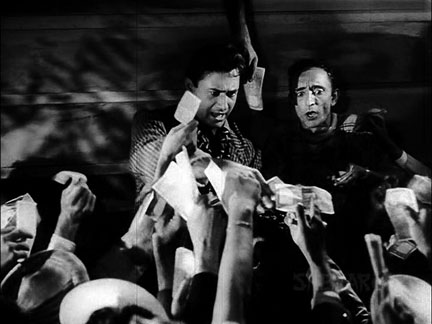
Dev Anand, in Kala Bazar (Vijay Anand, 1960), sells tickets in black for the premier show of Mother India. |
In 1957, in the wake of the bomb blast outside Jagat cinema,
13 the Crime Record Office began the process of creating personal dossiers of known ‘bad characters’ with photographs, fingerprints, criminal history and ‘criminal working methods’ as part of a planned 6,000 photograph, ‘ready reference [library] on bad characters.’14 I have as yet been unable to establish what finally happened to the Delhi-Lahore proposal, even whether such an exchange occurred or not, but it does show the extent to which the working class migrant male was invariably already constituted as the lumpen other through a shared set of codes and figurations.Of course, this discourse circulated in the name, and on behalf and for the protection, of the unmarked spectator-citizen-consumer. The citizen consumer’s ire was piqued by being forced to pay higher rates to see the cinema, which as the Nav Bharat Times noted, was contrary to the government’s stated declaration regarding its commitment to ending, ‘cheating, trickery and robbery of the public.’
15 It also highlighted the role of lumpens who, ‘violently rush the windows and buy up all the tickets when they open, so that those standing in queue for hours have to return disappointed.’16 Cinema hall employees on their part claimed complete inability to stop this on account of the threat of violence and murder they received from the thugs.
O
ne way of thinking about how a figure like the black marketeer comes to be constituted at the conjunction of judicial and police discourses is advanced by Vivek Dhareshwar and R. Srivatsan in their discussion of the ‘rowdy-sheeter’ in Andhra Pradesh. The ‘rowdy-sheet’ is a record kept by police stations in Andhra Pradesh of a rowdy, and tautologically then, as with juridical categories, a ‘rowdy’ is someone who has a rowdy-sheet. The rowdy is someone who is ‘habitually addicted to petty crime’ and is generally responsible for ‘breach of peace’.In their discussion of the figure of the rowdy-sheeter, Dhareshwar and Srivatsan note that the, ‘rowdy inhabits the dark zone of the city, trafficking in illegal, immoral activities; a zone that is invariably in need of law and order, and always threatening to spread to the safer, cleaner habitat of the city.’
17 This they argue is indicative of the discursive violence through which the language of citizenship simultaneously produces its ‘other’. Their formulation opens up fruitful ways in which we might be able to understand the contradictory impulses of subjectification that coalesce around the site of the cinema hall, pointing to a larger anxiety regarding the terms of post-partition citizenship.
I
t appears that this ‘doubling’ is manifest in the figure of the rights-bearing ticket-holding cinema-goer who is mirrored in his alterity by a range of practices and figures that also lay claim to this cinematic space – the goondas involved in black-marketeering of tickets outside the hall, the ‘lumpen’ frontbenchers, the ‘illiterates’ who comprised the ‘lowest classes of the cinema audience’ and who were not ‘booking minded’ and therefore gullible to black marketeers.18Equally, as Dhareshwar and Srivatsan note, it reflects the disengagement or dissociation of subaltern spaces by democratic politics that the citizen-subject refuses to acknowledge. ‘If one of the major conditions for democratization is a certain disincorporation – my particularity has no bearing on my participation in the public sphere – not everyone can participate equally in the logic of disincorporation… some bodies – like the ‘rowdy’ or the ‘lumpen’ – will not disincorporate so tied are they to their shameful positivity.’
19In the case of the post-partition goonda, the politics of corporality that Dhareshwar and Srivatsan indicate above literally comes to pass. A report in The Times of India, commenting on the steps being taken by the government and police to curb the menace of black-marketeering, notes with an air of amused approval an innovative new strategy adopted by the police to identify repeat offenders. It says, ‘Those arrested have their heads shaved off so that the police can identify them in queues outside the hall.’
20 The body of the black marketeer is literally marked by his crime.In contrast, there was much discussion and heartburn about a move by cinema halls to stamp members of the audience on their arms as they come in (to ensure that only one ticket is sold to one individual) as offending the sensibilities of movie-goers, the deep embarrassment the practice might cause, especially as many of them, ‘are accompanied by their families.’
21 One outraged ‘stampee’ wrote an incensed letter to the home secretary demanding that the practice be stopped immediately22 and from all accounts the move was hastily suspended.
I
n Delhi the anxiety over the black-marketeering around cinemas was a sublimation of an entire complex of worries to do with the changing contours of the city and the inability of the middle class and elite to adequately control this transformation. These fears and anxieties were reflective of a larger worry about the future of the city, of being assailed by crowds which the city could not contain. These worries had significantly to do with the inhabiting and occupation of space, as can be discerned from statements made by prominent public leaders at the time and the media discourses that accrue around them. So Nehru could say with a touch of indignation in Parliament that, ‘There is a perfect racket on in Delhi in the name of refugees.’23 Or that, ‘Vested interests have been created who are undertaking illegal construction.’24 The article goes on to quote N.V. Giri who warned that, ‘If the authorities show any slackness, Delhi will be converted into a "city of slums".’25
T
he accommodation of 4.5 lakh migrants was not an easy process, and as the decades wore on the figure of the working class migrant male came to be associated with crime and activities like bootlegging in the ‘grey’ economy. With the government releasing large tenders for the construction of new colonies, shops and residential areas (the built-up area of Delhi tripled in the first decade after independence), coupled with the confusions of the evacuee property legislation, Delhi saw the emergence of a real estate and land mafia. Wartime shortages and profiteering had seen the birth of a rampant black market in essential commodities such as grain, oil, sugar and wheat. A news report detailing ‘police action’ in 1958 prominently mentions the seizure of illicit liquor and narcotics, and the arrest of 209 cheats by the newly constituted Anti-Cheating and Anti-Forgery Squad on charges of ‘forging passports rackets, bogus colonization plans, "doubling" currency notes and infringement of trademarks.’26 When Indira Gandhi finally came to power for a second term in the 1970s, she did so on a powerful rhetoric against hoarding and ‘black-marketeering’ (including cinema tickets), which drew on a latent elite anxiety around the ungovernable ‘chaos’ of the city which had been building in the preceding decade. Nor is it coincidental that the figure of the smuggler would become the primary villain of the ’70s Hindi action cinema.
B
hrigupati Singh makes a related point in his own work on goondagardi, where he notes that the narration of the stories attached to each of the goondas and the way people remember them is deeply invested with elements of 1970s early action Hindi cinema.27 Puran Tunta, for instance, the surrogate ‘owner’ of Majestic cinema, beat up a dhobi who had been rude to him without ‘knowing who he was’. Tunta was the local leader of some 200 coolies and while he had lost one hand in a fight, he was not to be trifled with on account of the lethal knife he carried in the other hand at all times. Tunta was subsequently murdered one day when he was not carrying a knife, ironically Singh notes, because he was taking his wife to the hall to watch a film.In the case of Imperial, Manha Singh had made it known in the area that black-marketeering of tickets and the accompanying mayhem notwithstanding, eve teasing of women was unacceptable. Any offenders to this writ were ruthlessly dealt with, and Kali Charan, the manager, notes with pride that the regular ruckus apart, ‘No ladies have ever faced problems of that sort in our cinema hall.’ The writ also says something about the owners’ perception of the decline of the hall and its vicinity. In the locality the cinema hall was the place young men congregated, to ‘hang around’.
R
akesh, one of the oldest employees of Imperial joined service in 1987. His father used to work at the hall, and when he died, Rakesh got a job at the age of 14. In those days, he told me with some amount of bravado, he used to sport hair till his shoulders, wore long boots, drank hard and was a ‘performer’. He recounted his first encounter with Kali Charan and his first day at the hall through the lens of a fight. On his first day at work, at a screening of a Dharmendra action film, the local toughs from the community of charpai weavers started creating a ruckus and roughed him up. He complained to Kali Charan, the grizzled old manager, who had been at Imperial for 40 years and was a veteran of such encounters. Kali Charan in turn handed Rakesh some money, said he had no use for sissies on his staff and sacked him.Rakesh begged for another chance and duly acquitted himself by beating up the miscreants at the subsequent screening of Five Rifles.
28 Rakesh is of course speaking of a much later time, almost three decades after the era we are talking about. Yet I think that his narrative about redeeming himself through a performative display of his masculinity which is itself located in locality politics, might give us an entry into how the cinema hall as a public site acquired almost a gladiatorial function – an arena where all sorts of selves including shows of strength could be asserted which functioned as metonyms for supposed influence in the locality.As a cinematic character, the black marketeer is compelling because he represents a mode of negotiating the city, which while not innocent of, nor untouched by, violence, nonetheless makes its adjustments with power through the mobilization of hyperbolic performance. In this the goonda is an intensely cinematic figure – both in the way he is remembered and narrated in popular reminiscence – as well as a trope through which cinema has chosen to reflect on the experience of marginality and everyday non-heroic resistance that characterizes urban living.
S
ignificantly the black marketeer is a figure who emerges on the cusp of cinema and the city, at the site where cinema interacts with the city. In his person he seems to represent the coalescing of elite anxieties to do with crime and migration, the occupation and inhabiting of space, and the illicit charge of contraband consumption. Yet he also poses questions about the inherent exclusions of citizenship and the vocabularies through which the domain of ‘politics’ and ‘agency’ are produced. As a marginal though resilient presence, he makes us consider afresh the relationship between cinema, subaltern experience and subjectivity.By attempting a reading of the space of cinema as an unstable locus of various urban journeys, this essay hopes to initiate a method of thinking which simultaneously addresses the cinematic and the urban. My interest has been, albeit on a small scale, to understand the cinema and the city as mutually constitutive experiences and forms, to mine each for what they open out about the other.
Footnotes:
1. Unpublished interview with O.P Sharma and V.C Jain, managers of Liberty Cinema, conducted by Bhrigupati Singh. I am very grateful to the Publics and Practices in the History of the Present project at Sarai-CSDS for making this material available to me.
2. Ibid.
3. Interview and conversations with Kali Charan, Jagmohan ‘Jaggi’ and Kulwinder Singh, March-May 2008.
4. Hindustan Times, 25 March 1951.
5. DDA General Administration & Revenue Files/F.20 (14)/1952
6. Ibid.
7. Ibid.
8. Hindustan Times, 19 August 1950.
9. DDA General Administration & Revenue Files/F.20 (14)/1952
10. Ibid.
11. Ibid.
12. DDA CC office/116/1950: Exchange of History Sheets of Bad Characters.
13. Hindustan Times, 27 August 1957.
14. Hindustan Times, 28 June 1958.
15. Nav Bharat Times, 15 April 1952.
16. Ibid.
17. Vivek Dhareshwar and R. Srivatsan, ‘ "Rowdy-Sheeters": An Essay on Subalternity and Politics’, in Shahid Amin and Dipesh Chakrabarty (eds.), Subaltern Studies IX: Writings on South Asian History and Society, Oxford University Press, Delhi, 1996, p. 202.
18. DDA General Administration & Revenue Files/F. 20 (107)/54-GA&R/Fin: There is an entire discussion in the files regarding pre-booking of tickets as a possible method to contain black-marketeering. However it was felt it would not be efficacious given that the poor classes did not think ahead and were not ‘booking-minded’.
19. Vivek Dhareshwar and R. Srivatsan, op cit., p. 223.
20 Times of India, 16 September 1952.
21. DDA General Administration & Revenue Files/F.20(14)/1952
22. DDA General Administration & Revenue Files/F. 20 (107)/54-GA&R/Fin.
23. Hindustan Times, 6 February 1950.
24. Ibid.
25. Ibid.
26. Hindustan Times, 6 January 1958.
27. Bhrigupati Singh, et al, ‘Media Itineraries’, in Sarai Reader 05: Bare Acts (Delhi, 2005).
28. While Rakesh insists there was such a film, I have been unable to find any information on it.