Cosmopolitan dreams
RANJANI MAZUMDAR
IN the history of Bombay cinema, the 1950s has almost always been identified with directors like Guru Dutt, Bimal Roy, Mehboob Khan and Raj Kapoor. The creative energy generated around the four directors led to the retroactive naming of the post- independence decade as the ‘golden fifties’. In most historical and journalistic accounts, the four auteurs are identified primarily with films that dealt with the epic questions and conflicts facing a newly independent India.
Not surprisingly, one of the most powerful and successful studios of that time has faced tremendous neglect in this historical account of Indian cinema’s past. The story of Navketan Films and the Anand brothers offers a remarkably different entry point into the 1950s. Set up in 1949 by Dev Anand with his brothers Chetan and Vijay Anand, Navketan Films introduced a number of creative professionals to the film industry ranging from directors, music directors, actors, scriptwriters, lyricists, camera technicians and art directors
The Anand brothers inhabited an intellectually charged milieu because of their relationship to the world of theatre (IPTA), writers and artists, and yet their cinematic ventures insisted on a particular kind of entertainment aesthetic.
1 A world of crime, the city, the adventures of modern life and a cosmopolitan world view emerged in the Navketan films. In contrast to the perceived and often cited euphoric nationalism or disaffection with the nation that marked 1950s cinema, the Navketan films were embarking on a different kind of spatial imagination. Through a discussion of two films, Taxi Driver and Nau Do Gyarah, I return to the decade of the 1950s with some new questions.Chetan Anand’s Taxi Driver (1954) and Vijay Anand’s Nau Do Gyarah (1957) were both extremely successful at the box office. Enthusiastically received by the audience, both films gave Navketan that special status of a powerful studio of the 1950s. The frenzy of the theatre crowds and the popularity of the films was captured by several critics. The Times of India described the craze following the premiere of Taxi Driver at Bombay’s Minerva, Capitol and other cinemas as an enthusiastic moment ‘in and outside the theatre, with crowds blocking the main street and causing traffic jams for half a mile in either direction.’
2|
|
|
Kalpana Kartik and Dev Anand in Taxi Driver. |
T
he same enthusiasm was present when Nau Do Gyarah was released three years later. Bombay Chronicle produced a series of one line statements on different days. The first declared, ‘Navketan’s musical hit, Nau Do Gyarah is running to packed houses at the Novelty in its 8th week…’3 The second said, ‘Vijay Anand wins his directorial spurs’4 and the third observed ‘The songs of Nau Do Gyarah, Navketan’s and Dev Anand’s newest offering, have already become popular over the radio, and the picture itself has proved a box office smash in the North, Bengal and Madhya Pradesh.’5 The Navketan banner was flying high in the midst of other films that played on different kinds of themes. What was special about these two films? What were the concrete cinematic manifestations of this desire to be different? A reflective journey follows.
T
axi driver was made on a shoestring budget when Navketan had suffered losses at the box office after the failure of their film Andhiyan. Dev Anand recalls how someone told him that he should do a film on a taxi driver because that would appeal to the image popularized after the release of Guru Dutt’s Baazi, where the actor had played the role of a small time gambler.6 Chetan Anand was mobilized and Uma Anand and Vijay Anand wrote the script. Taxi Driver was shot mostly on Bombay’s locations with a light French ‹clair camera.7 These light cameras played a major role in the French New Wave8 because they allowed directors the freedom to explore locations, moving out of the studios that had traditionally dominated French cinema.
I
t is indeed intriguing that five years before the first film of the French New Wave, Navketan’s Taxi Driver used the ‹clair camera to affectionately map the city of Bombay in a manner that was quite unusual at that time. Unlike Baazi’s studio iconography of Bombay, Taxi Driver was overwhelmingly shot in the public spaces of the city. The use of the taxi as a mode of vision provided the film with a wanderlust aesthetic that combined the movement of the taxi with the possibilities of new camera technology. Dev Anand recalls the filming of Taxi Driver:‘We would all leave early in the morning, slog the whole day long, canning the maximum footage possible minus the soundtrack, leaving the dubbing of dialogues to be done at the post production stage, and come back home late in the evenings. It took us less than thirty five days of filming to complete the project. Survival of the company was the motivating factor, and lack of funds drove us to work at breakneck speed. The result was phenomenal. Taxi Driver turned out to be a super hit, and drove home an old truth, that big money does not necessarily make a big film.’
9
T
axi Driver deployed a documentary style of shooting with the exploration of the city emerging as a key element, a point noted by several reviewers of the film. The Times of India film critic wrote, ‘The street scenes with their glimpses of Bombay and suburbs, practically covering them all from end to end, are as good as a conducted tour of the city in all its phases and aspects, photographed and presented with the artistic appreciation of a camera pictorialist. The photography is one of this picture’s highest production values.’10Bombay Chronicle referred to the film as ‘refreshing entertainment’ that would ‘appeal to Bombay crowds, since the film is laid in the city.’
11 The desire to display and wander, guiding the viewer through Bombay’s topography, gave Taxi Driver its cosmopolitan imagination as both daytime and night time travel got carefully calibrated into the narrative. If, as many have suggested, cinema should be treated as a mode of transportation and the automobile as a mode of representation, then Taxi Driver stages this relationship unabashedly with a desire to possess Bombay through images.12For Bombay Chronicle the plot was a ‘compound of incident piled upon incident’ that would ‘prove immensely popular even if patches appear a trifle ragged or far-fetched.’
13 Despite such observations that the film lacked a refined narrative, Taxi Driver’s power clearly resided in the mobilization of incidents to present a vivid streetscape, an architectural panorama, a subculture of gambling, street fighting and small dreams. Uma and Ketan Anand recall how the lack of funds forced the director to innovate. With absolutely no ‘scope for elaborate sets, Chetan took the camera outdoors, strapped to the bumper of a taxi. Almost the entire story is shot in the streets, on the beaches, through the palm groves and gullies of a remarkable character: the city of Bombay circa 1954. This feat earned the city a separate mention in the titles’.14
A
lmost everyone responding to the film and its memory recognized the central character as Bombay, something richly acknowledged in the opening of the film where we see the city unfold from the point of view of a moving taxi.15Taxi Driver
framed itself as an episodic travelogue with an interesting set of characters and innovative narrative moments deployed to highlight the tourism of the city. The three principal figures in the film are Manglu (Dev Anand), Mala (Kalpana Kartik) and Sylvie (Sheila Ramani) the nightclub dancer. This is a familiar story now of two women who love the same man, one from the village and the other a worldly-wise dancer in a tavern. Yet the travel economy of Taxi Driver provides all the characters with a transitory status and erotic circulation highlighted quite obviously in the performative power of the two women.
K
alpana Kartik arrives as a migrant from the village with dreams of becoming a singer in the film industry. Remarkably, we see no relationship to her family, only her arrival in the city clutching a bundle with her belongings. This uneventful entry turns into an event when she is waylaid by two thugs to a secluded beach spot where Dev Anand as the taxi driver saves Kartik. The film then shows her living in Dev Anand’s house where an interesting relationship develops between the two. But the desire for outdoor locations and urban travel gives the narrative moments a spatial dynamic, indulging the spectator in the pleasure of movement and adventure. Kartik wants to meet a well-known music director who had once heard her sing and given her the idea that she could become a famous playback singer.Kartik has dreams, is ambitious and ready to take risks. Despite her difficult entry into the city, she has no fear of wandering. The search for the musician is embarked upon by both Dev Anand and Kartik. They travel all over Bombay in a sequence that masterfully showcases through a series of dissolves the city’s art deco seafront apartments, the train, the crowded streets and Marine Drive. A combination of perspectives from the moving taxi is intercut with pedestrian views as the two characters drive, walk, gaze curiously and tiredly at the buildings. The search leads nowhere, but the spectator’s ‘touristic consciousness’ is satisfied by this street travel imagery.
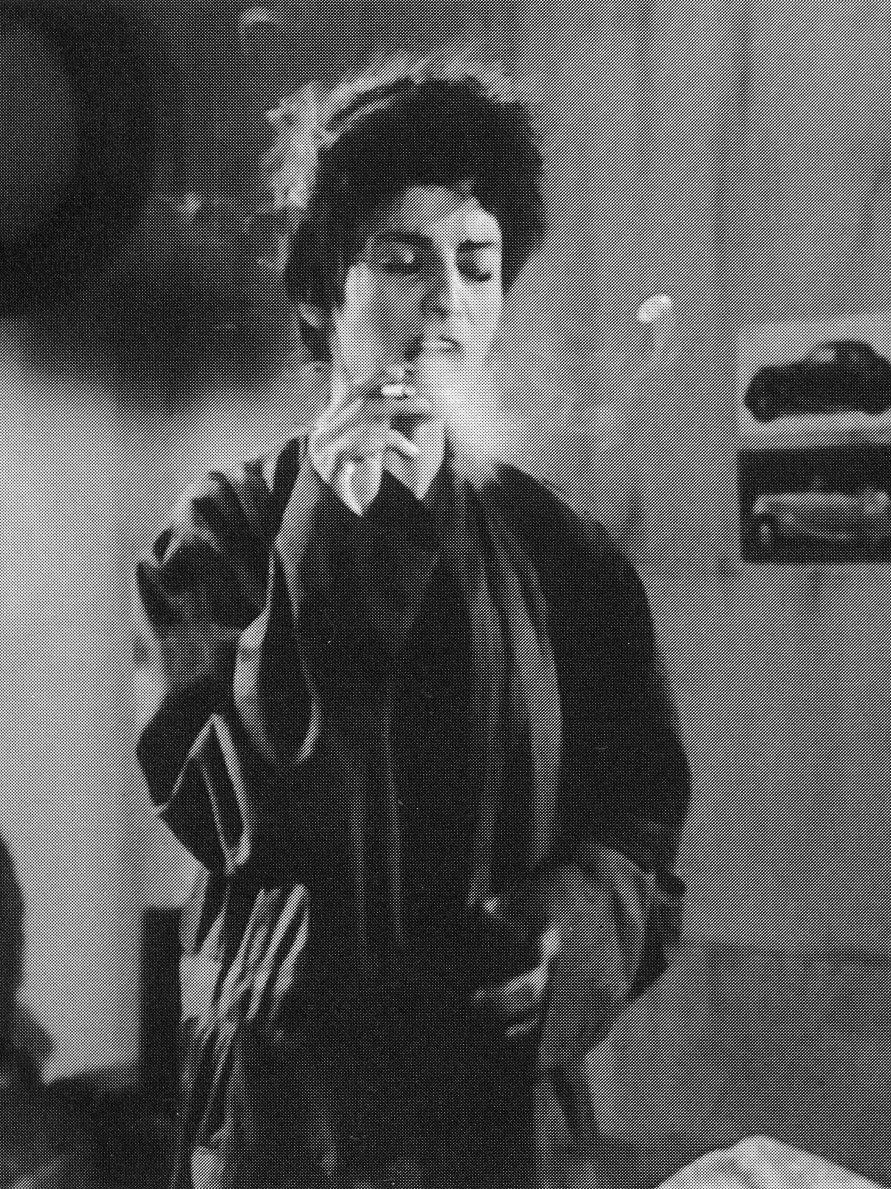
In another narrative moment, Kartik is forced to cut her hair and dress in oversized men’s clothes to masquerade as a man so that Dev Anand’s sister-in-law who is visiting him, does not get scandalized that a woman lives in her brother-in-law’s house. The Encyclopedia of Indian Cinema refers to this moment in the film as the ‘most dramatic’ presumably because of the cross-dressing.
16 Dev Anand tells Kartik how to be a man, which she plays with great aplomb performing the gestural world of men. Kartik swaggers, holds a cigarette in style, and speaks the language of the street as she moves with the taxi drivers in a gang, play-acting her manliness.|
|
|
A cross-dressed Kartik in Taxi Driver. |
I
n a sudden narrative turn Kartik runs away from home due to a misunderstanding and Dev Anand sets out at night to search for her. The city of the night unfolds for the spectator even as we see a strained Anand who is unable to find Kartik. Next Kartik is seen at a large taxi stand cleaning cars where she gets into a fight with some boys and runs out of the parking area. She subsequently collides into Anand’s friend Johny Walker who, now convinced that she is a woman, follows her and brings her back to his friend. This chase is vividly crafted as we move through the gothic architectural landscape of Bombay, its bridge walks, sidewalks and alleys.17Sheila Ramani as Sylvie the club dancer offers a different kind of spatial dynamic. She moves around in the city’s cafés, seductively flirts with Dev Anand on the street and dances for the men at the nightclub. Her costumes are western and often outlandish. Sylvie’s central role in the film clearly caused some anxiety – filmindia refers to her as an ‘Anglo Indian cabaret girl’ who ‘wears T-shirts or transparent clothes and entertains with songs and dances to a clientele exclusively composed of taxi drivers, ill clad and unshaven gamblers and riff-raffs. It is discovered that she is an over sexed woman who pines for satisfaction from the handsome Mangloo.’
18
T
he nightclub is the site where some of the important action sequences unfold and Sylvie is quite central to these sequences. Filmindia’s anxiety about the presence of an underclass in a nightclub seeps through the writing and Chetan Anand is criticized for creating an unreal space.‘If there is one restaurant like that in the whole of India, we would like Chetan Anand to give us its address as we need the relaxation more than the taxi drivers of our city.’19The censors are criticized for not preventing the release of a film that is ‘nothing but a clumsy container of some violent crimes, sexy dances, physical fights, gambling orgies and some cheap thrills.’
20 In contrast, Uma Anand and Ketan Anand offer a uniquely Navketan interpretation of the vamp in the studio’s films.‘The vamp conjured up a vision of a short skirted, cigarette smoking bob-haired heavily made up young woman named Molly or Maria who had a one track mind: how to win by hook, but mainly by crook, the susceptible noble minded hero. Not so with the Anand brothers. In Baazi with Geeta Bali, an actress of vital energy and flair, in Sheila Ramani in Taxi Driver and much later with Waheeda Rehman in Guide, Navketan set the style of the talented young woman of independent spirit, but more specifically of generosity of heart… They set the standard towards a sophisticated assessment of women on the left bank of society, the bohemian or dropout who gave herself the right to command the respect, if not to win the heart of the hero.’
21
T
he urban cartography of Taxi Driver allowed the characters and narrative events the chance to inhabit space inventively. The freedom to move, to travel, to access the city and its myriad little stories provided a cosmopolitan vision to the film because it empowered the city’s underclass with the right to occupy a plurality of spaces. The nightclub is not an inaccessible space for the underclass in Taxi Driver but a place that they negotiate on a daily basis. The nightclub attracts all kinds of people who peddle their crimes, dreams and weaknesses. What makes Taxi Driver interesting is that specific devices are used to adventurously gaze at the city. This gaze is kinetic and pedestrian, a combination that richly brings out the landscape of Bombay. The lives of street characters, migrants, crooks and dancers are placed within this mise en scene as ordinary worlds, a fluid female subjectivity and desire are allowed to float.The women in the film are adventurous and their mobility marks them as different. The absence of familial space is remarkable. While Awara and Sri 420 are both films with working women – in the former she is in a powerful position due to lineage; in Sri 420, she is the voice of redemption, in a morally superior role as a school teacher. Taxi Driver’s desire to keep out all notions of tradition and Indianness made it significant for its time.
N
au Do Gyarah was Vijay Anand’s directorial debut. At the time of its release in Bombay in 1957, other popular films running in theatres included Mehboob’s Mother India, M.V. Raman’s Asha, Raman Desai’s Naag Mani, Shantaram’s Do Ankhen, and B.R. Chopra’s Naya Daur. Nau Do Gyarah was very different from all these films.22|
|
|
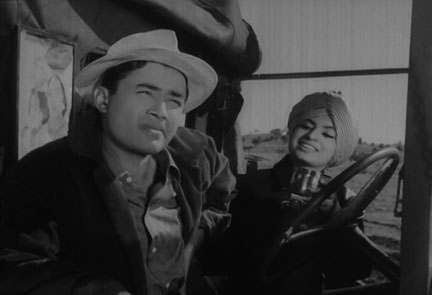
Kalpana Kartik masquerading as a Sikh in 9211. |
23 These lines encapsulate the quintessential Vijay Anand style – an amalgamation of adventure, thrill, mystery and entertainment, a formula he held on to in almost all the films he made. What the review misses is the director’s unique approach to cinematic travel.The pre-release line in Bombay Chronicle said, ‘Dev Anand plays a dashing young man on his way to inherit his uncle’s fortune, and Kalpana Kartik is a sprightly girl who has run away from home… Filled with mirth, mystery and music the picture has an excellent supporting cast led by Shashikala, Jeevan, Lalita Pawar, and Helen. Dances composed by Zohra Sehgal and Surya Kumar are among the main attractions of the film, which is due to arrive in town towards the middle of next month.’
A
straightforward thriller, Nau Do Gyarah unabashedly borrowed its style from Hollywood. Inspired by Frank Capra’s film It Happened One Night, Anand’s film starts as a road movie and then locates itself in the picturesque location of Mahabaleshwaram. The film is woven around the protagonist Madan (played by Dev Anand) and his search for a missing will. The search takes Madan to Mahabaleshwaram where the film’s climax takes place. In the course of the journey to Mahabaleshwaram, Madan meets up with Kalpana Kartik who has run away from home trying to escape an arranged marriage.Structured like a travel film without the rubric of instruction, but as experiential and performative, Nau Do Gyarah combines descriptive passages with the visceral experience of cinematic turbulence. Jeffrey Ruoff notes that ‘cinema may not be "objectivity in time" … but it is a medium of space in time; travel has been the way filmmakers have explored this nexus’ since ‘cinema is the art of travel.’
24 Vijay Anand plays out this creative dynamic vividly in the film to offer another kind of cosmopolitan logic.The story begins in Delhi. An unemployed and penniless youth, Madan suddenly receives a letter from his uncle about his inheritance. Overnight, Madan changes his clothes, dressed now as a debonair and stylish gentleman. Borrowing money from others he leaves in a truck for Bombay. En route he discovers Kalpana Kartik who has run away from home to avoid an arranged marriage, sitting in the back dressed like a young Sikh man. Like Taxi Driver, the cross-dressed Kartik plays this role admirably. Madan only discovers later that the boy is a woman and subsequently falls in love. Kartik is impish, feisty, assertive and sharp.
T
he road journey displays the director’s desire to use songs, locations and geographic scale to describe the developing romance. The entry into Bombay is presented as a montage of traffic, skyline architecture and people. From here the narrative shifts to Mahabaleshwaram where the two meet with all the crooks who are trying to steal the inheritance. Kartik and Madan pretend to be husband and wife for the owners who have hired Anand as a manager of the estate. The flirtatious relationship between the two is one of the highlights of the comic track which unfolds within a narrative of intrigue and double-crossing.Like Taxi Driver, the film boasts of a wanderlust aesthetic as it opens with vivid images of Delhi, celebrating its monuments, its modern architecture and wide roads. The city unfolds as a film within the film with the credits placed over the projected image. Travel, curiosity and discovery are central to its style. The mode of travel shifts from walking to road transportation and deploys the cinematic eye to generate a desire to see through movement. Roads, people, petrol pumps, mountains, valleys, forests and architectural density are vividly structured in this travel narrative.
Ruoff notes how ‘automobiles freed travellers from the standardization of railroad timetables and established routes, breaking the railways monopoly on cross-country tourism.
’25 The automobiles, episodic travelogue style with detours, chance encounters and adventure, created a different kind of imagination, deployed creatively in films. While the modern road movie genre addresses this squarely, Nau Do Gyarah (often referred to as a road movie) creates connectivity between three sites – Delhi, Bombay and Mahabaleshwaram. The road movie’s generic play with film as travel, film as freedom from the constraints of time and space is established consciously by Vijay Anand at the outset and transportation provides a mode of viewing that continues even in the interior spaces of the palatial home in Mahabaleshwaram.
M
adan literally gives the spectators a tour of Delhi before he makes his exit on to the road – a metal bridge, the Parliament House, India Gate, the Red Fort, Connaught Place – everything is mobilized as an image through his moving truck. Once he leaves Delhi, the landscape changes. The journey is structured around several little events and an accident. The journey is a romantic one with songs, flirtation and comic acts played out between Kartik and Madan.The entry into Bombay is presented as a montage that begins with the train and transitions on to city images with traffic, apartment blocks and people. This montage is superimposed onto the wondrous expression on Madan and Kartik’s faces. This is the city of spectacle, adventure, excitement and thrill. The film then briefly enters Madan’s friend’s apartment and subsequently takes us to a nightclub, a dance by Helen, and a robbery scene. The city of crime is established and our two protagonists then move towards Mahabaleshwaram. On the way, we see Madan curve up a steep mountain, the camera providing the viewer with imagery that plays out the excitement of being close to death. The thrill of the voyage derives part of its pleasure from the use of such sensational travel imagery. The experience of danger is offered as pleasurable entertainment because it is illusory. The spectator enjoys the experience from the comfort of the theatre.
26
L
ike Taxi Driver, but in a somewhat different mode, the travel in Nau Do Gyarah not only establishes a network but allows us to see both departure and arrival in city spaces. It is the journey that structures the narrative which makes way for interesting song picturizations, romantic travel and little events. The travel narrative overwhelms the story, bypassing the focus on familial space, questions of tradition, social and sexual morality.The film is light and breezy. The only family that exists is the strange and dysfunctional one in the palatial Mahabaleshwaram home. The layout of the home is, however, explored vividly as Vijay Anand turns the walls, railings, nooks and crannies of the home into a web of mystery, psychological intrigue and sensations. The camera is restless. Anand generates movement within the static space of the home to navigate its mysterious psychic world. The dynamic use of the camera, foregrounding techniques, careful editing and music turns this space and its location into a dense maze of chimneys, corridors, the staircase, a hidden secret room, open mountain space, and a dense forest. The restlessness of the camera highlights the travel and discovery form which moves from outdoor to indoor space.
I
f Taxi Driver locates its narrative in Bombay, Nau Do Gyarah moves from Delhi to Bombay to Mahabaleshwaram establishing a geographical network using the travel form. Like Taxi Driver, travel generates an adventurous curiosity, fulfilling a desire to wander through space. The search for the missing will is the plotline that is placed within a spectacular photography of space. The film’s tension filled action climax ends with the couple back in the truck with the two children from the home, now orphaned, sitting at the back. We don’t know where they are headed but they are again on the move. Dev Anand’s account of the shooting of Nau Do Gyarah substantiates the desire to foreground travel over plot and story.‘The film began with me at the wheel of a truck going from Delhi to Bombay, the camera sometimes following me, sometimes running ahead of me and making a photographic survey of the countryside, from state to state, as we travelled along… We went over the highways and through tunnels, through forests of eye-pleasing Gulmohar trees and dangerous looking dacoit infested ravines, through sunshine – with the burning heat of June scorching us… It all made for a great road show of mirth, gaiety and revelry, as we kept on canning footage for the movie. It was a long drawn out picnic of great joy and creative satisfaction – a three week long adventure.’
27The exploratory narrative remains the prime signature in both Taxi Driver and Nau Do Gyarah as events become secondary to this primary desire for cosmopolitan travel, visual cartography and the desire to generate urban vignettes. The family and its iconography have to concede to the pleasures of adventure and tourism. Familial morality and the epic conflicts of the new nation are conspicuously marginal. The nation itself is absent in both films and there is remarkably no discussion of ‘tradition’ or ‘Indianness’. What we see instead is a parade of urban types, a navigation of locations and a quintessential modern sensibility.
Created at the intersection of new technology, a fascination for city spaces, Hollywood crime films, geographic travel and urban types, both Nau Do Gyarah and Taxi Driver escape the discourse of nationhood to evoke a different sensibility. It is the fluid mobility in the films, their wanderlust aesthetic and their desire to get consumed by a travel narrative that allowed the films to articulate a cosmopolitan imagination with the wayward women placed at the centre. Small wonder that these memorable films of the 1950s have been marginalized by the cacophony of the pantheon that identifies the decade of their production as the ‘Golden Fifties’.
Footnotes:
1. In December of 2007 I met Dev Anand and his son Suneil Anand in their office at Pali Hill. Dev Anand felt that despite Navketan’s successful track record, the studio had been neglected in historical accounts of the 1950s. Suneil Anand attributed this to their ‘westernized’ themes and felt the films were ahead of their time. Dev Anand disagreed and insisted that the films were not ‘western’ but ‘modern’. I found this discussion illuminating.
2. The Times of India, 21 February 1954, Sunday, p. 3.
3. Bombay Chronicle, 10 November 1957, Saturday, p. 10.
4. Bombay Chronicle, 21 September 1957, Saturday, p. 8.
5. Ibid.
6. Dev Anand, Romancing with Life: An Autobiography, Penguin, Viking, 2007, p. 137.
7. Ibid.
8. The French New Wave (or Le Nouvelle Vague) was a film movement in France that dealt with urban life, youthful exuberance and angst and the transformation of the filmmaking process itself. The movement originated in 1958 and continued till the mid-sixties. Shooting on location, long takes, direct sound and natural lighting were some of the characteristic features of the movement.
9. Dev Anand, Romancing with Life: An Autobiography, op cit., p. 137.
10. The Times of India, 21 February 1954, Sunday, p. 3.
11. Bombay Chronicle, 20 February 1954, Saturday, p. 3.
12. Jeffrey Ruoff (ed.), Virtual Voyages: Cinema and Travel, Duke University Press, Durham and London, 2006, p. 8.
13, Bombay Chronicle, 27 February 1954, Saturday, p. 3.
14. Uma Anand and Ketan Anand, Chetan Anand: The Poetics of Film, Himalaya Films Media Entertainment, 2007, p. 57.
15. For Madhava Prasad films that lay out the city like a series of snapshots invoke the experience of ‘arriving in Bombay’. See his ‘Realism and Fantasy in Representations of the Metropolitan Life in Indian Cinema’, in Preben Karsholm (ed.), City Flicks: Indian Cinema and the Urban Experience, Seagull Books, 2004, p. 86.
16. Ashish Rajadhyaksha and Paul Willeman, Encyclopedia of Indian Cinema, BFI/Oxford University Press, revised edition, 1999, p. 339.
17. The sequence has an uncanny resemblance to the well-known chase sequence in Ramgopal Varma’s Satya that climaxes with Guru Narain’s murder on a bridge. For an account of the chase in Satya, see chapter IV of my book, Bombay Cinema: An Archive of the City, Permanent Black, New Delhi, 2007.
18. filmindia, May 1954, p. 82.
19. Ibid., p. 81.
20. Ibid., p. 82.
21. Uma Anand and Ketan Anand, Chetan Anand: The Poetics of Film, op cit., p. 59.
22. Bombay Chronicle, 10 November 1957, Saturday, p. 10.
23. Bombay Chronicle, 21 September 1957, Saturday, p. 8.
24. Jeffrey Ruoff (ed.), Virtual Voyages: Cinema and Travel, Duke University Press, Durham and London, 2006, p. 18.
25. Ibid.
26. Tom Gunning, ‘The Whole World Within Reach: Travel Images Without Borders’ in Jeffrey Ruoff (ed.), Virtual Voyages: Cinema and Travel, op cit., p. 38.
27. Dev Anand, Romancing with Life: An Autobiography, op cit., pp. 156-157.