Sensible economics, sensible politics
N.K. SINGH
IT is well-known that Bihar had achieved great heights of civilization, culture and development in an earlier period of history. As the seat of the Gupta and Mauryan empires, the prosperity, knowledge and territorial sweep of Bihar occupies a glorious chapter in Indian history. It housed the oldest university in the world, Nalanda, and other seats of learning such as Vikramshila flourished between the fifth and twelfth centuries.
Unfortunately, during the colonial period, the development of Bihar was neglected and suffered on two accounts. First, the permanent settlement system, popularly known as the zamindari system, meant that the zamindars were given the right to collect rent, leading to exorbitant rent extraction by subordinate agents. This was a sharp contrast to the ryotwari system which was practiced in other states creating incentives for farmers to improve productivity. Second, the lower provincial expenditure per capita on basic services like health and education under the colonial administration led to a sharp deterioration in the social development indicators of Bihar.
Even in post-independent India the policy of freight equalization which commenced in 1952 was operative till 1993. This destroyed the comparative factor advantage of the then undivided Bihar. Its rich mineral and other mining resources did not incentivize creation of manufacturing activities, since these raw materials were available at the same cost in all other parts of India. Nonetheless, between 1950-80, the average growth in Bihar stood at 3% compared to 3.6% for India. Bihar lagged behind, but not significantly.
The real sharp difference in growth trends became evident after 1991 with the commencement of the policy of economic liberalization. India experienced rapid growth of GDP in the post-1991 period along with strengthening of infrastructure and improved competitiveness of the private sector enhancing productivity. No doubt this story has been somewhat muted over the last few years given creeping macro-economic weaknesses and policies which have dented the insatiable global investor appetite to harness the India opportunity. Analysts believe that this could be transient.
Within this overall framework some federal states have marched ahead. The spectacular success of Bihar over the last seven years in achieving high rates of economic growth, restoring the rule of law, effecting far reaching changes in the quality of governance, administrative and financial reforms, strengthening both social and physical infrastructure is universally regarded as an impressive success story.
H
ow did Bihar achieve such a turn-around? How did a basket case become an example worthy of emulation? Isn’t seven years too short a time to make such a reversal possible in making a deep dent on poverty, reversing endemic economic backwardness and bringing more equitable inclusive change? What were the factors behind the ‘peace dividend’ – the undefined relationship between improved security environment and unleashing the micro-entrepreneurial spirits of an average person? What were the ‘out of the box’ policy approaches in social engineering, improving access in schools, teacher training, monitoring primary hospitals and improving vocational skills? What made the growth process more inclusive, like gender reservation for panchayat institutions, in appointment of primary school teachers, local bodies and recently in the police constabulary? An answer to these questions is what constitutes the development narrative of Bihar. More importantly, the Bihar story has barely begun to unfold. However, the ‘Bihar model’, which seeks high but inclusive growth, is in place and worthy of emulation elsewhere.
B
ihar has emerged as the best performing state in the country in terms of compound annual growth rate (CAGR) of gross state domestic product (GSDP) during the 11th plan period (2007-08 to 2011-12). Bihar’s GSDP has recorded an average annual growth rate of 11.95% during the 11th plan period, the highest among all Indian states. Consistent with the dramatic increase in growth rates, poverty levels have also declined, with the percentage of people living below the poverty line declining from 61% in 1993/94 to 54% in 2009/10.However, the pace of poverty decline has not matched the growth in state GDP because a significant part of the growth has come from sectors like construction, communication and financial services with little or no contribution from the manufacturing sector. Other than achieving high economic growth, there has also been a massive effort to strengthen the social sectors, especially health and education. Improvements in some key infrastructure sectors such as roads, bridges and telecom have been significant. Considerable success has also been achieved in streamlining the state finances.
I
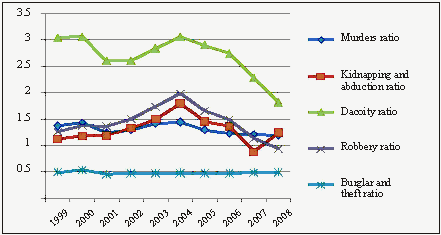
n a nutshell, the Bihar turnaround story can be attributed to the following key variables:Improved governance: There has been a dramatic improvement in the quality of governance. This is discernible from the improved law and order situation in the state. The steep reduction in crime rates relative to all-India levels for many crime categories and the absence of any major communal and caste strife in the last seven years have been a major success in Bihar’s recent development journey. The steep reduction in crime rates, which is supported by data from the National Crime Records Bureau, relative to all-India levels for many crime categories, can be observed from the accompanying figure.
|
|
|
Source : Mukherjee and Mukherjee (2012). |
Macro management: The gradual financial turnaround of Bihar has also been significant. Till 2003-04, the state government had a deficit in its revenue account, but in 2005-06, for the first time, there was a revenue surplus. Over the years, this surplus has been increasing continuously. This has been made possible not by squeezing the expenditure necessary for maintaining the pace of development, but by increasing the revenue, efficient debt management and containing the interest payments. The quality of expenditure in Bihar has also undergone significant improvement. For example, capital outlay has increased from a meagre 7% to nearly 25% of total expenditure. Similarly, plan outlay has leapfrogged from Rs 5,000 crore in 2005-06 to Rs 34,000 crore in 2013-14. In certain areas there have been large investments, particularly in construction and road connectivity.
H
uman resource development: There has been a massive effort to regenerate the social sectors, especially health and education. In the education sector, Bihar has made notable progress. The government has taken various proactive measures to strengthen the primary education infrastructure. Over 3,00,000 primary teachers have been appointed of which 50% are women. Due to improvement in infrastructure facilities, the teacher-pupil ratio has drastically improved. The percentage of students who are not attending school has also dropped from 12% to 3% during the last seven years. Bihar saw the largest increase in literacy rate across India in the last decade. The literacy rate in general increased by 16.82% whereas the female literacy rate increased by 20.21%.There has been visible improvement in the health sector scenario of Bihar with growing public-private participation. There is evidence of poor people coming to government facilities in much larger numbers than before. Shortages in human resources, physical infrastructure and equipment are being addressed under various state sponsored schemes. The average number of patients visiting government hospitals per month has increased from 3077 in 2006-07 to 9317 in 2010-11. The bed occupancy rates have also increased, from 22.6% to 77.1% during this period. The infant mortality rates have also dropped substantially from 56 to 48. In 2006 Bihar was vaccinating about 30% of its children which has gone up to 60% in 2011.
I
mproved climate for private investment through enactment of key legislations: To improve the climate for private investment various legislations and policy measures have been initiated. The Bihar Single Window Clearance Act, Bihar Infrastructure Development Enabling Act, new industrial policy, price preference policy, new policy initiatives for entertainment, tea processing and sugar sectors, simplification of VAT regime and creation of corpus fund for sick and closed units have considerably improved the climate for private investment in the state. Upto September 2012, the State Investment Promotion Board (SIPB) has approved a total of 939 project proposals for establishment of industrial units in the state, involving an investment of Rs 3.19 lakh crore, with employment potential of 2.27 lakh persons. Around 53% of the proposals approved are for food processing; power plants which are an important sector, constituting around 10% of the total investments.Improved infrastructure: Investment in roads and rural roads in particular, bridges, power generation and urban infrastructure has gone up substantially in recent years. New roads and bridges were constructed under various schemes such as the Mukhya Mantri Gram Sadak Yojana (Chief Minister’s Rural Roads Programme), and the Bihar Rajya Pul Nirman Nigam (Bihar State Bridge Construction Corporation Limited). In the area of road construction, although the central government had a scheme in 2000 to connect rural areas with cities, the implementation of the scheme proceeded very slowly which led to a reduction in allocation of funds to Bihar by the central government. Starting 2005, the new state government brought road construction under its jurisdiction, made it a high priority and showed remarkable success during the first term itself.
B
ihar is one of the top performers among Indian states in terms of changes in various development indicators over half a decade. However, it cannot afford to be complacent as most indicators on human development continue to be abysmal. Its real per capita income is the lowest among all states, and well below the national average. Not surprisingly, the incidence of poverty is also the highest in the state. Bihar is ranked 20th among 28 listed states in terms of infant mortality, and literacy is the lowest among all states at less than 64%. As far as physical infrastructure is concerned, for variables such as electricity consumption per capita, density of roads and railway and tele-density, Bihar is well below the national average.Similarly, the credit-deposit ratio of Bihar is abysmally low which impedes capital formation. Most shocking among the economic indicators is the poor industrial base of the state which is evident in its meagre contribution to national manufacturing output. The present economic turnaround notwithstanding, empirical studies suggest that it will take decades for Bihar to overcome its huge development backlog. According to an NIPFP estimate, ‘At the present pace of high growth it will take Bihar around thirty years to catch up with the average standard of living in the country.’
The political subtext implicit in the Bihar story is one of inclusive governance. It is difficult to define governance or identify an improvement with any precision, but easier to describe it when one sees it in action. It is more often than not a product of both institutions and leaderships. Autocratic leadership can secure short-term results but outcomes fade away if institutions do not outlast the leader. On the other hand, credible institutions need to be blended with enlightened leadership to generate strong and positive outcomes. Bihar in the past seven years has changed the development discourse in multiple ways. However, its future would continue to depend on the following key variables which have larger political connotations.
F
irst and foremost, the traditional arithmetic of caste coalitions suggestive of stratified social order has been somewhat dented in Bihar. Improved education and health prospects of its young demography, which have just begun to taste the fruits of development, will create enough pressures to keep improving and make electoral outcomes increasingly dependent on development outcomes. The second term of the present government is recognized to be a mandate not for change but repayment for improved governance and development. The synergy between electoral outcomes and better governance will continue to create a virtuous cycle in the foreseeable future. It would be impossible to reverse the hands of the clock.Second, the concerted effort of the ruling political class in Bihar to secure what is called a ‘special category status’ has several implications. These go beyond political rhetoric. The rationale of the demand is embedded in the recognition that in a fiscal polity like ours, all federal states must have a Right to Development. The principle that equal levels of taxation should give equal access to merit goods is well accepted. Unfortunately, this principle has eluded Bihar. It suffers a huge deficit in its development spending on social and economic services, which is only about half the average for all states in the country. This shortfall is mainly attributable to a massive deficit in central transfers compared to the scale of transfers required for fiscal equalization. There is, therefore, a strong case for continued development assistance and award of special category state status to compensate Bihar for the large shortfall in central transfers. The compensatory additional central investment would be crucial for the state considering that in the near future private investment will remain shy. A degree of fairness in access to raw material inputs like coal for new power generating companies is also necessary to meet the energy deficiency in the state.
T
hird, the success that the state achieves in harnessing its comparative factor advantage in agriculture through a rainbow revolution. It implies, notwithstanding fragmentation of land holdings, that farm incomes can be boosted by allied activities like animal husbandry, fisheries and horticulture. Optimum utilization of its rich water potential and adoption of new technology would be crucial. The extent to which agricultural productivity can be enhanced by diversified agriculture practices through creating and implementing the enabling policy framework would determine its success.Fourth, to what extent can the demographic differentials, namely, its very young population, be harnessed and vocational skills imparted to create the ‘Missing Middle’. This entails increasing urbanization very significantly through many more satellite towns and ambitious vocational training and skill inculcation programmes which can provide gainful employment activities outside the agriculture sector. Bihar needs to boost manufacturing for sustaining high growth and for creating gainful employment opportunities based on low and medium intensive skills for its vast young population.
F
ifth, the growth rates achieved over the past seven years have been substantially driven by sharp increases in public outlays. Significant private investment is yet to come. Public private partnerships, creating an environment for private flows to supplement public outlays, would be crucial in sustaining these high growth rates over the medium term. Besides the composition of the State Domestic Product remains rather skewed where agriculture constitutes 22%, services 73% and industry 5%.Seeking a more balanced composition of the GDP implies creating manufacturing hubs and employment opportunities outside agriculture. Assured energy availability, supply side elasticity for semi-skilled labours at competitive wage rates and improving the ease of doing business must receive priority attention. Many of these are linked to fostering an orderly urbanization and harnessing the state’s comparative factor advantages. The agro-processing industry has an enormous potential if marketing and rapid transport arrangements can enable high profitability. A reliable transport system which is multi-faceted is crucial in overcoming the handicap of a landlocked state.
Sixth, to what extent can Bihar leverage its political power to create an enabling international framework on sharing our river basins particularly with Nepal for generating irrigation and hydel potential to optimize the resources of this region. It is well known that rivers emanating in Nepal inundate large parts of North Bihar, destroying crops and infrastructure, and cause unmitigated human suffering. For long the need to have an international arrangement with Nepal for dams and a river taming programme has been discussed, but without much success. The fragile relations between India and Nepal have prevented multilateral international institutions like the World Bank or the Asian Development Bank to suggest and arrive at arrangements which would be both ecologically and economically desirable.
Seventh, another important opportunity is the development of what is loosely been described as the Buddhist tourist circuit. The development of Bodh Gaya, Rajgir, Nalanda along with Pavapuri, the holy place of the Jains, and connecting it to Patna city gurudwara can create tourist flows and income which can revolutionize the economy of this part of Bihar. There are no doubt other places of Buddhist interest like Vikramshila and Vaishali which can become part of the same thrust. The multiplier beneficial effects of tourism must receive high priority.
Finally, there is the need for continued good governance. Can Bihar rewrite its history, rediscover its past glory and foster new green shoots of investments, employment and diversification in its activity patterns? All these, of course, require stable policy framework and institutions which can incentivize private investment. Bihar’s robust performance is a relatively recent phenomenon and it will require many more years of strong performance to overcome its poor development legacy.
R
eversing history always takes long. The synergy between sensible economics and sensible politics is never easy to achieve. Nitish Kumar’s rainbow coalition in electoral politics has been socially empowering. The political compact between his traditional vote base with Mahadalits among the Dalits, the extremely backward among Other Backward Classes, minorities, and women has created a new vibrant political compact. Economic policies of the state have resulted in conferring economic benefits and politically empowering them in tangible ways. Illustratively, the new empowerment of women in the political hierarchy, through reservations in panchayats, local bodies and the constabulary has resulted in energizing nearly half the population which has tasted the fruits of development. All this has altered expectations and invested confidence for the future.
I
nvestment decisions are more often than not based on expectations. A more optimistic future unleashes the latent entrepreneurial energy in each one of us. So is the Bihar story or the Bihar model a flash in the pan? Is it a durable change or transient phenomena? The author remains optimistic because identity politics has yielded place to development-centric politics. People have tasted the fruits of development and would be unwilling to go back to the old model which might have resulted in political empowerment of neglected groups, but where development occupied the back seat. The decline of Bihar was its unfortunate outcome. Its transit to new voter expectations would put continuing pressure to meet development expectations.Further, while nothing can be taken for granted in predicting electoral outcomes, the probability of incumbents retaining power based on development record improves prospects of a governance-centric administration to continue in the future.
Bihar has a long way to go to overcome its socio-economic challenges. There are no short cuts. However, Biharis are optimistic that both their pride and their place in history can be restored. Only time will tell if their expectations have been realized.