Social contestation in post-1977 Bihar
CHIRASHREE DAS GUPTA
THIS article attempts to chart the trajectory of social contestation in Bihar in the context of the 2015 elections to the state legislature. This trajectory started with the ‘social justice’ agenda of the 1970s, negotiated the process of economic integration from the early 1990s, the bifurcation of the state in 2000 and culminated in the contestations over ‘developmentalism’ within the neoliberal conceptualization of governance in the last ten years. The political economy dimensions of the emergence of a ‘nouveau elite’ in Bihar and their relationship of both contestation and compromise with the traditional ruling class has been one of the key elements in shaping both continuities and changes in economy, polity and society in terms of patriarchy, caste, class and religion in Bihar. This is the central argument of the article.
Over the years, apart from widening of regional disparity in India, the relative rankings of the different states in terms of their per capita income levels have remained mostly unchanged for the last three decades, barring moderate changes in the ranking of middle or high income states within their respective groups. The regions that were ‘poor’ or ‘rich’ earlier continue to be ‘poor’ or ‘rich’ today. This secular homogeneity among the poorer and richer regions of India signifies a close correlation between the overall national growth strategy both in the pre and post-liberalization period and its regional outcomes. There is a geographical pattern of prosperity which has no association with the natural endowment of the different states.
1The composition of the poor has also been changing. Rural poverty is getting concentrated in agricultural labour and artisan households and urban poverty in casual labour households. In high income states, poverty is being concentrated in agricultural labour households, while in low income states it has extended to other occupational groups.
2 Poverty is also getting concentrated among Dalits and Adivasis. The poor among those classified as Scheduled Castes in rural areas are concentrated in UP, Bihar, and West Bengal (58%) while the poor among Dalits in urban areas are concentrated in MP and UP (41%). Although official poverty is relatively low in Punjab, around 80% of the rural poor in this state are Dalits.3
T
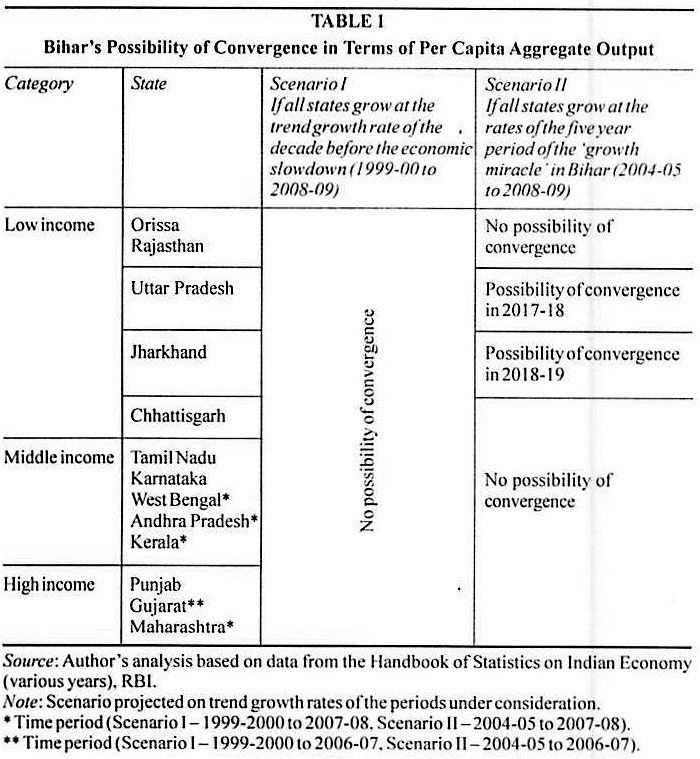
he question remains whether Bihar’s growth acceleration has the potential to break the secular homogeneity of historical patterns of regional disparity through a process of ‘catching up’ and convergence of per capita income with either middle or high income states. Our scenario modelling under ceteris paribus conditions of per capita Net State Domestic Product of various Indian states is summarized in Table 1. We look at two scenarios. First, we examine the possibility of Bihar’s catch-up if all states grow at the trend rate of the last decade till 2008-09 before the setting in of the economic slowdown. The second scenario assumes the sustenance of the trend growth rates of the five year period of the so-called growth miracle in Bihar up to 2008-09. Table 1 shows that there is no possibility of convergence of Bihar’s per capita NSDP despite the so-called economic miracle. Under the most optimistic assumption that the growth momentum reflected in the CSO numbers will be sustained over a period of ten years, Bihar would at best overtake its immediate low income neighbours – Uttar Pradesh in 2017-18 and Jharkhand in 2018-19. For all plausible and implausible scenarios and assumptions of sustained growth momentum, Bihar will remain among the bottom three in the league table of states in terms of per capita income.|
|
I
n the backdrop of Bihar’s post-independence continuation of divergence from the middle and high income states in terms of economic expansion, 1977 marked the electoral resolution of a decade of social upheaval in Bihar with a distinct mandate for a shift away from the Congress. Bihar played an important role in the formation of the two landmark non-Congress governments at the Centre in 1977 and in 1989. Each of these formations marked a culmination of social churning, one traced to the longer political history of land struggles in Bihar and the other to the aspirations for social justice that emerged out of caste oppression. The two were intertwined, but the socialists moved towards caste based identity politics abandoning the question of property rights structures and social relations while the CPI remained mired in a mechanical economistic understanding of class at the cost of the ‘social’. The question of patriarchy in relation to caste and class was hardly on the agenda of social transformation except for a peripheral role.The JP movement with its call for the ‘end of ideology’ and the popular reaction to the repression of the Emergency years sounded the death-knell of Congress monopoly that had faced many challenges from the late 1960s. There was an ideological branching out of the petty bourgeois urban/peri-urban base of the JP movement which constituted the core of the politics of social justice encapsulated in the rise of the Janata Dal. At the same time, it also added traction to the strength of the Jan Sangh which emerged as the BJP by the early 1980s. It was with the clear demarcation of the anti-reservation movement that signalled the political consolidation of the Sangh Parivar as ‘the favoured representative’ of upper caste, cross class interests. The majority of the ruling landed upper caste combine in Bihar in this period started losing faith in their ‘traditional’ party, the Congress, and moved towards the BJP.
The twin trajectories of land struggles and anti-caste subversive resistance also consolidated in the aftermath of the JP movement and contributed to the expansion of various ML factions through the 1980s. The decline of the CPI was in keeping with the broader national pattern of the party paying the price for its alliance with the Congress between 1971 and 1977. It failed to return a single MP from Bihar in 1977. The rise of the women’s movement in Bihar in this period too was linked to the caste/class struggles.
T
he intensification of caste and class confrontations given the rise of the private senas of upper caste landlords and a gradual democratization, started from the period of implementation of reservations under Karpoori Thakur in Bihar in 1978. This process, which gathered momentum after the implementation of the Mandal Commission recommendations in 1989, resulted in the emergence of a new rank of political leaders in Bihar (whose political training came from the JP movement) drawing upon the assertion of ‘backward castes’ on the plank of social justice. At the same time, the murderous attacks on Sikhs in urban Bihar, especially Patna, in 1984 (a murky history on which the political and academic silence is absolute), led to a coercive takeover of trades from Sikhs by the rising intermediate caste consolidations (author’s case study of Patna). The rise of the private armies and the intensification of the Hindu fascist mobilization around Ayodhya culminated in the rural pogroms in Bhagalpur.4 The various dimensions of this social contestation by the end of the 1980s created antagonisms between the interests of the traditional ruling classes and that of new social groups, who by then were aspirational in terms of becoming the nouveau elite. While dignity and social justice were at the core of the rise of this elite, economic power, still concentrated in the hands of the semi-feudal caste-Hindu landlords, was also challenged as a response to increasing oppression of unreconstructed agrarian exploitation.5
B
ihar represents a textbook example of an enclave economy, illustrative of the contradictions between public and private investment and the prevalence of non-capitalist predatory accumulation. There were centres of heavy industry – steel in Jamshedpur, iron and coal in Dhanbad, cement in Dalmianagar and Dehri-on-Sone, oil in Barauni, to name a few. These were either controlled by a few top Indian family owned business groups or the local mafiosi, as in Dhanbad. Most of the big industry was not just regionally concentrated, it developed few linkages – upstream and downstream – with the local market. The only exception, to a minor extent, was sugar, with nearly 40% of capacity falling in the cooperative sector. In most other cases of heavy industry, from leather to paper, both the ownership and the spillover effects remained narrow. Overall, the industrialization process failed to impact on agrarian misery and exploitation. And, post-bifurcation in 2000, most industry went to Jharkhand,6 leaving Bihar with an industrial output that accounted for less than 4% of gross state domestic product.Given this enclave of a very thin industrial base, India’s integration with the neoliberal global order added a new dimension to the prevailing social contestation in Bihar. The material basis of this contestation lay in the functioning of the land market, further intensifying conflicts over both joru and jameen as property, even as the state experienced a growth take-off from the mid-1990s, buoyed by agriculture and trade.
7
T
he traditional upper caste ruling class switched en masse from Congress to BJP, not only on the anti-reservation plank but also on the question of land. By the early 1990s, the material basis for land struggles had re-emerged in Bihar with a government that was trying to challenge upper caste hegemony but without any visible empowerment of the small and marginal peasants, mostly Dalits and other ‘backwards’. Land struggles led separately by left parties in different parts of Bihar created an uproar in the state legislature when the BJP warned the Janata Dal government, led by Lalu Prasad Yadav, of dire consequences if it failed to check the conflict. The Congress too sided with the BJP.For the first time in several decades the floor was split on class lines. Lalu Yadav gave an assurance that the police would not use bullets against peasants who were involved in the land kabza, but lathi charge and arrests did follow. The struggles subsequently lost momentum following an intense fightback by the state, but there are pockets in North and Central Bihar even today where peasants retain their possession of the acquired land. The contest within these struggles and their subsequent waning lies in the change in regime of accumulation as social access to land to the upwardly mobile sections of the ‘upper backwards’ had to be facilitated. In an overall agrarian impasse, land increasingly became monetized and invisibly changed hands as most land records themselves were largely characterized by benaami.
The rise of the various factions of the nouveau elite emerged as fragments of the Janata parivar, best reflected in the rise of private armies of intermediate caste landowners. The intervention of the first government of the nouveau elite under Lalu Yadav epitomized the attempts to manage this contradiction through twin bureaucratic measures: subjugation of land struggles and upholding of social justice as dignity.
B
eyond electoral equations and the specificities of feudal social conditions in Bihar, the complete and absolute surrender to neoliberalism by successive governments at the Centre continued to create a material basis for discontent at the state level. But as long as the Rashtriya Janata Dal (RJD) of Lalu Yadav was in power, the full thrust of neoliberal policy implementation at the state level had been held at bay. This had partly to do with the RJD’s ‘non-policies’ at the state level which ironically, only led to the perception of its ‘failure to govern’.The fiscal crisis at the state level was a direct outcome of this surrender. The bifurcation, which resulted in Bihar ending up with a disproportionately high level of liabilities while most of the assets went to Jharkhand, ruled out the option of state-led economic expansion. The RJD government at the state level, thus bore the brunt of the fiscal crisis unleashed by central policies of fiscal cuts in the 1990s. While the impact on all state governments had been severe, Bihar’s crisis was aggravated by its historically high fiscal dependence on the Centre and a mismatch between post-bifurcation share of assets and liabilities.
The neoliberal assault on the state’s fisc reinforced the conditions of ‘backwardness’ traceable to the pre- and post-independence history of the state being at the receiving end of policies that deepened regional inequality, central policies before and after liberalization that further undermined state level institutions, and the intensification of regional disparity through sectoral approaches that failed to address the specificities of the social in the regional and the structural features of Bihar’s primarily feudal agrarian society.
8 The RJD government after presiding over the bifurcation of the state in its last tenure, remained trapped in fiscal crisis during a period of overall low economic growth, a situation worsened by the reluctance to authorize any spending in the aftermath of the ‘fodder scam’.
T
he integration into the neoliberal governance agenda (2005-2015) was itself linked to the larger process of India’s integration with the neoliberal world order. The tussle and churning within the ruling class over a period of time reached a semblance of reconciliation between the traditional upper-caste landed ruling class and the emerging sections of the ‘backward’ nouveau elite. Contrary to assertions of community based ‘bottom-up’ empowerment through political alliances, alliance politics in this period reflected attempts to reconcile this conflict and change within the regime of accumulation between the traditional upper caste landed ruling classes and the emerging contending factions of the ‘backward’ upwardly mobile nouveau aspirants.9 This long drawn-out conflict had been contained for a brief period through the power sharing arrangements reached by the Congress and the RJD and LJP in the UPA, and the BJP and the JD(U) in the NDA up to the 2009 general elections.
T
his period was marked by the phasing out and dislocation of occupations (especially those of Dalits and Muslims). These changes in the structure of labour relations reduced the status of Dalits to that of landless agrarian workers alongside the overall expansion of the reserve army of labour. The resultant tension between distributive justice and neoliberal governance was evident in the politics of commissions set up by the first NDA government under Nitish Kumar immediately after coming to power – Amir Dass, common schools, land reforms, farmers’ commission, administrative reforms and Mahadalit commission. These commissions were a way of holding the demand for distributive justice at bay, while the substantive policy orientation now became hinged on facilitating the market for investment through the adoption of the ‘good governance’ agenda.The Land Reforms Commission submitted its report in early 2008 after holding extensive public hearings. However, till date, the government has not implemented the recommendations of this report which, among other issues, delves into the institutional problems related to updating of land records. Under these circumstances, the demands from the early 1990s to allot land to the landless (largely the section of people accorded mahadalit status by the NDA government through a separate commission) and give parchadharis the actual kabza of their lands have been resurrected in a muted form. However, the fear of ‘land reforms’, even to a possible updating of land records, instigated panic among the traditional and the nouveau elite, which came to be seen as the prime cause of the NDA’s defeat in the by-elections in the state in September 2009. Expectedly, the political leadership in government had to publicly assure the landowners that there would be no land reform.
T
here were other indicators of the renewed assertion of the two elites in Bihar. Street humour renamed the claims of sushasan to bhushasan (the rule of the bhumihars). The feeling of safety and security was associated with a decline in the kind of crimes that affect the safety of life, work and business of the dominant propertied social constituencies. But, this growing ‘peace and confidence’ had ominous portents in the increasing threats to life, livelihood and security of the dispossessed. If indeed the ‘swaggering goons’ of the RJD period, who made the propertied and the affluent lose sleep, had been leashed, they now seem to have been replaced by a different set of ‘swaggering goons’ whose targets were the most discriminated, oppressed and exploited. The social patterns of crime were one indicator of the reassertion of the power of Bihar’s traditional upper caste feudal patriarchy through the front door of good governance under the NDA government. The nature of social governance was evident in the changing social nature of crime – with a disproportionate rise in rape and particularly that of Dalit women. Moreover, petty crime gave way to high value crime linked to the accumulation regime based on real estate and finance.10
T
his period of a fragile social contract entailed new patterns of urban and peri-urban mobilization, involving a move from an indifference/oppression regime to a co-option/oppression regime. This was evident in the intensification of activities of caste organizations (samaj);11 mahapanchayat against land reforms; hindutva abhiyaan against so-called ‘Bangladeshi infiltrators’ in areas with a high concentration of Muslim population;12 revival of worship in archeological sites and old abandoned temples using para-statals; appointment of Dalit priests in some of these temples;13 and the introduction of Sati worship (as an invented tradition)14 by the Hindu right with a targeted mobilization of the poor, lower caste women in the heart of Patna.The Directorate of Social Welfare of the Bihar government introduced the Mukhyamantri Kanya Vivah Yojana (Chief Minister’s Programme for Daughters’ Marriage) in 2007-08. The first woman President of India, Pratibha Patil, inaugurated the scheme. The interventions for security and protection of women showed fluctuations in allocation, except for the Kanya Vivah Yojana which saw the maximum takers. In the government’s Gender Budget statement for 2008-09, this scheme accounted for 22.3% of the budget of the Directorate of Social Welfare and constitutes an allocation wherein women are considered to be 100% beneficiaries. The stated aim of the scheme is to assist poor families to cover marriage expenses, encourage marriage registration, give a fillip to education of the girl child and stop child marriage. A cheque or demand draft is issued in the name of the ‘bride’ at the time of marriage only if she is above the legal age for marriage. Contrary to any notion of empowerment or emancipation, a substantive proportion of the gender budget was used for subserving the patriarchal agenda of reinforcement of dowry and thus aggravate discrimination against the girl child.
U
nlike the situation before 2004, the fiscal constraint eased out between 2004-05 and 2008-09 due to the buoyancy of central revenues, allowing the state to increase its share of development expenditure. This conjuncture enabled the construction of a fragile social contract between the traditional and the nouveau elite for state resources as the terrain of primary accumulation.The accumulation regime had become increasingly fractious under ‘good governance’, having to manage contradictions characteristic of economic growth under neoliberalism. The structural vulnerability of Bihar’s economy was evident in the non-translation of high economic growth into an autonomous source of revenue for the state government. The four ‘growth sectors’ that constituted the so-called miracle of the late 2000s were the more ‘integrated’ components of the economy, driven primarily by conditions beyond the remit of the state government. Communication, construction, trade and real estate-led growth leave little room for translation into an increased revenue base and net income for the state coffers. The government had policy tools in its sushasan agenda under the present structure of Centre-state relations to intervene in the specificities of the accumulation process driving this growth. Ironically, this period also saw the state government becoming far more dependent on central devolution of finances than it was in the earlier period.
O
ne of the most visible contradictions is that in the period of the so-called growth miracle in Bihar and the stepping up of development expenditure, the state’s dependence on the Union government for public expenditure almost doubled. From a share of 40% in 2004-05, the proportion of central government devolution to the state government’s total expenditure went upto 72% in 2008-09. While a larger unconditional quantum of financial devolution is indeed necessary, an increasing dependence on the Centre for ‘development expenditure’ also indicates that the movement to the higher growth continuum is having no significant impact on resource mobilization at the state level.The public expenditure policy agenda under sushasan is committed to greater ‘integration’ based primarily on large nodal infrastructure development that facilitates this particular kind of lopsided growth, which further reinforces the dependence on the Union government for resources. This accompanied the conservative fiscal responsibility legislation promulgated at the state level as part of ‘good governance’. Consequently, budgetary expenditure patterns reflected the trade-offs in distributive justice. Expenditure was compressed in the form of cuts in budgets for minorities, while the allocation for SC and ST welfare increased over the first five year period of sushasan. However, by the end of the five year period, the relative share of development expenditure in total state expenditure was down to the same level as the last years of the RJD government.
T
hese constraints led to the dilution of the policy of distributive justice in favour of a neoliberal targeting and eventually formed the material reason of the collapse of the social contract between the contending elites evident in the break-up of the JD(U)-BJP alliance in 2014.The current alliance of the JD(U), RJD and Congress in power can best be seen as a new social contract of the largest factions of the nouveau elite in an attempt to limit the fractiousness of the earlier contract. Even though this coalition is more sustainable socially, the political economy contradictions remain irreconcilable: the incompatibility of distributive justice with neoliberal governance; economic slowdown in the integrated sectors; increased fiscal dependence on the Centre within the current structure of economic growth; and the long-term constraints on the possibility of Bihar’s convergence and ‘catch-up’ in terms of regional, sectoral and social shares of wealth and well-being. Breaking the specificities of bondage in economy, polity and society in the interstices of patriarchy, caste, class and religion in Bihar remains an unfinished task.
Footnotes:
1. P.P. Ghosh and C. Das Gupta, ‘Political Implications of Regional Disparity’, Economic and Political Weekly 44(26-27), 2009, pp. 185-191.
2. For details, see R. Radhakrishna and S. Ray (eds.), Handbook of Poverty in India: Perspectives, Policies, and Programmes. Oxford University Press, New Delhi, 2005.
3. Ibid.
4. See People’s Union for Democratic Rights, 1996 Report, PUDR, 1996.
5. P.H. Prasad, ‘Towards a Theory of Transformation of Semi-Feudal Agriculture’, Economic and Political Weekly 22(31), 1987, pp. 1287-1290.
6. For a detailed account of Bihar’s industrialization woes, see C. Das Gupta, ‘Can Bihar Industrialize?’ Seminar 580, December 2007.
7. See, C. Das Gupta, ‘Unravelling Bihar’s Growth Miracle’, Economic and Political Weekly 45(52), 2010, pp. 50-62.
8. See C.P. Chandrasekhar and J. Ghosh, ‘Fiscal Devolution in the Era of Globalisation’, Macroscan, 2000; A.N. Das, Agrarian Unrest and Socio-Economic Change 1900-1980. Manohar, New Delhi, 1983; P.P. Ghosh, ‘Change From the Middle’, Seminar 580, December 2007, pp. 34-37; S. Gupta, ‘Nine Months of Nitish’, Bihar Times, 2006; Mohan Guruswamy, ‘Centrally Planned Inequality’, Seminar 580, December 2007, pp. 41-44.
9. For a descriptive account of the conflict between the traditional and the nouveau elite which emerged from the political churning of the social justice movement of the 1970s in Bihar, see S. Kumar, ‘New Phase in Backward Caste Politics in Bihar, 1990-2000’ in Ghanshyam Shah (ed.), Caste and Democratic Politics in India. Permanent Black, New Delhi, 2004, pp. 315-55; and C. Das Gupta, ‘The United Left Bloc in Bihar’, Economic and Political Weekly 44(10), 2009, pp. 15-18.
10. For a detailed account, see Das Gupta, 2010, op. cit.
11. Organizations of the kayastha samaj, brahman samaj, and the vaishya samaj had visibly become proactive in the ten years of NDA rule.
12. The sangh parivar made annual neofascist political assertion through the ABVP leading an ‘abhiyan’ against alleged ‘Bangladeshi infiltrators’ in Kishanganj, Bihar’s only Muslim majority district since September 2008.
13. The NDA government had been using a parastatal, Bihar State Religious Trust Board to revive worship in archeological sites and old abandoned temples. In some of these, Dalit priests have been appointed. Dalit women were being mobilized for weekly Sati worship in a new temple in the heart of Patna.
14. Sati worship had not been prevalent in Bihar earlier.