The political campaign
SARTHAK BAGCHI
THE election to the Bihar assembly held in October-November 2015 was without doubt the most widely watched and keenly followed election in India since the 2014 parliamentary election which brought Narendra Modi and the BJP to power. The outcome, however, turned out to be strikingly different from the one in the parliamentary polls. Nitish Kumar, together with his one-time friend turned foe turned friend again, Lalu Prasad Yadav, successfully managed to lead an unlikely coalition – the ‘grand alliance’ or mahagathbandhan – to power, decisively defeating the NDA coalition which comprised of BJP and its allies like Ram Vilas Paswan’s Lok Jan Shakti Party (LJP), Upendra Kushwaha’s Rashtriya Lok Samta Party (RLSP) and Jitan Ram Manjhi’s Hindustan Awam Morcha (HAM).
Much of the post-poll analysis of the Bihar election verdict favoured the methodological foregrounding of caste and communal solidarities on voter’s choices. There are also others who gave greater weightage to the development plank, debating between the merits of the two different types of development models on offer – the BJP’s ‘growth centric development’ versus Nitish Kumar’s ‘inclusive development’. The Bihar assembly election, a keenly contested bipolar contest between these two alliances, indicates the importance of studying campaign strategies. The referendum, as many pointed out in the course of my field interviews, was largely between ‘what Nitish Kumar has already provided’ and ‘what Narendra Modi promised to give’. In such a situation, it becomes vital to understand and analyze the two different campaigns that ran parallel on the ground and their impact on the voters mind.
This article is a comparative study of the campaigns by the BJP-led National Democratic Alliance and the Janata Dal (United) and Rashtriya Janata Dal-led mahagathbandhan in the assembly elections in Bihar. I closely observed the electoral process in Bihar for a few months and catalogued the campaigning, mobilization, persuasion and polling strategies of the various political parties involved in the fray, combining it with interviews of leaders and strategists from both the coalitions.
|
|
|
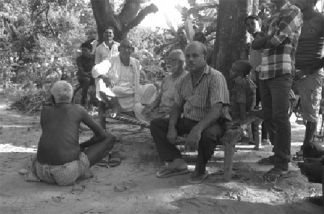
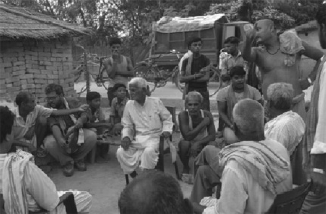
The voters in Bihar are highly politically conscious, partly due to the primacy of public institutions and state resources attached to them in daily life, and partly because of the dynamics of local power which, till a few years back, had effectively prevented people from exercising their franchise. The importance that people attach to their right to vote in particular, and politics in general, can be gauged from the regularity with which people in villages sit together to discuss politics in their daily charcha sessions. Arriving in Bihar a couple of months before polling, I both observed and participated in many of these charchas in the course of my fieldwork in Samastipur district. Social hierarchies and local power dynamics were clearly visible in these gatherings which almost invariably comprised of men. Women, though markedly absent from these discussions, more than compensated by turning out in large numbers at political rallies and election sabhas (meetings). Women are also more committed voters as compared to men, perhaps because of the high levels of out-migration among men in Bihar. Sitting under the shade of the village tree on a cemented platform (made by the gram panchayat), one could easily grasp the social milieu of the public sphere. The men from upper castes like Bhumihars, Rajputs and Brahmins to a large extent still dominate the discourse while the Yadav, Kurmi, Koeri intermediary castes come a close second in terms of asserting their status in the village public sphere.
T
he earlier stranglehold of the upper castes in the local power hierarchy was broken by Lalu Yadav’s ascendance to power with his politics of empowerment. This change was aptly captured in what Shambhu Yadav, a farmer with a meagre landholding, told me in Samastipur: ‘Lalu ji humko awaaz diye, humko babu sahib ke saath baithne ka sahas diye aur aaj hum aapke saamne bhi kursi pe baithe hai unke kaaran’ (Lalu ji, gave us voice and the power to sit at par with the babu sahibs – Rajput caste men. It is because of him that we can sit on a chair in front of you today). A follow up question about whom he considered as his leader yielded an obvious reply – Lalu Yadav.
H
owever, Lalu’s empowerment strategy was more focused on antagonizing the upper castes, in effect benefiting the middle castes instead of empowering the hitherto lowest castes which fall under the Most Backward Castes (MBCs) or Extremely Backward Castes (EBCs), as they are categorized under Nitish Kumar’s regime. In many village charchas, one observed the transformation resulting from the bottom-up incorporation of the mahadalits (22 out of 23 sub-castes which come under Scheduled Caste list in Bihar) and EBCs that has happened under Nitish Kumar’s inclusive governance agenda. With reservations in the panchayats for men and women from the mahadalit and EBC segments, one now hears strong voices from these communities as well, making their presence felt in the public discourse of the village. Given the backing by the state to those now holding offices of local importance like mukhiya (village head) or vikas mitra (development assistant), even upper caste men now take a back seat and let the new entrants bask in their ‘new-found’ power without protest. A little over two decades back, such a scenario would have been unimaginable in rural Bihar.
T
he discourse at these village level charchas, a good barometer to measure the effectiveness of the campaign, often changed with the rising intensity of the contest. Over the course of the campaign and across the five phases of polling, many issues like caste based reservation, beef, Pakistan, black money, communal polarization, different ideas of development, distributive benefits of the state resources, common goods like roads, electricity, law and order and individual gains like payments from some scheme, jobs and so on were discussed. At different stages of the campaign, the emphasis shifted from one issue to another, along with the support of groups who kept rooting for one coalition against the other. A lot has been written about the ‘silent vote’ of the EBC voter who played a pivotal role in the mahagathbandhan victory. During my participation in such charchas, I found the EBC voters to be generally quiet in large gatherings consisting of other social groups but, when in a majority, they often spoke up for their choice of party.
P
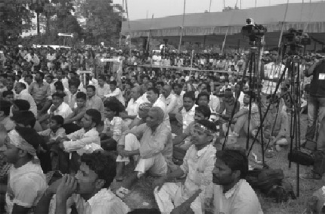
olitical rallies are an important site to observe the point of contact between political leaders and voters. The crowd at NDA rallies was very different from what one saw at the mahagathbandhan rallies. At NDA rallies, chairs were provided for the crowd, mostly occupied by upper caste women and the elderly. The upper castes were the dominant demographic at NDA rallies. Much of the crowd was made up of restive young people who came in hordes to see and hear their favourite Modi.
|
|
|
They often crowded around the area near the jimmy-jib cameras, which along with LCD screens, were a mandatory feature of Modi’s rallies. The master orator, Modi rarely disappointed, firing salvos and one-liners, even if based on unverified ‘facts’. Neeraj Singh, a Bhumihar whom I met in Mokama, told me: ‘I had been in Modi’s rally at Bhagalpur. He landed at Purnea, from where he reached Bhagalpur using three helicopters. Everything was meticulously planned to the last detail. People had been collected from at least two districts apart from Munger and Bhagalpur. Two trains had been specially arranged to ferry in supporters from Jharkhand. It was like a huge festival.’ According to Santosh Singh, a senior journalist with The Indian Express, who had also covered Modi’s rallies across the state, the crowd theory had finally been put to rest. ‘Bhagalpur and Samastipur were two of the largest rallies I have seen in my time covering the Bihar elections. Both were massive gatherings, but the BJP failed to get a single seat in either district. This is a trend for political parties to keep in mind for the future.’
NDA election rallies, as Modi repeated reminded audiences in all his speeches, were not ‘rally but rallaa’. Effectively managed with aplomb and opulence – from the setting of the stage to the seating arrangements – NDA rallies were an example of showmanship in campaign politics. Big Modi rallies in Gaya and Bhagalpur attracted supporters from half a dozen adjacent districts and even the neighbouring state of Jharkhand. Even a small election meeting by Amit Shah for a single candidate in Samastipur had about 5000 people. Large or small, NDA rallies were meticulously organized events. The stage had a distinct décor, and unlike the normal practice of giving an opportunity to local leaders to speak at length, NDA rallies followed a strict timeline with short and sharp speeches. Usually local leaders were made to speak before the arrival of the main speaker or badka neta, who then addressed the gathering and left. Everything was done on time.
H
owever, in a series of review meetings of BJP candidates held in Patna, a critical observation routinely made was that a ‘lot of time and resources (money and manpower) was wasted in organizing big rallies and in crowd management.’ Talking to some drivers outside the BJP headquarters in Patna, while their bosses were busy doing sameeksha (introspection) indoors, it was evident that many were unhappy with this style of event management and scale of campaigning. ‘Pehle hum apne neta ke saath ghar ghar jaate the, logo se judtey the, par ab toh sahaab rally karne mein hi busy ho gaye’ (Earlier we went door to door with our leader and connected with people individually, but they are all now busy arranging and attending rallies), said one driver whose boss had lost from Chapra district. A senior BJP leader closely involved with the campaign organization told me, ‘Bihar has not embraced these big shows and spectacles. The Bihari voter still prefers to talk about his politics sitting at the village square – gaon ke chaupal pe. Too many vehicles, too much show and too much of activity raises suspicion in the minds of voters – ‘negative message jaata hai.’
M
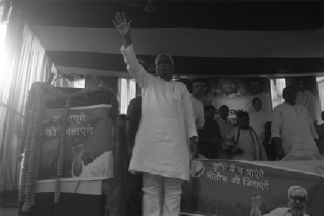
ahagathbandhan rallies, on the other hand, were in sharp contrast to those of their main rival. Starting from the much talked about swabhimaan (self-respect) rally at Patna’s Gandhi Maidan on 30 August, to other small election meetings or sabhas by its leaders, I closely followed the alliance campaign over the entire phase. All NDA rallies, whether those held by BJP or allies like LJP or RLSP, emulated the pattern set by their leader, Narendra Modi. On the other hand, each mahagathbandhan rally was distinct. For instance, a Lalu rally was markedly different from one of Nitish Kumar’s. Nitish Kumar and Lalu Yadav, as Sankarshan Thakur wrote, are like chalk and cheese, very different in their stylistics and ideas of governance, including ways to garner mass support etc. Their coming together may have been more a compromise than a union of compatibility. But a positive to emerge from this marriage, even if forced, was the space both gave to each other in their respective campaigns.
U
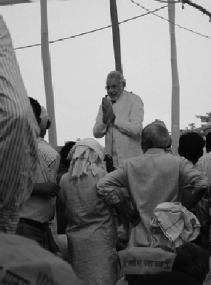
nlike the Modi rallies which centralized all power at one place by combining 6-7 constituencies at one go, much like a war elephant brigade moving with grandeur, Nitish and Lalu never shared the same stage after the initial swabhimaan rally in Patna, preferring to hold single election meetings separately in all the constituencies. They hopped from one constituency to another, covering around 6-7 and sometimes even 8 or 9 constituencies a day. Their hop on, hop off jansabhas were likened to the game of kho-kho (an Indian sport in which a player touches an opponent and runs away) by BJP President Amit Shah, who insisted that BJP would rather play kabbadi (another Indian sport in which players have to grab an opponent and hold on till he runs out of breath). In my opinion, Nitish and Lalu’s swift movements to mobilize voters across the state may be likened to a cavalry unit which approaches the battlefield from the side flanks and wades through the enemy lines at a fast pace, inflicting maximum damage with minimum casualty to itself.
|
|
|
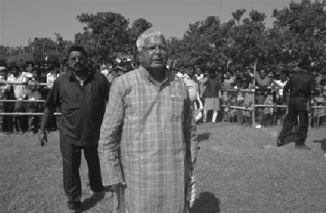
Nitish Kumar preferred to engage audiences with speeches laced with data, talking about his development agenda and not shying away from listing his achievements as one of the best chief ministers Bihar had seen. Lalu Yadav, on the other hand, enthralled audiences in his characteristic humorous style laced with episodic references to hard facts; basically he underlined his position as the biggest caste leader from Bihar. This is not to underplay the symbolic caste politics that Nitish too indulged in or to negate the symbolic development that Lalu had ushered in during his tenure as chief minister. The separation of these two different protagonists and their respective agendas enabled the mahagathbandhan to maintain the necessary distinction between caste (Lalu’s domain) and development (Nitish’s forte), while engaging with both issues, even if at different junctures in the campaign. The problem the NDA created for itself by centralizing the campaign around Modi, was that it burdened the PM with the need to invoke both caste rhetoric and development. Most often it ended with Modi under-performing on both counts.
T
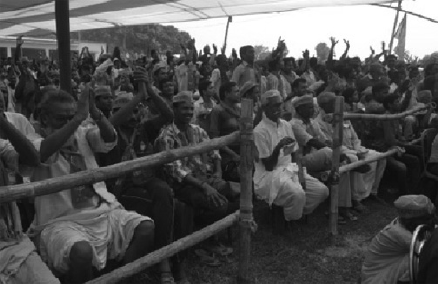
he stage at mahagathbandhan rallies was less exuberant than the ones I had seen in NDA rallies. Barring the swabhimaan rally, none of the other mahagathbandhan rallies made use of jimmy-jib cameras or LCD screens. The venue of these rallies, irrespective of whether they were held in Patna or Samastipur or Wazirganj or any other remote area of the state, was devoid of any chairs – people sat on the ground. Tarpaulin pandals were a common feature in all their rallies. ‘Mahagathbandhan does not hold rallies, they hold sabhas. Sabhas are more organic and involve less of hype. That is the basic difference between the NDA and the mahagathbandhan,’ commented Ghanshyam Thakur, a JD(U) sympathizer from Samastipur.
T
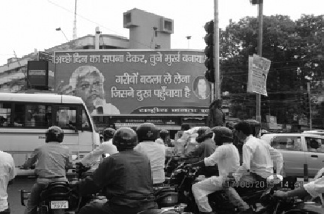
he NDA’s entire campaign centred on the personality of their most popular leader, Narendra Modi though Amit Shah, the BJP president, also commanded substantial space in the NDA propaganda and popular imagination of BJP activists. The hoardings I saw on arriving in Patna towards the end of July were all about Modi. From September onwards, when the elections drew closer, Amit Shah provided company to his state brethren on hoardings across Patna and its surrounding areas. After the first two phases of elections, possibly a corrective to Nitish and Lalu’s insistence on playing the ‘Bihari vs bahari’ card, the NDA hoardings began to portray not only the alliance party leaders like Ram Vilas Paswan, Jitan Ram Manjhi and Upendra Kushwaha, but also state level BJP leaders like Nand Kishore Yadav, Sushil Modi, Ravi Shankar Prasad, Shahnawaz Hussain, among others. Apart from the hoardings, brand Modi dominated the merchandise as well, with NaMo tee shirts, caps, wristbands, badges and water bottles being made available at all rally venues. In Patna, during the much widely celebrated festival of raksha bandhan in August, I found Modi rakhis (wrist ties) in some shops, which sold like hot cakes, according to the shopkeepers.
I
n Patna city though, Nitish and Lalu with their distinct brand of politics and slogans, managed to corner a fair amount of space on hoardings and walls. Huge posters of ‘Phir ek baar, Nitish Kumar’ (once again, Nitish Kumar) in yellow and ‘Jhanse mein na aayenge, Nitish ko jitayenge’ (Will not be fooled and will make Nitish win) in bright red grabbed eyeballs on the streets of Patna and matched Modi’s propaganda, poster by poster. Even Lalu in his posters came across as confident, claiming he had given voice to the poor which was now being termed ‘jungle raj’ while taking jibes at Modi’s promise of ushering in acche din.Leaders from both alliances often campaigned in several constituencies. Even at this level, there was a difference between the way the two alliances – mahagathbandhan and the NDA – conducted their campaigns. While the NDA used parivartan raths (chariots of change) fitted with LCD screens and GPRS monitoring devices to spread their message, the mahagathbandhan made use of both LCD screen fitted vans as well as cycles with placards and hoardings for their campaign. The videos being screened on the parivartan rath that I saw mainly featured Modi with excerpts from his various speeches, more like an instruction module for those who had missed Modi’s earlier speeches. The mahagathbandhan van or swabhimaan rath, however, had a well researched videos showing the internal collusions within the NDA, where BJP leaders were shown badmouthing their current allies, the content drawing on archival video footage. Apart from knowledge and information, this definitely provided some entertainment to the onlookers. I could see the smiles on their faces as we watched the video in a van stationed at a small roadside shop in Samastipur under a balmy evening sky.
T
he cycle pracharaks (instructors) of the mahagathbandhan also worked in an organized and dedicated manner. On my trips across the state, I could spot the beaming yellow cycle chariot. It silently made its way from one panchayat to another, much like the EBC and mahadalit voters of the mahagathbandhan, known to be silent voters, not revealing their choice till the time of polling.
|
|
|
Some of the cycle pracharaks I spoke to described their arduous routine, explaining how they covered 10-12 villages in a single day. ‘It’s a lot of hard work. While we get some money to eat, we do it because we believe in the message we are spreading. I am a Rajput by caste and still I support mahagathbandhan over the BJP, because it has given us safety and development,’ said Aman Kumar Singh, a young pracharak standing next to his yellow cycle, wearing a matching yellow tee shirt. A sense of the deeper commitment of the mahagathbandhan pracharak emanated from a candid admission by a senior BJP leader in Patna who told me, ‘Humara voter sirf humara karyakarta reh gaya, par unka voter bhi unka karyakarta ban gaya’ (Only our workers ended up voting for us, but their voters also became workers and mobilized other voters).
M
uch of the credit for this organized and corporatized campaign of the mahagatbandhan, though with a grounded touch, has been attributed to Prashant Kishore (PK) and his team I-PAC (India-Political Action Committee). PK worked with a core team under a director which designed and managed the campaign. The team was divided into different sections like ghar-ghar dastak, cycle prachaar, swabhimaan rath, to name a few, each under a point person. For smooth implementation, monitoring and coordination of these different aspects of the campaign, Bihar was divided into administrative divisions of nine pre-existing commissionaires. Each commissionary had a person in charge called the PoC (Point of Contact). Reporting directly to the PoC was a district level CRM (Central Responsibility Manager) who was in charge of the campaign activities in his/her district. A chain of command was set up and specific tasks and responsibilities were assigned to different links of this chain.
T
he ‘influence’ of local party JD(U) workers at the block and district levels was sought to be channelized given the lack of an organizational structure and dedicated cadre base. For a regional party like the JD(U), much like other regional political parties like the BJD in Odisha or SAD in Punjab or NCP in Maharashtra, it is important to combine their ideological moorings with an effective face that people can relate to. With Nitish Kumar’s proven record of good governance and ability to redistribute benefits effectively to the lowest groups in society, the JD(U) and even RJD activists found it relatively easy to take their campaign to the last person in the remotest of villages.Nevertheless, given BJP’s vote share across different sections of society like dalits, mahadalits, EBCs and upper castes, it would be incorrect to infer that Modi had lost his appeal. Perhaps Modi’s appeal was not as great as was presumed by the BJP campaign committee. During my field work, I observed that while the initial campaigning relied more on national leaders like Lalu, Nitish and Modi, as polling day approached and campaigning became more micro-level, local social dynamics and power struggles proved more effective in influencing voter choice.
In Samastipur district, the constituency that I was studying, the local BJP candidate depended more on bike rallies, involving 150-200 bikes with mostly enthusiastic young boys riding them. The JD(U) candidate also used bike rallies but was never directly seen in their company, preferring to use them as a supplementary tactic. The young BJP candidate often used it to reach out to his constituents. However, the effect that a motorbike rally of say 150-200 bikes causes in a rural area has its own dynamics, as I learnt in the course of my field work. ‘Yeh sab dhool uda ke gaya abhi, fir aankhon mein dhool jhonk ke jayega!’ (They have left after raising dust here now, then they will throw the dust in our eyes by telling us lies), said Rambilas Rai, a JD(U) supporter in Samastipur immediately after a huge BJP bike rally had passed on that road. Another JD(U) sympathizer told me that when upper caste boys on bikes aggressively move through dalit and backward villages, it sends a negative message, resulting in the consolidation of the dalit and backward voter, effectively changing the positive hawa (air) into a negative one! This may have been the reason behind the NDA’s decision to tone down their grand campaign, shifting its campaigners from the comfort of helicopters to the jerks and bumps of Bihar’s roads.
B
ut even this alteration in an otherwise tailor-made campaign proved to be a non-starter. With a significant number (around 4%) of the voters shifting from the NDA to the mahagathbandhan between the pre and post-poll surveys conducted by Lokniti-CSDS, it became clear that the political spectacle that played out in the course of the campaign had many keen viewers who were visibly influenced by what they saw and felt while making up their minds. The Bihar assembly election 2015 campaign thus needs to be carefully studied in all its dimensions by both political parties and academics, for a better understanding of electoral/political dynamics.
* This paper draws upon fieldwork in the Bihar elections carried out as part of a larger study under Mukulika Banerjee, funded by EECURI-LSE.