The challenge of delivery in extremism affected areas
ABNER E. DANIEL
‘I can fight the Naxals but not Naxalism. That (meaning Naxalism) has to be done through development.’
– Rahul Sharma, SP, Dantewada district, Chhattisgarh as told to Kumkum Dasgupta from ‘Hindustan Times’, December 2008
1‘Strategy and Tactics’ a comprehensive document adopted in 2004 by the Communist Party of India (Maoist) – more popularly known as the ‘Maoists’ or ‘Naxalites’ – mentions ‘A large part of the remote countryside, most advantageous for establishment of Red liberated areas from the geographical and military point of view, is inhabited by the discontented and agitated nationalities and tribes, who are engaged in bitter armed confrontation with the Indian state’.
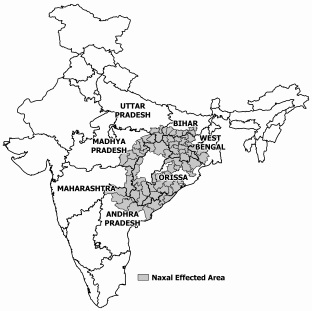
2Thus, it is not surprising that geographic areas affected by left wing extremism (LWE) overlap with the vast tracts of land inhabited predominantly by tribal communities. It is not coincidence that these areas have a rich forest cover and huge minerals deposits. The tribal communities largely depend on these areas for their daily needs.
The Government of India has adopted an integrated approach to address the challenges of Naxalism, which includes the four key elements of security, development, public perception management, and surrender and rehabilitation. In addition, the Union government has suggested that states undertake comprehensive development of affected regions. On more than one occasion,
3 the state response to the challenge of Naxalism has acknowledged the need for a comprehensive plan of action encompassing development activities as well as security measures; this was included in the 14-point policy of the Union government that was released in the Lok Sabha.4 In fact, the CAG report of 2011-12 that reviewed the implementation of the Integrated Action Plan – a decentralized fund for left wing extremist (LWE) affected districts to allow for integrated planning on security measures and development activities for Odisha – revealed that projects were selected in consultation with line departments and local Members of Parliament (MPs) and Members of Legislative Assembly (MLAs) but with no inputs from the Panchayat Raj Institutions.5 Critical gaps were not properly assessed and as a result, a significant number of projects were cancelled as they were finalized without proper examination of their feasibility and ground realities.|
|
D
uring my engagement in the area of child nutrition in various blocks of the Bastar district and the Narayanpur district (carved out from erstwhile Bastar district) of Chhattisgarh, I have closely observed the implementation of various government programmes. Such programmes are typically characterized by poor quality of implementation and varying degrees of coverage. The context of LWE brings forth its own set of problems. Development work related to infrastructure – such as roads, mobile towers, and buildings – is generally opposed by the Naxalites. However, soft programmes related to education, health, nutrition, civil supplies, etc. are not opposed or ‘targeted’. The strategies that need to be applied in tribal areas affected by left extremists are unique and based on informal structures and methods, but remain undocumented in literature.
D
ata segregation for left extremist affected and non-affected areas is difficult. However, one of the out-come measures – underweight status – is available since 2012 on an annual basis through a state specific initiative of ‘wajan tyohaar’ (weighing festival). While underweight status improved from 40.9% in 2012 to 30.5% in 2015 (a 25.4% reduction); when analyzed separately for 14 LWE affected districts and 13 non-LWE affected districts, the status improved from 42.2% to 33.5% (a 20.6% reduction) in LWE affected districts, while the status improved from 40.0% to 28.6% (a 28.5% reduction) in non-LWE affected districts. Thus the reduction in the levels of underweight status among children under-5 was lower in LWE affected districts than non-LWE affected districts to the tune of 7.9% points.UNICEF started implementing the Abujhmarh Health Outreach Project (A-HOPE) in Chhattisgarh with funding from ECHO in 2011 for 209 villages of Orcha block through a local partner, RKMA. Subsequently, the programme was extended with an addition of 99 hard to reach villages of the Narayanpur block in 2012 through partnership with the organization SAATHI, making it a total of 308 villages of Narayanpur and Orcha blocks combined.
B
oth organizations RKMA and SAATHI, through their years in the Bastar district, have reasonable access to remote locations and their ability to negotiate humanitarian space for delivering services for poor communities is proven. Identifying and treating SAM (severe acute malnourished) children, counselling for IYCF (infant and young child feeding), promoting RI (routine immunization) and institutional deliveries are the prime focus areas under the A-HOPE project.A-HOPE initiative aims to strengthen service delivery at local level by addressing some of the bottlenecks, both at the supply and demand side and issues of equity and inclusion for the most vulnerable and marginalized communities. The project has supported five existing Abhujmarh centres which are at inaccessible places to make them functional health outposts in Orcha block which is now equipped and appropriately staffed health referral centres. It is worth mentioning that the ICDS services consisting of 85 AWCs and 185 mini-AWCs were outsourced to RKMA by government. The project utilizes the ICDS platform for service delivery at the grassroots level. The facility based interventions include the establishment of six nutrition rehabilitation centres (at present 3) for SAM children management and out-patient facilities for community members.
D
uring phase III of the project and as part of UNICEF multi-sector convergence approach, the project expanded the scope by targeting beneficiaries through activities on WASH (water, sanitation and hygiene), child protection and education issues that have a direct and indirect bearing on improving the health and nutrition status affecting women and children.Based on my experiences in Chhattisgarh, I present below a systematic approach to undertaking development programmes in LWE affected areas.
1. Existing administrative maps are of little use in these areas. In reality, there are situations where even apparently adjacent villages cannot be approached due to presence of a mountain or creek in between. When the villages are grouped into sectors (under ICDS) or sub-centres (under the health department), these factors are not taken into account. There are few select old-time functionaries in government departments who know the locations of most of the interior villages and could have prepared local maps of the areas. It is thus suggested that while introducing development work in an LWE affected area, it is necessary to map these areas using the experience of local functionaries to determine the best routes to approach villages rather than relying on the artificial administrative boundaries for planning of interventions.
2. It is difficult to determine the extent to which villages are affected by left wing extremism. The degree is across a spectrum and hence functionaries of different departments base the exercise of determining villages as ‘affected’ on subjective assessments. Many villages can be grouped as minimally affected or severely affected; still there are a significant number of villages where the degree cannot be easily defined. This leads to a situation where affected villages are viewed as different for different government departments; they vary in their extent of how affected and are dynamic. It is thus suggested that a tested operational definition of ‘affected’ left wing extremism villages be prepared and consistently used.
3. Frontline functionaries usually describe the situation of villages in the context of LWE as severely affected due to a ‘perceived threat’. This is different from ‘actual threat’ and is influenced by the frontline functionary who presents this as an excuse for not providing regular services or staying at the designated place. It is suggested that ‘perceived threat’ is differentiated from ‘actual threat’ by applying an objective criteria and authenticating responses from multiple sources.
|
|
|
|
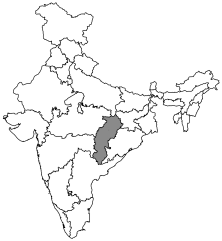
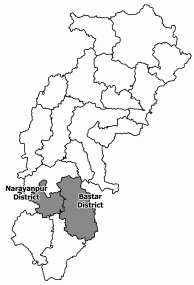
Map of India with Chhattisgarh state highlighted (left); Map of Chhattisgarh with Narayanpur and Bastar districts highlighted (right). |
|
4. Programme implementation needs to be planned in phase wise manner, moving progressively from the accessible villages to the more severely affected ones. This has two advantages. First, the functionaries establish trust with local communities, thereby increasing demand from the affected villages. Second, after observing benefit to communities from nearby ‘lesser affected’ villages, the demand for services from more severely affected villages increases for the required services. Demand by local communities for development programmes leads to formation of pressure groups which are able to negotiate for access to programme interventions. This negotiation is required not just with the Naxalites but also the security forces, as in many instances the detention and questioning of the tribals residing in interior areas leads to lack of movement of tribal adults across the check posts. The only exception to this approach is the most interior villages within the core of the affected regions that serve as headquarter villages for the Naxalites and which are ‘no-go zones’.
5. The tribals residing in LWE affected areas are caught in the crossfire between the Maoists and security forces. The tribals staying in interior areas are questioned by security forces while they are crossing, and also threatened by Naxalites against sharing information with the security forces. As a result, and owing to their inherent nature of being closed, these communities prefer to stay in and around their villages and avoid confrontation with both parties. Communication channels with tribal communities need to be kept open so that lack of trust between the communities and government functionaries can be bridged. This is especially important for ensuring adequate programme communication as well as utilization of services.
6. Interventions need to be designed keeping the culture of tribal communities in mind. If programme interventions are not culture sensitive, they are likely to be rejected by these communities, leading to poor utilization of services.
7. For effective delivery of planned interventions, a credible local agency like a CSO or NGO needs to be engaged for maintaining the necessary checks and balances.
8. The coordinators hired should be from the local areas. This ensures that they are conversant with the local language and are better placed to negotiate with the Naxalites for access to programme interventions by the local communities.
9. It is crucial for local coordinators engaged by these NGOs to stay within the project villages. From my experience I have realized that this provides social fencing for the coordinators, meaning that local communities support the coordinators after trust is established.
10. At certain instances, there is a need to dialogue informally with the Naxalites through indirect channels so that safe spaces can be negotiated to provide life-saving interventions to the communities. These approaches can be further refined with programme experience, and through consensus developed into an operational framework for planning and monitoring development programs in LWE affected areas.
I
believe that the mentioned ‘ten commandments’ for planning and designing development programmes for LWE affected areas can be systematically applied, hopefully leading to improved development outcomes. However, questions remain: Would the political and administrative machinery be committed to apply these approaches to LWE affected areas sincerely? Or will there be continued neglect and only shallow commitment to experiment with strategies that have the potential to alter the development scenario in these challenging areas?
* Views expressed in the article are personal.
Footnotes:
1. Sudeep Chakravarti, Red Sun: Travels in Naxalite Country. Penguin/Viking, Delhi, 2008.
2. P.V. Ramana, Measures to Deal with Left Wing Extremism / Naxalism, IDSA Occasional Paper No. 20; Institute of Defense Studies and Analyses, New Delhi, October 2011.
3. Annual Conference of Chief Ministers on Internal Security in December 2007; Annual Report of Ministry of Home Affairs for 1997-98; 2005-06; 2007-08 and 2010-11.
4. Status Paper on the Naxal Problem, Internal Security Division, Ministry of Home Affairs, New Delhi, 13 March 2006.
5. Audit Report – General and Social Sector Audit, for the year ended March 2012; accessed on 9th August 2015 from http://saiindia.gov.in/english/home/our_products/audit_report/Government_Wise/state_audit/recent_reports/Orissa/2012/Civil/Chap_1.pdf