Addressing water scarcity: the Urmul experience
ARVIND OJHA
ACCESS to safe drinking water and sanitation is not only an important measure of the socio-economic status of the household, but also fundamental to the health of its members. Safe drinking water is essential for child survival. When you talk of a desert, it automatically conjures up the image of scarcity of water, the first parameter to consider for any settlement.
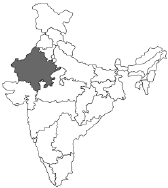
Rajasthan is situated to the northwest of the country, sharing a border with Pakistan and is often referred to as a desert: the Indian desert, the Rajasthan desert or the Thar desert. McGinnies (1979) writes that the whole of the Thar desert (stretching from the Aravalis in India to the Indus in Pakistan) is part of the Afro-Asian desert belt, stretching from the Sahara to the Gobi desert. Almost 58% of western Rajasthan, the Thar, is made up of sand dunes, low infertile hills and land high in mineral content.
The western regions of the state are hot arid zones receiving an erratically distributed annual rainfall of less than 60 centimetres. Temperatures vary between 48-50 degree celsius in summer and fall below the freezing point in winter. These oscillations in the climate averages for this century suggest that the drought cycle has increased from one good year in three to one in six years. This is not to forget that some pockets in the Thar are almost perpetually drought prone. These conditions makes ‘living’ in the desert fraught ‘with hard realities’.
|
|
|
|
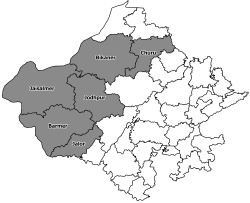
Desert districts of Rajasthan. |
|
The annual average rainfall does not go beyond 60 cm whereas the national average is 110 cm. Rajasthan’s average thus amounts to only half of what the country receives. However, the figures showing the average cannot give a true picture of the state’s rainfall for it can be up to 100 cm at some places and less than 25 cm at others.
T
he region has suffered severe ecological degradation due to frequent droughts and absence of a holistic drought-proofing strategy. The crisis manifests itself in drinking water scarcity for animals and human beings. The National Habitation Survey 2003 found that about 50% of the total rural habitations of Rajasthan were not covered by the government’s water supply system, 15.5% were partially covered whereas only 33.3% habitations were fully covered with optimum water supply.Over time, a predominantly pastoral economy has transformed into an area of intensive agriculture with scant regard to the soil profile and ground water system. The existing land use is entirely dependent on exploiting ground water, leading to further desertification and scarcity in fodder, fuel wood and food availability. The region is characterized by extreme economic backwardness, environmental degradation and vulnerable livelihoods for local communities. The land use classification reveals that there is very little forest cover, less than 1%; barren and uncultivated lands account for around 10%; pastures 4% to 7%; and cultivable wastelands up to 5%. The net sown area is more than 60% and most of the cultivation is carried out under rain fed conditions. With increasing demand for water and in the absence of regulation and community participation, groundwater has been over exploited in most parts of the project area, leaving communities dependent on rainfall for meeting their water needs for domestic as well as productive uses.
W
ater scarcity goes beyond a ‘simple’ quest for clean water and exposes the unjustifiable conditions in which people and mainly children live daily. The effects of water scarcity can be grouped into these four broad areas – health, hunger, education and poverty. People are forced to drink low quality water, much of which is contaminated. There are many water-borne diseases and diarrhea is the second biggest killer of children – an issue that is completely preventable. The UN estimates that the lack of clean water is the primary reason why more than 3,000 children under five years of age die every day from diarrhea and other water-related illnesses.In Rajasthan, 15.1% cases of child morbidity from diarrhoea were reported.
1 Also, less water also means sewage does not flow, and mosquitoes and other insects breed on still (stagnant) dirty water resulting in malaria, another deadly disease. Lack of water or quality water causes huge sanitation issues. Clinics and other public places are forced to use very little water for cleaning, compromising the health of the staff and people who use the facilities. In addition to being exposed to hazardous, unpotable water, children search for potable water sources as a daily chore and spend many hours each day hauling water from pumps and basins to their homes. In what is sometimes described as a ‘six hour journey’, this population, predominantly girls, spend their day fetching water instead of attending school or playing with siblings or friends.It takes a lot of water to grow food and provide adequate care for animals. Experts say that globally we use 70% of our water sources for agriculture and irrigation, and only 10% for domestic use. Less water means reduced farming and crops that need water to grow suffer from lower yields. It also means farm animals will die and others will not do well. The outcome is constant hunger and thirst and low quality of life. The results are manifold, affecting the most vulnerable populations.
U
rmul’s approach has been people-oriented – that is, the community itself has developed solutions to water scarcity and assumed the lead in constructing and conserving water structures and sources. Communities are organized into groups to restore/build and manage water-harvesting systems. The community approach also paved the way for decentralized social governance systems and a community level social capital that was created through managing and implementing micro projects by the communities themselves. A water development and management fund was created where communities maintained bank accounts to undertake sustenance and maintenance activities. Further, the facilitation of small water enterprises in villages as community owned institutions to contribute to increased availability of inexpensive and safe drinking water.With a belief that the success of development plans depends on the empowerment of the beneficiaries, Urmul adopted a participatory approach to decision making which by default instilled a sense of ownership of and by the end user who was fully vested with the rights and duties regarding the restoration and the development of resources and with the transparency as far as management and benefits are concerned.
I
n the harsh and inhospitable regions of rural Rajasthan, Urmul Trust has been innovating models for inducing community driven socio-developmental changes by devising, strengthening and sustaining programmes, and finally handing them over to the community. Urmul’s work is guided by the spirit and trust placed in people’s capabilities to bring about the much needed social change through their own efforts. Food, fodder and water security are major concerns, including drought and disaster mitigation. Women’s socio-economic empowerment, capacity building, improving access to basic services, education, early child care and development, and child rights issues are some of the concerns addressed.Group of farmers and communities are engaged in the collective management (harvesting and distribution) of surface water and groundwater (wells and percolation tanks). They are empowered to oversee the activities such as determining the water requirement, selection of sites, water troughs for cattle, record keeping, ensuring participation of women and voluntary trench digging in the villages etc. In addition, they also manage disputes over water distribution between individuals or villages.
Water quality is another area of concern and hence the need to bring to the field a range of technologies for treating water where communities themselves can play a role and offer potential for fostering partnerships with public and private agencies. An awareness of improved hygiene practices and sanitation facilities is another important area, given that a substantial part of the income goes towards health expenditure of which a substantial percentage is due to water-borne diseases. Other health hazards arise from people and particularly animals consuming brackish water and people bathing with it. According to a study more than 75% villages in the area have groundwater problems associated with high TDS, nitrate and fluoride content.
2 Further, women’s empowerment and their participation in water management continue to be an area that needs more attention.
W
here the government supplies water, it is generally piped water fed into a water tank placed in the middle of the village. However, this does not entirely solve the problem. The water supply remains uncertain: when the water tank is not replenished, villagers are left stranded. In western Rajasthan, the dominant pattern of settlement is in dhanis (hamlets) where only a few families of the revenue village reside near the water tank and the majority live a few kilometres away. Thus even when water is supplied to the village tank, those who live in the distant dhanis still have to spend many hours each day to get to the village and fill water. Those who can afford it pay for the water to be put into their private tanks.For women in particular, the effort to build equitable access to water resources have paid off. Many were saved from the drudgery of walking long distances for water and families could access water during months of acute shortage. The proactive involvement of women in community activity has contributed to greater social inclusion in a predominantly patriarchal society. Further, the supply of water, mainly by women through small water enterprises, has provided a crucial source of income and helped families achieve financial security.
P
ost-independence, as a social welfare state, the government is mandated to provide water. Unfortunately, we have shattered our own existing water management systems and only increased dependence. The water management systems have been lost even in crisis regions like deserts. All other difficult terrains too are facing water crises – a key reason being the decline of community ownership and the feeling of responsibility.The Rajasthan Canal has helped improve irrigation (Indira Gandhi Canal) and supply of drinking water, successfully minimizing the water crisis in western Rajasthan. However, as an URMUL study has revealed, it has paradoxically resulted in an increase in malnutrition. The reasons are directly linked to water security issues. Safe drinking water is a huge problem for the people staying along the canal as stagnant canal water gets contaminated, increasing waterborne diseases in the area. The World Bank in its report has also highlighted this issue and suggested installing water filters during the construction of the canal, but this has failed to materialize in reality.
A huge investment has been made in the construction of the canal. The study reflected on the fact that though agricultural productivity has increased as a result of the water supply, malnutrition has also seen a rise. With water availability the farmers stopped growing traditional grains like bajra, which has a high iron content. With wheat now grown in the area, the population is moving away from its traditional diet and adopting new eating patterns. This has resulted in an increase in anaemia among adolescent girls and women.
What is lacking is departmental coordination and convergence and monitoring of this convergence. Coordination and integration between the social and technical wings of the water related departments is crucial for successful implementation of a water policy in a water scarce state. Community participation and engagement towards supervision, construction or maintenance and sustenance of the efforts to combat water scarcity is to be ensured for better results. In the villages, the customs and traditions of target communities should be respected and addressed before starting the work.
Open defecation is another problem and the government has begun to promote toilet construction. Government schemes for such promotions should, however, take a longer perspective, initiating plans for multiple years. The toilets constructed under ICDS are not child friendly and neither are the toilet seats. Innovative tailor-made toilets need to be introduced for the beneficiaries to ensure maximum usage and least water requirements. Improving water, sanitation and hygiene in schools requires some innovative interventions to enable community participation.
Building water ownership has to be a key factor when deciding on new schemes, policies or projects. Community engagement must be part of an integrated strategy and existing models that have been implemented in the past and produced results need fresh road maps for replication. A balanced approach towards water management is required; it needs both community engagement and government efforts to use modern technology. A state core group could be the answer to engage civil society organizations to design, monitor and reflect on ongoing and future plans of action to combat water scarcity in the state of Rajasthan.
Footnotes:
1. http://www.sihfwrajasthan.com/ppts/full/Child%20Health.pdf-State Institute of Health and Family Welfare
2. Public Health Engineering Department, Government of Rajasthan, Jaipur, 2003.