A total sanitation initiative
JOE MADIATH and GOBINDA DALAI
TOTALLY inclusive water and sanitation is a flagship programme of Gram Vikas, a rural development organization working in partnership with indigenous people, dalits and marginalized communities in the state of Odisha. Founded in 1979, Gram Vikas has been implementing its community based sanitation and water supply programme called MANTRA since 1992, in which each family in the village builds its own toilet and bathing room, with piped water supply from a common overhead water tank, ensuring 24x7 access to protected piped water supply to all families throughout the year. MANTRA (Movement and Action Network for Transformation in Rural Areas) is the overarching framework of Gram Vikas’ habitat development initiatives. This model has transformed more than 1200 villages and successfully proven that the rural poor can and will pay for better sanitation and water facilities.
Odisha, one of the poorest states in India, has a population of close to 37 million of which 84% live in rural areas; over 60% of the population is below the poverty line, defined as Rs 12, 000 ($ 240) per family per annum. According to a survey conducted by Gram Vikas in 2004, of the 4399 households in 49 villages across nine districts of Odisha, less than 1% had access to piped water supply. In the early 1990s, Gram Vikas conducted studies and found that over 80% of the cases of morbidity and mortality in rural Odisha could be traced to poor quality of drinking water, which to a great extent, was a consequence of the callous attitude towards human waste disposal. Human waste, in its raw form, found its way to the same waterbodies people are dependent upon.
Poor quality drinking water accompanied by inadequate sanitation and hygiene remains the cause for over 760,000 diarrhoeal deaths of infants and children below five years, worldwide in a year. While good health is the biggest economic asset of the poor, diarrhoea and dysentery are the commonest of diseases afflicting the poor, specially in rural areas. Diarrhoea, dysentery and other waterborne diseases drain people of their physical strength, making them weak and incapable of physical labour. With an inability to earn, it often results in insufficient food and malnutrition.
In the absence of proper mechanisms for sanitation, women bear the terrible indignity of defecating in the open. In order to maintain some level of decency, women rise before dawn and have to endure the humiliation of searching for discrete locations to defecate. In addition, given the lack of water supply, they spend a better part of the day fetching water for household needs. On an average (specially during the summer) women traverse nearly four to five kilometres to fetch water spending between four to six hours. In most villages, the women are also accompanied by their girl children to help. As a result, attendance figures for girl children in school are abysmal. Also, in the absence of water supply and a protected enclosure, women are forced to bathe in the common village pond. Due to the presence of men in such public places, women are forced to hurriedly clean themselves. Moreover, in the summer, communal bathing in turbid waters of a shallow pond is generally an instant recipe for the spread of skin diseases.
The social exclusion experience in Odisha is reflective of a deep-rooted hegemonic system. Social exclusion of dalits, adivasis, lower castes, widows, and women in general – where the excluded now believe that it is their fate to be discriminated against – is the accepted norm. To achieve an improvement in the health status and ensure a better quality of life in rural areas, it is important for the ‘excluded’ to be exposed to an experiential learning of social inclusion.
I
n the community based intervention by Gram Vikas, water and sanitation forms an entry point activity aimed at improving the quality of lives in rural areas and demonstrating as to how a socially inclusive, gender equitable, people friendly and financially viable model of sustainable and holistic development can be constructed. The notion that the rural masses basically need only low cost (almost always taken to mean low quality) solutions add to their problems and is by now a part of the psyche of policy makers. The MANTRA programme demonstrates that people are important stakeholders and not merely beneficiaries of development programmes.
E
very household in the village constructs for itself a toilet and bathing room. Potable water is brought to an elevated water reservoir from where it is distributed to each family through three taps – one each in the toilet, bathing room and kitchen. A water meter is fixed to the supply line of each family who pay for the amount of water they consume. The water is pumped up using electricity where available; in the hilly areas it is sourced from perennial springs using the gravity flow system. Where neither of these possibilities exist, solar power is being used.|
Action |
Impact |
|
24x7 potable piped water supply from a protected renewable source. |
Around 80% reduction in water borne diseases. |
|
Total sanitation infrastructure & healthy living environment for all. |
100% inclusion – ‘all or none’. |
|
Hygiene training and periodic health camps with PHCs, programmes for maternal health care and immunization, training and capacity building of local health workers, training of traditional birth attendants to increase the safety of childbirth at home. |
Access to a quality toilet and bathing room for each family. |
|
Backyard kitchen garden around soakpits for effective liquid waste management, livelihood enhancement through on-the job training. |
Improved child and infant health, capacity building of village level functionaries. |
|
School-based hygiene education programmes. |
Increased food security and nutrition, increased livelihood options. |
With the belief that as primary beneficiaries people must pay for their own development, people contribute at least 60% of the cost of toilets and bathing rooms (costing a total of Rs 25000) and up to 30% of the cost of establishing a water supply system. The idea is that when people contribute substantially, it creates a strong sense of ownership. For construction of an individual toilet and bathing room, Gram Vikas helps mobilize government resources while people generate the rest through local materials (like bricks, sand, stones, boulders, aggregates, etc.), their physical labour, as well as some cash contribution. This support meets the cost of externally sourced materials including cement, steel, door, toilet pan, etc. In case of an overhead water tank, the government contribution through the drinking water supply programme is to the tune of 70-75%. Again, people bear the remainder of the cost.
G
ram Vikas insists on the inclusion of every household, without exception, in this endeavour as even a single family can defile the quality of water with its human waste disposal habits. The programme approach demonstrates how rural communities can be involved in sustainable and affordable development of their own village infrastructure. This holistic approach starts with the provision of water and sanitation for the entire population in any given habitation, thereby ensuring full inclusion and participation.In order to ensure sustainability in the MANTRA villages, once all the toilets and bathing rooms are constructed and the piped water supply is in place, all families are expected to pay a monthly fee (less for the poorer people), as fixed by respective village committees, which is sufficient to cover the salary of the pump operator and the maintenance costs of water supply systems. These monthly collections contribute to a maintenance fund established in every village. Also, apart from masonry, one or two village youth receive training in plumbing and handling electrical equipment and thus are able to service the infrastructure, reducing dependence of the village on outside support.
H
ealth remains an important aspect of the programme. The positive impact of sustainable and clean water sources, the programme strengthens community health by training Gaon Kalyan Samitis (village welfare groups), mother’s associations and anganwadi workers to carry out growth monitoring of children, care of ante-natal mothers, immunization, malaria control, etc. ASHA and traditional birth attendants are trained on safe delivery practices and post-natal care. Such intensive training has been useful in the remote tribal pockets where illiteracy, lack of awareness and traditional mores and practices have a bearing on child and maternal health. In Kalahandi and Gajapati districts, there has been a significant reduction in infant mortality rate (earlier in the period of 1980s it was 250-300 per 1000 live birth which came down to 35-40 per 1000 live birth).All this is done by promoting processes which are sustainable, socially inclusive and gender sensitive. Gram Vikas aims to enable a critical mass of poor and marginalized people in rural areas to empower themselves to achieve a better quality of life.
T
he most important determinant of the success of the behavioural change process initiated by Gram Vikas is whether everyone in the village regularly uses the toilets and bathing rooms and keeps them clean. Once the toilets and bathing rooms are constructed and water supply systems established, the village committee lays down a code of behaviour for everyone. Any deviation from this is met with heavy fines. The village becomes free from open defection and anyone defecating within a kilometre radius of the village has to pay a fine ranging from Rs 50 to 500. A dirty toilet attracts a fine of Rs 10 to 25. Because of the social pressure, people soon get used to toilets and all the villages have 100% use of toilets; more importantly, toilets are kept spotlessly clean. In addition to this, every week/fortnight, schoolchildren move from house to house, inspecting the facilities. A penalty is imposed on the household for any toilet found to be dirty. The money collected goes towards the school fund.
|
|
|
|
|
|
|
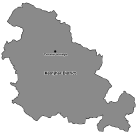
Map of India highlighting Odisha state (top left); State of Odisha highlighting Keonjhar district (bottom left); Keonjhar district with Teranti village (right). |
|
|
Story of Teranti village Teranti village is situated in Sankari panchayat of Keonjhar district in Odisha. It comprises of 65 households (HH) and a total population of 391 (195 male and 196 female). Of the 65 families, 33 HH are below poverty line, 24 Scheduled Tribes, 3 Scheduled Caste and 38 are from general caste. The main occupation of the villagers is agriculture and daily labour. In the absence of toilets in the village, people defecate in the open and bathe in the village pond. In addition, the pond is used to clean themselves after defecation, bathe animals, wash clothes etc. For easy access to water for cleaning, people would defecate on the banks of the pond. In the summer, with the pond and alternate sources of a bore well drying up, women travelled for nearly two kilometers to fetch water. After persuasion, the village collected a corpus of Rs 65,000. People were still unsure that they could have quality toilets and bathing rooms and 24-hour potable piped water supply. On an average, a thousand rupees per family was collected, with the more affluent contributing more. Today the corpus amount has become Rs 75,000 and only the interest can be spent to subsidize the cost of new toilets and bathing rooms. The people make bricks, collect rubble for the foundation, sand and prepare the aggregates. Daily wage earners in the village were trained in masonry by Gram Vikas. All families contributed labour and local materials, which can be collected or made locally. The newly trained masons constructed the toilets and bathing rooms under Gram Vikas’ supervision. An elevated water reservoir with a capacity of 40,000 litres was constructed. A sanitary dug well was established. Every family got three taps – one each in the toilet, bathing room and kitchen – and 24-hour potable piped water supply was established. The work began in October 2005 and as the people did all the work themselves, it was completed in February 2008. There are separate toilets for girls and boys in the school, besides running water. Hygiene education is a subject being taught in the local school. More than 90% girls and 95% boys of school going age are attending school. The finances for building the water reservoir and the water distribution system: * Rashtriya Sam Vikas Yojana (RSVY) scheme – Rs 665,000. * People contributed by labour, local materials and some cash – 60%. * The local MLA towards the cost of sanitation – Rs 75,000. * Gram Vikas contribution per family – Rs 3,000. 82% of the waterborne diseases have been reduced in the village. Moreover, now young girls from this village are not willing to marry boys from villages which have no toilets and running water. |
|
Through community-led total sanitation it was realized that institutional mechanisms can be developed around this programme, which would be the first experience for a community managing their own village institution and financial resources. The marginalized sections of the community need to be given an opportunity to sit together with the more powerful sections and negotiate issues regarding the village on equal terms. This helps build the capacities of the community and instills a high level of confidence in people. Villagers learn to deal with conflicts and act as pressure groups against vested interests within their village and outside. They learn to question and hold accountable the village committee that is elected by them. Villagers learn the ropes of maintaining public accounts, organizing general body meetings and elections.
The first six years of the MANTRA programme (1992-1998) was characterized by the ‘push’ factor. From 1999, the ‘pull’ factor has gradually emerged. The demonstration effect is clear as neighbouring villages are tempted to undertake the programme. Old villages often play a key role in motivating new villages. People perceive the enhanced social capital in villages that are a part of the programme. The visible reduction in the incidence of waterborne diseases, reduction in the drudgery of women and the comfort of privacy they now enjoy are also powerful motivating factors for adjoining villages. An interesting development has been that girls from MANTRA villages are now reluctant, and often refuse, to be married in villages where there are no toilets, bathing rooms and piped water.