Improving primary health care
PAVITRA MOHAN and AKANKSHA DUTTA
POOR people in underserved rural areas face a huge and disproportionate burden of ill health. In a baseline study of four underserved panchayats in South Rajasthan, we found that a whopping 68% of all children reported falling ill at least once in the last two weeks of the survey period. In such vulnerable areas public health services either do not exist or are affected by absenteeism of physicians. Concurrent evaluations of the National Rural Health Mission have revealed that physicians were available in only two out of 10 PHCs surveyed in Rajasthan. The formal private sector also does not operate here as people’s capacity to pay is limited. In such conditions, unqualified private practitioners and traditional healers are the default care providers: often poor in quality, exploitative, but available. Most such providers are men, further limiting the access of women to even this rather abysmal level of care.
A high illness load and poor access to quality health care is reflected in high levels of mortality, and large disparities in mortality. For example, infant mortality in rural India at 44/1000 live births continues to be one and a half times that of urban India. Even these averages hide further inequalities within rural areas, especially those prevailing within the underserved areas. For example, 33% of all women of reproductive age group in the survey referred to above, reported having at the least one child death in the past.
Families also end up spending significant money, despite receiving poor quality of care. Not surprisingly, expenditure on health care is one of the major reasons for families slipping into indebtedness in rural India. In communities with high levels of migration, most households have an absent adult male head. With an erratic cash flow, women of the family (wives of the migrant males), who are often left behind, juggle between many roles, often tend to neglect their own health care needs and may find themselves stretched to provide adequate care for their children. Thus on one hand, the families are more likely to fall ill, and on the other, their capacity to prevent or respond to such illnesses is even more compromised than the families of non-migrants.
The health care system in India at present has a three-tier structure to provide services to its people. The first tier, known as the primary tier, has been developed to provide preventive, promotive and curative health care services to the vast majority of rural people. The primary tier comprises of sub-centres (SC) and primary health centres (PHC).
The primary health centre is the foundation of rural health services. A typical PHC covers a population of 20,000 in hilly, tribal, or difficult areas and a population of 30,000 in plain areas with six indoor/observation beds. It acts as a referral unit for five to six sub-centres and refers cases to CHC (30 bedded hospital) and higher order public hospitals located at sub-district and district level.
Virtually, primary health centres and services are located too far from the populations they serve, provide too few services, and have too little resources. Primary health care in India suffers from inadequate public investments. Each PHC in India is supposed to serve a population of 25-30000, which makes them too far for many families to access, and for the providers to give continued care.
A
dditionally, primary health care services in India rely too heavily on the presence of doctors, despite a shortage of them nationally. Since few doctors live in the rural areas, especially in remote areas, the primary health centres by default become dysfunctional. There is no cadre of primary care providers in the country, unlike many western countries where general physicians and nurse clinicians are the certified primary care providers. MBBS doctors are by default the primary care providers in India with no additional training, and only nurses to assist them. The situation aggravates when it comes to tribal populations as they are not only distant and dispersed, but also too ill and malnourished with divergent health care and social needs. India’s tribal people thus have far worse health indicators than the general population. Most tribals live in remote rural hamlets in hilly, forested or desert areas where illiteracy, trying physical environments, malnutrition, inadequate access to potable water, and lack of personal hygiene and sanitation make them more vulnerable to disease.
T
hough there are different definitions of primary health care, the one proposed by Starfield, a champion of primary health care, seems most apt for us. She defines primary health care as the one that has the following characteristics: (i) The point of first contact for all new needs, (ii) person focused rather than disease focused continuous care over time, (iii) comprehensive care provided for all needs that are common in the population, and (iv) coordination of care for common needs and also those that are sufficiently uncommon to require special services.|
|
|
|
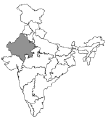
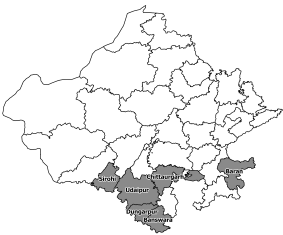
Map of India highlighting Rajasthan state (top left); Rajasthan with its tribal districts (right). |
|
In addition to the above service characteristics, an effective primary care system needs to be accessible to all, based in the community and include preventive, promotive and curative health care. Services addressing almost 85% of the health care needs can be provided at the primary level, including curative, preventive and promotive care. For other needs, such as for specialized treatment, the primary health care system assumes the responsibility of coordinating care across the higher levels of care.
The countries that have the most developed primary health care systems also have good health at lower costs. Delivering primary health care, however, requires a team of skilled health professionals, workers, and volunteers. A judicious skill mix is often required depending on the resources available: while most systems would be coordinated by a physician, increasingly nurses are playing a central role in providing primary health care in developed as well as in the developing countries.
K
nown for its history, heritage and hospitality, the state of Rajasthan, geographically one of the largest states spread over 342000 sq kms, has a population of 68.6 million people (Census 2011). Rajasthan’s 9.2 million tribal inhabitants represent about 13% of the state’s population. They live in dispersed clusters, often in arid rural areas that are prone to drought and food insecurity. Furthermore, about one third of Rajasthan’s tribal population lives below the national poverty line. According to Census 2011, the state has seven zones, 33 districts (the plains area is covered by 20 districts; seven are known as tribal districts and the last category of six districts have desert areas), 249 development blocks, 446720 revenue villages and a reasonably large health infrastructure with health care delivered through 11487 sub-centres, 1517 PHC, 408 CHC level hospitals and 34 district hospitals. The tribal districts also have a fairly reasonable three-tier health infrastructure.The IPHS (Indian Public Health Standard) specifies norms to provide an optimal level of quality health care with the aim of delivering high quality services that are fair and responsive to the client’s needs, which should provide equitably, and deliver improvements in the health and well-being of the population. The IPHS for PHCs are designed to provide: (i) comprehensive health care to the community through these centres, (ii) to achieve and maintain an acceptable standard of care, and (iii) to make the services more responsive and sensitive to the needs of the community.
B
ut their functioning, especially in tribal areas, is questionable. Many people in India, particularly the poor, face the problem of seeking effective health care at a cost they can afford, at the distance they can travel, and with a dignity they deserve. They make compromises depending on the situation: either on cost, or quality, or dignity. In many cases, families shop for health care services across different providers at different levels, still getting a raw deal in the end.A summation of these effects at the individual level is reflected in the poor health outcomes at the population level (such as high levels of mortality, high prevalence of diseases such as tuberculosis, etc.), and high levels of inequalities in these outcomes. They are also reflected in impoverishment of families due to high recurrent or catastrophic expenditures on health care.
AMRIT Clinics have been set up to provide high quality, low cost primary health care services in underserved high tribal, high migration communities of South Rajasthan. AMRIT Clinics are a collaborative initiative between Aajeevika Bureau (AB) and Basic Health Care Services (BHS). Aajeevika Bureau is a specialized non-profit, public service organization that provides solutions, services, and security to seasonal migrants who leave their villages to find work in cities, factories and farms. Basic Health Care Services is a not for profit start up organization that is driven with a vision of a responsive and effective health care ecosystem that is rooted in the community, where the most vulnerable communities can actively access high quality, low cost health services with dignity.
Realizing the need for accessible, migrant friendly and low cost yet high quality primary health care services in underserved areas, AMRIT Clinics have been set up in three remote underserved communities of South Rajasthan in the Salumbar block of Udaipur district.
C
urrently, three AMRIT Clinics serve seven panchayats, reaching out to about 7000 families (population of about 36,000). More than 90% of the covered population is tribal, and about 60% of the households have at least one male member who has migrated to a city for livelihood. About one third of the mothers reported a still birth or a child death in the past. In these areas public systems have limited reach, and the illness load is high.The model consists of a network of three primary care clinics, each serving a population of about 12,000. The clinic is set up in a community premises following a contract with the local self-government. Three nurses (women) provide clinical care and outreach care to the surrounding dispersed populations. A physician visits the clinics once a week and is available for tele-consultation 24 hours a day. The clinics provide consultation, dispense drugs and administer basic laboratory tests. They also provide safe childbirth services, and manage emergencies 24x7. Outreach services include antenatal care, postnatal care of mothers and newborns, follow-up of chronic patients and community education. Social contracts with private hospitals enable referral care. Patients pay a small user fee for clinical services.
AMRIT Clinics promote practices that judiciously combine three distinct innovations: human resource innovations, partnership innovations, and technology innovations, to meet the need for low cost, high quality services for health care in remote, rural and underserved areas.
H
uman Resource Innovations: Community health workers (CHW), when adequately skilled and supervised, have been shown to improve specific health outcomes such as neonatal mortality. A strong reliance on these CHWs coexists with the AMRIT Clinics. However, the health care needs of the families extend much beyond what community health workers can provide. So while CHWs can supplement the functional health services, they cannot be a substitute. In AMRIT Clinics, skilled nurses are the primary care providers and managers. There is a downward integration with community volunteers and an upward integration with a family physician. Nurses are more likely to work in remote areas, and have the basic education and skills to provide primary curative care provided they are skilled and supported. Use of appropriate technology, and intensive training and supervision allows them to deliver high quality care.Partnership Innovations: Many primary care systems are not well utilized because of the weak linkages with higher level of care. AMRIT Clinics forge a social contract with private hospitals to provide near free referral care. It has led to several lives saved, increased confidence of the families in primary care and fulfilled social obligations of the private sector. The clinics also forge contracts with the public system for entitlements to enable targeting of health entitlements to families, such as for free diagnostics and conditional cash transfers.
T
echnology Innovations: Telemedicine and other technology based solutions often aim to substitute the presence of skilled providers. Amrit clinics use technology as an enabler to allow nurses to provide high quality care, rather than as substitutes. They also use technology that addresses the realities of such remote areas: for example, use of 2G instead of a 3G network for remote consulting. Use of rapid diagnostic kits for prompt and simple diagnosis of common illnesses such as malaria, and typhoid reduce the dependence on skilled laboratory technicians. The clinics also use primary care MIS for efficient management and quality assurance of the services.
A
MRIT Clinics have recorded an increasing number of patient visits over the years in some of the most remote and underserved areas: cumulatively, the clinics have received 22,000 patient visits. Of these visits, 2,667 (12%) are children under 5 and 11,844 (55%) are women. Services provided have included quality antenatal care, safe childbirth, management of children with diarrhoea and pneumonia, detection and management of tuberculosis, detection and surgery for cataract, etc.
|
Ramlal Meena incapacitated by TB returns to work after receiving treatment at Amrit clinics. Ramlal Meena, resident of a remote village in Salumbar migrated to Indore when he was 16 years old. Able bodied, he earned well in a scrap shop, and would return home every year. A couple of year later, he started coughing regularly and ran a slight fever. He soon started feeling lethargic, enough for him to not work any longer. Unable to earn, he returned home. He consulted a few traditional and local health care providers and spent more than Rs 20,000 on the treatment, losing all his savings. The nearest government primary health centre is 20 kilometres with erratic transport. He then visited an AMRIT Clinic where he was detected with tuberculosis. He was started on anti-tuberculosis drugs, and was regularly counselled with follow-ups for drug compliance alongside a nutritious diet. His total treatment cost him 500 rupees and he has now returned to Indore, and supports his family. His wife received antenatal care from the PHC nurses at AMRIT Clinic and the child received immunization. |
In addition to these numbers, there has been a significant impact on financial stability of the patients. Access to reliable low-cost health services mean they spend much less on health care than if they had sought care from an alternate source. Second, the improved health outcomes also translate in the short-term in increased incomes, because of not having to miss work. It is difficult to quantify the improved incomes due to recovery from illnesses such as tuberculosis, malaria diarrhoea etc., but is likely to be substantial. There are several instances of people with chronic illnesses such as TB and HIV returning to work after completing the treatment. The families themselves have contributed to about 15% of all expenses incurred in providing these services.
AMRIT Clinics still have a long way to go to address the health care needs of the population. Limited autonomy of women, difficult terrain and an absence of menfolk still inhibits large numbers of women and children to access services from the clinics. The need to resume earning force many men to start working prematurely and drop out from the treatment for tuberculosis. Poor availability of nutritious food adversely affects the health of young children. However, they do create optimism that responsive and high quality services can be provided in such underserved areas, at a cost people can afford and with the dignity they deserve. Such services need not be dependent on physicians.
P
roviding high quality primary health care services to underserved tribal populations will require commensurate changes at the policy and programme level. The government must explicitly assume the responsibility of providing primary health care (and not rely on invisible private providers springing up once people are insured). Higher investments in the health sector and especially in primary health care, are the need of the hour. At the current levels of investments in the health sector, and within that the skewed priorities towards secondary and tertiary sector are just not sufficient to provide responsive primary health care in these areas. Increased efforts should be directed to help set up and run primary health care services in remote, underserved communities, by ensuring greater deployment of nurses as community health practitioners. Creating a cadre of family physicians would ensure the necessary oversight and referral care.There is an urgent need for strengthening primary health care in high tribal areas, with fresh infusion of money and ideas.