Role of NGOs
PRASANTA TRIPATHY
A large proportion of India’s tribal people live in the remotest of forest areas. They are isolated and often untouched by the ongoing entitlement programmes meant for them. This manifests in their state of ill health, poor education and low socio-economic status. The widespread poverty, illiteracy, malnutrition, absence of safe drinking water and sanitary living conditions, poor maternal and child health services and ineffective coverage of national health and nutritional services have been traced out in several studies as possible contributory factors to dismal health conditions prevailing among the tribal population.
|
|
|
Ekjut’s presence in Jharkhand and Odisha. |
In response to this situation, the Government of India has initiated various programmes for tribal development and empowerment through agencies such as cooperatives, government and non-governmental organizations, and other civil society organizations.
Over the last three decades, a significant shift has taken place in the approach of government and NGOs towards tribal development. What started as a welfare approach in the 1950s, shifted over time to development in the 1970s, and empowerment in the 1990s, particularly in the 10th five year plan that focused on tribal empowerment. In the 11th and 12th five year plans the focus was on faster, more inclusive, and sustainable development. This framework created space for civil participation and with the effective and efficient functioning of CSOs and NGOs, tribal people began to be involved in a participatory development process of their own.
Over the years numerous NGOs have played an important role in the development, implementation and reform of public health services, particularly those relating to nutrition of tribal peoples. In the current set up, the role of NGOs has become critical as they are expected to help in (a) service delivery, (b) highlight omissions and commissions with respect to services on the ground especially in tribal areas, (c) generate fresh evidence for decentralized community based health care models, and finally (d) empowering communities.
D
espite a substantial presence in the tribal regions, NGOs face an uphill task in tackling malnutrition in these areas. Malnutrition constitutes a multi-factorial challenge that demands a multi-sectoral approach. NGOs have been involved in various innovations and pilot projects to demonstrate context specific unique strategies that have a bearing on malnutrition with the objective of ushering in comprehensive and sustainable solutions with the support and involvement of the community.Because at most times it is not easy to facilitate the process, like many other development stakeholders, NGOs too look for ready-made and quick-fix approaches to address the nutritional needs of tribal people.
The difficult hilly terrain and a sparsely distributed tribal population in forests creates its own sets of problems – of accessibility, remoteness and poor transportation network being the most common. Despite these adverse circumstances, many voluntary organizations have successfully carried on with their result-oriented work. Complemented by various policies adopted by the Government of India, the work of local NGOs has yielded results for the overall tribal development process, including nutrition. NGOs have also made an important contribution in initiatives to eradicate various socio-economic problems knowing well that these have health implications.
In their effort to introduce practical and sustainable solutions, NGOs sometimes face problems when the services are not seen as community friendly in terms of timing and cultural preferences, thereby inhibiting utilization. Tokenistic involvement of tribal people and weak monitoring and supervision systems further adds to the complication. But with time and the effort put in by the field workers, their interpersonal communication and rapport with the community has helped to bridge the gaps.
|
FIGURE 1 |
|
|
Both their proximity to and the style of working directly with the tribal people has given NGO workers some unique advantages. As a result, they are often in a much better position to understand and deal with the various nutrition and health problems. The system works even better with the participation of tribal people in the development process, problem and solution analysis. This sort of engagement also provides a platform where the tribal people can voice their concerns.
I
n Ekjut, we try to promote culturally suitable approaches to improve health and nutrition of tribal people through a structured process of empowerment that leads to improved problem solving skills, better decision making for local solutions, improved uptake of services and better understanding of their rights and entitlements. Through a collaborative effort in producing research based evidence and outcomes, this process has positively impacted on the nutrition status of tribal people in Jharkhand and Odisha.
A
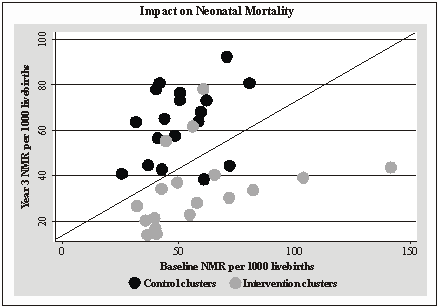
ccording to the Planning Commission, Jharkhand and Odisha are two of the poorest states in eastern India (with around 40% of their total combined population living below the poverty line). Census data shows that more than 20% of Jharkhand and Odisha’s population are Scheduled Tribes, and about 12% Scheduled Castes. As per NFHS 3, neonatal mortality rate (NMR) per 1000 live births was 49 in Jharkhand and 45 in Odisha, and maternal mortality ratio (MMR) per 100,000 live births was 371 and 358 respectively as compared to India’s national estimates of 39 per 1,000 for NMR and 301 per 100,000 for MMR.Ekjut’s initial work involved Participatory Learning and Action (PLA) during 2005-08 to reduce deaths of newborn babies as shown in the scatter-plot (Figure 1) comparing NMR in intervention and control clusters (panchayats) between the baseline and year three. Here, each dot represents a cluster and if all the dots fall on the line, it implies that the rates were the same in the baseline and in year three. Dots under the line represent clusters where the NMR was lower in year three than at the baseline.
The intervention clusters (in grey) have a lower NMR compared to their baseline, and many of the control clusters have higher NMR. This reflects the decrease in NMR in intervention clusters compared to the control clusters.
A
Participatory Learning and Action approach has been adopted to deliberate on nutritional issues for mothers and children. Another ongoing collaborative research with University College London, Public Health Foundation of India and Ekjut (CARING trial) seeks to evaluate if nutrition workers (su-poshan karyakartas) can deliver PLA alongside home visits and counselling to pregnant mothers and mothers of younger children to improve dietary diversity, hygienic practices, and referrals to malnutrition treatment centres when needed to positively impact on childhood undernutrition, and so on.
T
he poor health outcomes in these two states are the by-product of poverty and other social determinants. To tackle these issues, a project titled Action Against Malnutrition (AAM) was launched and implemented by Ekjut, Child in Need Institute (CINI) and Public Health Resource Society in Jharkhand and Odisha as part of a larger programme in four states. This is a collaborative project for addressing malnutrition in some of the remotest pockets while using multiple community based strategies that have been tried, tested and validated through experience over many decades. Thus the project has been conceived as a model to demonstrate the importance and effectiveness of community mobilization through women’s groups, systems strengthening and specific community based management of malnutrition through running of creches.
|
|
|
Ekjut’s Creche facilities. |
After long years in the field, many civil society organizations and workers have realized that while there is no shortage of government programmes, the gap lies in effective implementation. Within this context, the main strategy of AAM has been to improve the delivery mechanism of government programmes through building capacities of communities and service providers addressing malnutrition. The focus is mainly on Integrated Child Development Services (ICDS), health services (especially those related to immunization, treatment of childhood illnesses), setting up Nutrition Rehabilitation Centres (NRCs), strengthening the village level water and sanitation, public distribution system (PDS), and projects under the Mahatma Gandhi National Rural Employment Guarantee Act (MGNREGA).
T
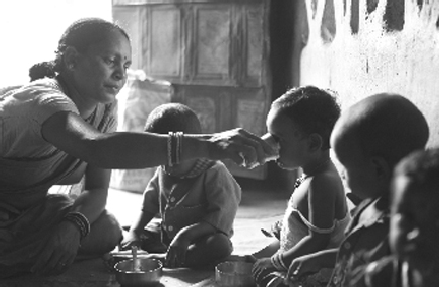
o maximize the impact of this intervention, community participation has been ensured through Participatory Learning and Action (PLA) exercises where the communities express their views, problems as well as possible solutions about health and nutrition concerns. Regular meetings of the community on malnutrition, childcare, child health and related issues are organized. In these meetings, information on nutrition, growth monitoring and related issues are discussed in order to facilitate community action, including finding local solutions out-side of current schemes and programmes. The AAM team also helps the gram panchayats to monitor programmes related to malnutrition and conduct social audits on programmes such as ICDS, PDS and MGNREGA. These are all part of the community mobilization process.Despite multiple programmes to improve nutritional status, much more needs to be done and achieved in both Jharkhand and Odisha. This was an opportunity for credible organizations to contribute through innovative community based solutions. Setting up crèches for six months to three year olds is one such innovative programme which addresses a number of determinants of child undernutrition and delivers good nutrition, clean and smoke-free environment, hygienic practices, regular growth monitoring and managing of at risk and malnourished children, and early childhood stimulation. Children with special nutritional needs and whose growth has faltered are fed three times a day. The community at every level extends support, including identification of location, provision of space, deciding on the menus and in management and supervision. Health check-ups are organized in partnership with the government and it is ensured that children access ICDS and other health services that they are entitled to.
T
o make this programme effective and fruitful, duplication of services offered by the state government is avoided during the implementation stage. The existing state government protocols for malnutrition treatment centres/nutrition rehabilitation centres and related efforts are adhered to and followed as a complementary step.
|
FIGURE 2 |
|
|
The Tata Trust has generously supported the AAM initiative at all stages, with Public Health Resource Society hosting the project management unit, Jan Swasthya Sahyog and Mobile Crèches providing inputs for effectively running of crèches, and Ekjut for providing capacity building for robust anthropometry and designing of a participatory learning and action (PLA) module. An advisory group consisting of experienced and committed individuals, along with partner organizations, was formed to periodically review, advice and support this project.
O
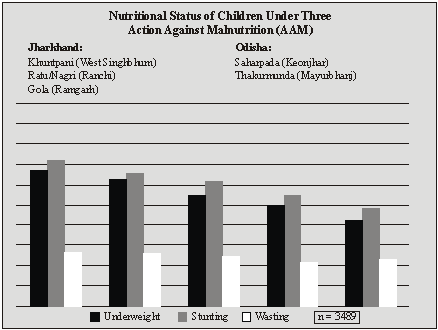
ur initiative has been to mobilize communities on malnutrition towards preventive, promotional and curative efforts. It has also worked to improve service delivery of the public systems and programmes, strengthening ICDS and NRHM, along with other social determinants of malnutrition such as water and sanitation. Through initiatives like the crèche, attempts have been made to fill the programmatic gaps for childcare and community based management of malnutrition.The legitimacy of the AAM consortium partner’s influencing role comes from their work on the ground, Ekjut in Keonjhar and Mayurbhanj (Odisha) and West Singhbhum (Jharkhand), PHRS in Ranchi (Jharkhand), CINI in Ramgarh (Jharkhand), Chaupal in Sarguja ( Chhattisgarh) and IDEA in East Champaran (Bihar). While the hypothesis of the AAM initiative that there will be progressive improvement in status of nutrition among children below three years of age due to the layering of additional crucial interventions (only system strengthening, system strengthening plus empowerment of women through participatory women’s groups and home visits and counselling of mothers, system strengthening with participatory women’s groups intervention plus crèches for children 6 months to 3 years of age) in three distinct geographical areas of the districts at different sites will be tested through robust anthropometry during the baseline and endline, in this poorly nourished population (Figure 2) there are already encouraging findings from MIS data from the crèche areas.
I
n the above three studies (Ekjut trial, CARING trial and the AAM initiative) the Ekjut model of participatory learning and action has been used to complement other nutrition sensitive and nutrition specific interventions for a possible synergistic outcome. Use of PLA also presents new opportunities for policy makers to improve demand generation for the services being offered in poor populations. Improved health and nutrition of the indigenous communities must include health system strengthening with improved access, coverage and quality of services, empowerment of women and setting up of creches for children and addressing social determinants.