A farming systems approach
RAJASHREE JOSHI
ALONGSIDE the growing flux of ‘poverty amidst plenty’, vast untapped resources characterize most under-developed tribal regions where communities live at subsistence levels and in relative geographical isolation. The prevalence of rain fed agriculture, use of age-old practices of production, depleting natural resources and distress migration for basic survival and livelihood, only adds to the hardship. In addition, the potential of livelihood generation from agriculture, forestry and livestock remains largely under-developed.
There are various factors that account for low agricultural yield in tribal areas – small and fragmented land holdings; heavy soil erosion resulting in depletion of soil productivity; water scarcity and inefficient use of water resources; outdated agricultural production technologies poor availability of agricultural credit; lack of infrastructure for post-harvest management and marketing of agriculture produce; and absence of organized efforts for natural resource management based livelihoods due to remoteness. Lower yield also results in low levels of income. Unfortunately, both local resources and knowledge about agriculture practices continue to be ignored in government policies.
Livestock has always been an important source of income, particularly for small farmers and landless families in rural tribal India, but its full potential yet remains to be realized due to neglect of health care and absence of scientific feeding practices of animals. As a result, livestock which was earlier an asset and contributed to income and food security, has turned into a liability. When the yields of crop and livestock are low, not only do farmers earn lower income, supplementary employment opportunities in the farming sector are also reduced. This leads to a reduction in farm wages, seasonal employment and increases the cases of malnutrition and migration.
High levels of unemployment in the farming sectors (in already marginalized and isolated communities) can have many serious outcomes. An increase in poverty levels lead to decline in health parameters, and neglect of corrective actions in time leads to further chronic poverty. Therefore, it is imperative to break this vicious cycle. Similarly, it is important to focus on the situation with regard to traditional crops and their gradual erosion in tribal areas. Modern high yielding varieties did not make significant inroads into the tribal regions during the first couple of decades of the Green Revolution (1960s to the ’80s). Hence, indigenous diversity remained surprisingly high in some tribal areas. However, over the last two decades, there has been a gradual erosion of this biodiversity. For example, the Thane district of Maharashtra has a fairly large tribal population who have traditionally cultivated over 300 diverse varieties of rice with specific attributes such as hunger satiation, instant energy provision during peak workloads, and for medicinal use. This wonderful diversity of rice has for long formed the basis of a nutritious and secure diet for the tribal population.
H
owever, the erosion of crop biodiversity and the knowledge associated with the use of these bio-resources has taken place at an accelerated pace in recent years. Most farmers are ignorant about the existence of gene banks, hampering their access to the local precious seeds and genetic resources. In some of the remote areas, a few farmers continue to cultivate the traditional varieties on a small portion of their land, mainly for subsistence. Thus, many of these crops still have a presence despite the neglect of the last few decades. This is indicative of their potential role in the cropping systems of India, especially in small landholdings.The efforts of the BAIF Development Research Foundation for holistic tribal development involve a combination of multi-sectoral, integrated, natural resource based and environmentally sound activities by introducing science and technology tools at the level of family and landscapes so as to provide multiple livelihoods and quality of life gains to the ST communities while enriching the environment.
|
|
|
BAIF’s work in the tribal clusters of Gujarat, Rajasthan, Madhya Pradesh, Chhattisgarh, Karnataka and Maharashtra. |
One of its programme approaches of improving agricultural production while focusing on various input components has been to address the challenge of small, low yielding lands. This has helped create employment and long-term productive assets in tribal settings. Some of the successful models that BAIF has adopted and introduced in tribal areas are discussed below.
O
ne of the most successful approaches used is the wadi (meaning orchard in Gujarati), a farming system based model (introducing combination of agri+ horti+ forestry species) using marginal lands of tribal families living in remote tribal clusters in Gujarat, Rajasthan, Madhya Pradesh, Chhattisgarh, Karnataka and Maharashtra.This is a unique agri-horti-forestry programme based on the principles of participatory development for sustainability. Local resources, local technologies and local skills are encouraged and promoted. The model benefits small landholding tribal families with limited resources and low access to irrigation facilities. The wadi model is practiced on marginal lands, in other words on degraded and underutilized lands, where most of these people live in scattered hamlets.This innovative method develops the farmer’s small land parcel as an orchard by planting drought tolerant fruit crops, while the inter-space (spaces in-between two rows of fruit trees) is used for growing food crops. In addition, orchards are fenced by plant species useful for food, fodder, timber, fuel and herbal medicines. The thrust is on mixed cropping of diverse local food crops and trees, rather than a single cereal/cash crop based production system. Around this core component, several other need-based elements are introduced, depending on the identified needs like health and livelihood alternatives, formation and strengthening of community based organizations, etc. The intervention has over time resulted in the creation of opportunities for increased food production using available resources for the small tribal farmer, in turn creating additional employment opportunities and reducing distress migration. This has helped meet most of the small farmer’s house-hold food requirements.
A
nother important approach is to encourage and promote farmers’ seed sovereignty.1 Many tribal regions are considered to be biodiverse ‘hot spots’ as they host a wide variety of food crops, including nutritious millets, beans, pulses and wild food resources such as tubers, wild trees and creepers. Over the years, these crops and resources have become scarce on account of several development forces. Some are even on the verge of extinction. An innovative programme has, therefore, been initiated for community-led conservation and revival of diverse, native food resources in five different tribal clusters. Under this programme, 1000 tribal farmers from 20 villages from Maharashtra, Madhya Pradesh and South Gujarat have been directly involved in participatory knowledge generation, conservation, seed production, seed multiplication and a community level seed banking programme. Encouraged and promoted as a ‘climate smart’ programme, this intervention builds the farmer’s resilience and insulates the basic agriculture production system in tribal clusters.
|
|
|
|
|
|
|
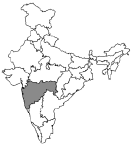
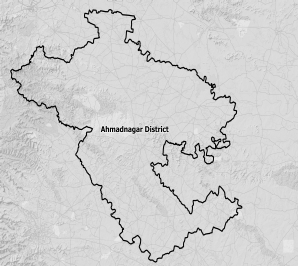
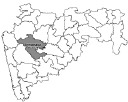
Map of India with Maharashtra state highlighted (top left); Maharashtra state with Ahmadnagar district (bottom left); Ahmadnagar with topographical layout (right). |
|
P
romotion of kitchen gardens to ensure access to local nutritious food has long been a favoured approach of the BAIF. This method revives and reintroduces the tradition of kitchen/ homested gardens on a small plot of land surrounding the home. The model includes multiple, multilayered and multipurpose indigenous trees, plants, herbs and shrubs which are mostly local and are traditionally used as food, fibers, fruits and medicines. Apart from access to seeds and planting materials such as tubers and seedlings, support is also given to ensure regular watering and basic protection. Self help groups (SHGs) and village health animators help to ensure integration of green leafy vegetables, nutritious tubers, mushrooms and wild tree parts (e.g. tender leaves of the Bauhinia purpurea tree, which are commonly cooked as curry or fried by many tribal families) in the diet of tribal girls, mothers and children. The combination of trees, shrubs and herbs is planned in such a way that the produce from a small plot is sufficient to meet the food and nutritional needs of a family for the entire year. The initiative has been tried out in Vidarbha and Akole in the Ahmadnagar region of Maharashtra and in the Dangs region of South Gujarat.|
|
|
|
Map of India with Gujarat state highlighted (left); Gujarat state with Dang district (right). |
|
T
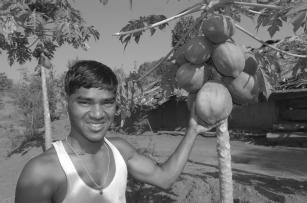
he successful efforts to develop a model based on a farming systems’ approach by combining livestock, (fishery) and food crops have been expanded to other resources too. This integrated approach to farming includes a technique of inland fishery and water chestnut cultivation using a small surface water body which is complemented with crops and vegetables grown on its surrounding land. This scheme has been piloted in the Vidarbha region of Maharashtra.Similarly, high value vegetable cultivation has been introduced on small plots by providing improved seeds and knowledge of other package of practices to tribal farmers. Different seasonal short duration vegetables like okra, brinjal, chillies, onion, bitter gourd, bottle gourd, yard bean, tubers /yam are increasingly being grown by tribal farmers in the Jawahar region of Maharashtra and of Kaprada region of South Gujarat. Prior to this programme, farmers mostly grew paddy crop under rain fed conditions. This intervention involves arranging for some water resource for critical periods of crop growth (through pumping water from rivers/streams/wells or some other form of water harvesting structure) as well as in organizing a series of technology extension and support interventions. This has proved useful in introducing new sets of cropping patterns on the (targeted) farmer’s fields, thereby ensuring income and food system diversity gains to participating tribal families
F
or tribals, goats and poultry play an crucial role in household level food production and also serve as an important resource to supplement family income. Hence, BAIF has popularized scientific management approaches by introducing improved and selected breeds and breeding services, and extending knowledge on scientific management and care of livestock resource. Apart from these programme interventions, the BAIF team has also helped communities to deepen their understanding of food-nutrition-health-income linkages.|
|
Efforts have been made to address issues of post-production wastage and loss of agro-horti and forest produce by building local groups and organizing them in collectives like SHGs, federations, cooperatives, producer companies and commodity interest groups. Initiatives have been taken to introduce post-harvest and supply chain related innovations.
With its more than three decades of work in tribal areas, BAIF has shown that in order to address the farming sector concerns of low yield and high unemployment, and to tackle health and food security issues in isolated tribal areas, it is critical to move away from sectoral or piecemeal solutions to more holistic approaches. There are available technologies that can be used by farmers in the tribal areas to address the challenges.To utilize these options, demystification of technologies is needed along with skill based capacity building. And it becomes important for the farmers to make an effort to diversify livelihoods so that they do not remain dependent on a single source of income and food. This, along with efforts to reintroduce and incorporate inherent local knowledge, traditions and existing biodiversity to support the diversification of livelihood and basic food and nutrition security, remains at the core of holistic tribal development approach of BAIF.
T
he good part is that many of these programme approaches are increasingly getting noticed by development actors including government agencies and policy makers. However, more focused efforts are required to create greater evidence for understanding the link between agriculture to income and nutrition outcomes, especially in tribal areas. Similarly, efforts are required to introduce such programmes at a scale so that more isolated tribal families may benefit from them.
Footnote:
1. Listing, mapping distribution and documenting local diverse landraces and cultivars; facilitating exchange of local knowledge/wisdom associated with these bio resources; community level exchange of seeds through establishing community managed seed banks at the village level after a lab analysis of the nutritional content of indigenous food promoting nutrient conserving recipes to enhance health; on field participatory production using various science and technology tools to select preferable seeds using various parameters such as grain and fodder yield, resistance to pests and diseases, tilling, suitability to land, drought tolerance, medicinal value, etc; building capacity and knowledge of farmers, extension workers, students, etc. for large-scale awareness and promotion of local agro biodiversity and associated sustainable practices and techniques; training farmers in preparation of quality organic inputs like vermi-compost, vermi-wash and natural pest repellents, which reduce their production costs and dependence on external inputs.