Crèches in tribal areas
RAMANI ATKURI
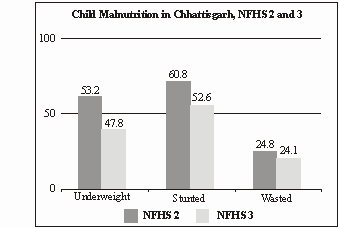
MALNUTRITION is one of the biggest health related problems afflicting India. Figure 1 illustrates the prevalence of malnutrition in the second and third national family health surveys for Chhattisgarh in Central India.
Widespread hunger is prevalent in the state with adults and children alike having insufficient and poor diets. This has resulted in more than 47% of its children being underweight as per National Family Health Survey (NFHS) 3.
1 There has been little change in prevalence of acute hunger (wasting) in children between 1998-99 (NFHS2) and 2006-7 (NFHS-3).Malnutrition leads to increased chances of falling ill and death. Its impact is particularly severe in small children as there is evidence showing that malnutrition, both severe and non-severe, is the underlying cause of over 50% of deaths among children under 5.
2 Besides high mortality, malnutrition in early childhood also leads to poor intellectual development, which is likely to have a lifelong effect. In early childhood, (below two years of age), when maximum mental development takes place, malnutrition can affect the child’s learning ability at school, worsening the consequences of early malnutrition. Undernourished children grow into undernourished adults who have poor work capacity that affects their earning ability, thus keeping them in a poverty trap. Frequent illnesses following a poor nutritional status further worsen malnutrition|
|
|
Map showing location of Chhattisgarh in Central India |
In Bilaspur, like in most parts of our country, the weight of children is normal in over 75% of children at birth. These children often maintain their weight improvement for the first six months of life thanks to the very high rates of breast feeding. However, after six months most children do not get adequate supplementary foods, which they need in order to grow well. The result is that children who were somewhat well preserved become progressively weak, and by the age of two a majority of the children are significantly undernourished. Almost 65% of our children below the age of five years are undernourished.
Why do our young children not get enough supplementary foods? Various reasons have been identified such as delayed introduction of complementary foods (possibly due to lack of sufficient knowledge about the need for it); where food is offered, the portion size is small; lack of a caretaker during the day to feed the child at frequent intervals – perhaps the most important cause when both parents go out to work; as well as a lack of purchasing power of the parents.
P
eople and organizations in India dedicated to improving child nutrition will acknowledge that there is no lack of initiatives being tried by the government and civil society organizations to improve nutrition of young children. Almost all of them are based on the assumption that the mother is the primary caretaker and hence mainly responsible for feeding and caring for the child. Thus, the focus is on teaching the mother about the basics of infant and young child nutrition, as well as the importance of hygiene and sanitation.Not only is this assumption flawed, other existing programmes also fall short in tackling the issue of child malnutrition. Kitchen gardens, through fruits and vegetables, can be a good source of vitamins and minerals, but they rarely provide the supplementary calories or protein required by the child or family. The programme of take-home rations for young children is often found to be unsuccessful as portion size meant for the child is diluted at the family level. Imparting health education goes only so far as it is well known that knowledge does not automatically translate into action for a variety of reasons. A mother may be knowledgeable about child feeding but may not have the time or the means to put it into practice. The initiative of Nutritional Rehabilitation Centers (NRCs) has not been uniformly successful as NRCs cater only to children with severe acute malnutrition (SAM). These centres improve the nutritional status of severely malnourished children but their effect is often not sustained once the child is sent back home. Besides, they don’t cater to moderately malnourished children who make up the bulk of India’s malnourished child population.
T
he Integrated Child Development Services (ICDS) programme of the Department of Women and Child Development is designed to provide a comprehensive package of services to adolescent girls, pregnant and lactating women, and to children under six. Despite this broad approach, it has been unable to significantly reduce levels of malnutrition as only 47.5% of sanctioned projects and 56% of sanctioned anganwadi centres (AWC) were operational in Chhattisgarh as of end-2009. This lag in implementation is evident in the fact that among the children weighed, only 52% have normal weight for their age, compared to an all-India figure for ‘normal’ children of 60% (NFHS-3).
|
FIGURE 1 |
|
|
T
he current ICDS programme has also fallen short of its goals in India as a whole. Several surveys have shown that the nutritional status of children in our country has slowly declined over the years, regardless of India’s so-called economic progress in the 21st century. A health and nutrition discussion paper commissioned by the World Bank in 20053 identified several gaps in the programme. The paper points out that ICDS does not adequately address the most vulnerable children, i.e. those under three years of age (the exact period when malnutrition sets in); that it does not function effectively where it is most needed, i.e. in the poorest states; and that it focuses almost exclusively on supplementary feeding while ignoring other cheaper interventions like health education within the community. In light of these shortcomings in the programme and to prevent children from slipping into malnutrition and its life-long consequences, it is necessary to intervene early.Crèches or day care centres have for long been common in urban spaces, enabling working women who can afford it to leave their children during the day. Despite the Factories Act mandating provision of crèche facilities for working women, this is observed more in the breach. Initiatives like the Mobile Crèches
4 run facilities in a few urban areas for construction workers with the contractor providing space and contributing to the costs. There are no similar initiatives in rural or tribal India, where most women go out to work each day.To supplement the existing programmes for improving child nutrition as well as to fill some of the gaps in the system, Jan Swasthya Sahyog (JSS) started a crèche (phulwari) programme for children between six months and three years of age in Chhattisgarh. The programme began five years ago on a small scale, and has now spread to 36 villages covering 1098 children in 93 crèches. These centres are run in consultation with the local tribal and rural communities.
I
n the initial stages of the programme, the response from the community was slow and only a few crèches were started. However, the demand for these centres quickly increased, more in the remote cluster of villages located within the Achanakmar sanctuary. The demand for crèches is higher in poorer villages as both parents go out for daily work. Though the crèches were started as an initiative to prevent childhood malnutrition, parents still see them more as a convenience that allows them to work and earn while being assured that their children are safe during the day.After the initial hurdles and some modifications, the programme has been standardized. A crèche is run by a woman selected by the village community. The caretaker-child ratio is usually kept at 1:10, but if there are more than 13 children, a second caretaker is engaged. The crèche usually runs from 8 am to 4 pm, but timings are flexible depending on the season and work availability. A special emphasis has been laid on personal hygiene of the caretaker as well as children.
I
n terms of nutritional inputs, roughly 2/3rd of a child’s daily requirement of calories and protein are provided at the crèche. It is assumed that the child has eaten something in the morning before coming to the crèche and will have a meal after going home in the evening. The three meals at the crèche complete the five times feeding during the day. Children are given sattu (made of roasted and ground gram, ragi, wheat and sugar), and two meals of khichdi (made of rice and dal in the ratio of 1:5, with 5 ml of oil each time as supplement). They are also given a boiled egg thrice a week. The village health worker weighs all the children from birth at specified intervals to keep track of their growth.In addition to being successful in improving the nutritional status of children, the crèche initiative has demonstrated multiple other positive outcomes. For instance, children have begun eating more even at home, and parents have begun to realize that even small children can eat and digest significant quantities of food; older siblings have started going back to school, allowing both parents to work resulting in increased family income. There are fewer illnesses among crèche children and less expenditure on health as hand washing practices learnt in the creche are carried back to family members. Early care-seeking in childhood illnesses has increased as a sick child is not kept in the creche, and the mother loses wages at work if she stays home with the child.
In terms of direct health impact on the child, the nutritional status of children has shown a positive change. The cohort of children regularly attending the crèche s has shown a significant reduction in proportion of children underweight or wasted.
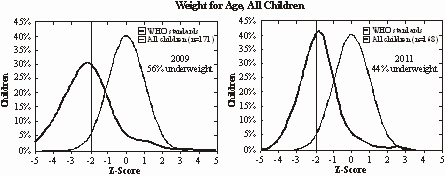
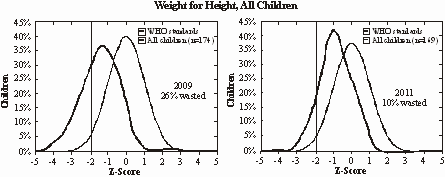
The graph below (Figure 2) compares the weight distribution of children attending the JSS crèches between two time periods. The comparison is done for the initial year of the programme (2009) and 2011 to observe the impact. The curves to the right show the dispersion of weight for age for a standard normal population. Among children attending the crèche (curves to the left), it is seen that in 2009 56% had a weight less than -2SD (standard deviation) (underweight) as compared to the normal population. In 2011, among the same group of children, only 44% had weights that were significantly lower (below -2SD) than normal. The results are much more pronounced when analyzing the degree of acute hunger, i.e. the proportion of children whose weight is too low for their height. There is a reduction in wasting among children attending phulwaris, from 26% in 2009 to 10% in 2011 (Graphs in Figure 3).
S
ome significant challenges in the running of the crèche progamme remain. An initial requirement was for parents to send their child with a handful of rice to the centre each day. Soon it was observed that the poorest families (the ones most in need of this facility) were not sending their children because they did not have the grain to spare. Discovery of this fact resulted in reversing the decision.Ensuring the supply chain of sattu, rice, dal, oil and eggs to so many crèches, scattered deep in the forests, is difficult, especially in the monsoon season when rivers and mountain streams are full. To avoid egg breakage in transit, boiled eggs are provided. The eggs are boiled at the sub-centre and then delivered to the crèches on motorbike or bicycle. Another challenge was to standardize protein-energy ratio in meals like khichdi, as different crèche workers used different amounts of rice and dal. This led to the decision of standardizing the measures for rice and dal for each child (a ratio of 5:1).
|
FIGURE 2 |
|
|
|
Graphs showing weight for age distribution of children going to JSS-run crèches in 2009, and the same cohort in crèches in 2011, compared to a standard normal population. In 2009, 56% of children were underweight, which reduced to 44% in 2011 in the cohort. |
|
FIGURE 3 |
|
|
|
Graphs showing proportion wasted (low weight for height) in 2009 and 2011, among children going to JSS-run crèches. In 2009, 26% of under-3s were wasted, while in 2011, this proportion had reduced to 10. |
T
his programme ensures that community members are involved in the process of improving their children’s nutrition levels. The woman or women most suitable and interested in taking care of young children (and whom the mothers trust) are selected by the community, though most are not literate. Record keeping requirements by the worker are therefore kept to the minimum. Where the health worker is also illiterate, a literate boy or girl in the village helps to maintain the attendance records and record the weights of children. A small honorarium is paid to the helper for record keeping. Stock records are updated by the supervisor during his periodic visits to deliver the eggs at the centre.A steep rise in the price of foodgrains and eggs over the past two years has emerged as a big challenge, requiring an extra effort to raise funds for the programme. Food costs, therefore, have increased from Rs 7/child/day to Rs 12.40/child/day. The wages for the phulwari worker have also been increased from the initial Rs 1000 per month to Rs 3300 per month. Consequently, despite all efforts, it is difficult to reach the poorest families who live in scattered single-hut dwellings far from the village or hamlet. Often, the children here are the most malnourished.
I
t is clear from the above that a crèche programme catering to young children in tribal /forest areas is necessary but faces many challenges. The biggest challenge is of skepticism towards the programme. Because of its expense, one might question the sustainability of this programme as it costs Rs 32 per day per child (Rs 12.40 food costs and Rs 19.60 non-food costs), when current ICDS allocation for 6-months – 3 year children is as low as Rs 4/child/day for food. However, savings in terms of reduced expenditure on treating illnesses in malnourished children far exceeds the cost of providing them supplementary food. Preventing malnutrition in young children is something one cannot afford not to do.Scaling up the programme will require more funds than a not-for-profit organization can access. In addition to the funds under the ICDS (whose budgetary outlay has been slashed by 50% by the present government), some possible additional sources of funds are from the Tribal Welfare Department, the Panchayati Raj Department, and funds under the National Rural Health Mission.
S
ome modification to the existing policies and programmes can also go a long way. For example, the MGNREGS has funds to pay the crèche worker but not for any facilities at the crèche – this could be remedied. Whether foodgrains can be allocated under the public distribution system (PDS) especially for young children in crèches per panchayat, should also be discussed. For all these possible changes to come about, inter-sectoral coordination is key. However, the unique selling point of the programme is its decentralized nature and active involvement of the community. Therefore, for the crèche initiative to be a success we should not compromise on these core principles.
*The author wishes to acknowledge inputs from Dr Yogesh Jain, Jan Swasthya Sahyog, Ganiyari, the dedicated work of the staff in the village programme of JSS, community members who send their children to the phulwaris, and the women who run them, for making this change possible.
Footnotes:
1. rchiips.org/nfhs.
2. D.L. Pelletier, et al., ‘A Methodology for Estimating the Contribution of Malnutrition to Child Mortality in Developing Countries’, Journal of Nutrition, 1994, 124: 2106-2022.
3. http://siteresources.worldbank.org/SOUTH ASIAEXT/Resources/223546-1147272 668285/IndiaUndernourishedChildren Final.pdf
4. www.mobilecreches.org