Malnutrition-free enclaves
ROHINI MUKHERJEE, J.C. REDDY and MANISH RAIKAR
A group of young parliamentarians from across political parties came together after the 2009 general elections to form the Citizens’ Alliance against Malnutrition as an advocacy platform for ending child malnutrition. Not only did India have the dubious distinction of having one of the highest rates of child malnutrition in the world, there was also a massive data deficit in this space. The Naandi Foundation through its engagement with the Citizens’ Alliance against Malnutrition took forward the work of child malnutrition on a priority basis.
Having co-opted some NGO leaders – including the CEO of Naandi Foundation – and senior journalists, the alliance decided to create high-decibel advocacy on the issue across the country so that it would attract attention of the highest in the land, and also get corporates and civil society to join in the war against child malnutrition. After four years of travelling the length and breadth of India, speaking to young mothers and anganwadi workers, exhorting local leaders and district level authorities to address the scourge of child malnutrition, this alliance of parliamentarians realized the need for more recent data on child nutrition to sharpen advocacy work on this subject. Naandi was given responsibility by the alliance to carry out a rapid survey of children’s nutrition status.
|
|
|
|
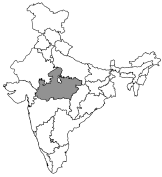
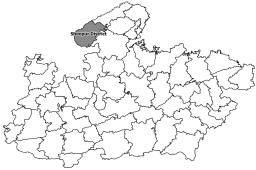
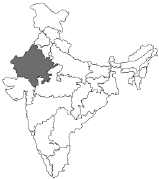
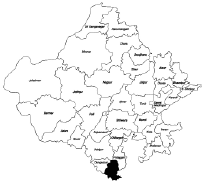
Map of India highlighting state of Madhya Pradesh (left); Highlighting Sheopur district of Madhya Pradesh (right). |
|
It was against this background that Naandi Foundation conducted the HUNGaMA (HUNGer and MAlnutrition) Survey 2011, which collected large-scale data on child nutrition. The findings of the survey confirmed everyone’s worst fears – in the 100 most challenged districts of the country, every second child was malnourished. The then prime minister, while releasing the report of the survey in January 2012, conveyed his anguish on behalf of the citizens of India by calling it a ‘national shame’.
|
|
|
|
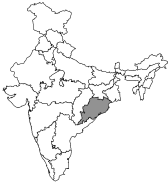
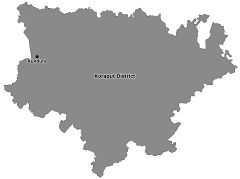
Map of India highlighting state of Odisha (left); Highlighting Koraput district of Odisha (right). |
|
The HUNGaMA Survey 2011, which captured the nutrition status of over 100,000 children and voices of 74,000 young mothers, created a hungama in India and outside for a number of reasons: (i) it was the first time that such large-scale data was collected by a non-government entity; (ii) it for the first time documented voices of young mothers; (iii) it was the first time since 2004 that district level data on child nutrition had been reported, and (iv) it demonstrated that large-scale information on child nutrition could be captured, analyzed and published rapidly (within a year).
T
he findings of the HUNGaMA Survey 2011 were a clear call for action – for governments, for civil society and the country as a whole. For Naandi, the logical next step was to start work on the ground in areas with a high burden of child malnutrition with the objective of demonstrating that a reduction is possible.
|
TABLE 1 Underweight Prevalence (-2SD) in Children 0-5 Years |
||||
|
State |
District |
HUNGaMA Survey 2011 |
Madhya Pradesh State Nutrition Survey 2010-11 Not applicable |
CAB* Survey 2014 |
|
Odisha |
Koraput |
54.48% |
53.6% |
|
|
Madhya Pradesh |
Sheopur |
This survey was not done here |
52.3% |
48.4% |
|
Rajasthan |
Banswara |
51.98% |
Not applicable |
51% |
|
* CAB - Clinical, Anthropometric and Bio-chemical Survey (2014) by Office of the Registrar General and Census Commissioner, India. |
||||
The findings of the HUNGaMA Survey and other research on the status of child nutrition in India pointed to the fact that the most crucial, foundation-laying period of a child’s life – the first thousand days – remain largely neglected in our country, and this is perhaps a key reason for the high prevalence of malnutrition. From the time a child is conceived in her mother’s womb to the time till she is two years (approximately thousand days), all the basic characteristics of the child – emotional, physical, nutritional – are shaped. There is little that can be done to alter these after the age of two. The primary focus of the entire set of interventions under HUNGaMA Next is, therefore, on the first thousand days.
W
ith funding from the Avantha Foundation, the HUNGaMA Next project was started by Naandi Foundation in mid-2012 in one block each of Koraput district in Odisha, Sheopur district in Madhya Pradesh and Banswara district in Rajasthan. The plan was to take three years (approximately 1000 days) to establish a successful template and show early results to prove its efficacy. The mandate was to locate all the work within the framework of the ICDS programme such that it should in some way strengthen some crucial aspects of the ICDS programme. After three years, having shown early successes, Naandi would work with the ICDS programme to integrate this template into their regular planning and implementation.More than half of the population is Scheduled Tribe as per Census 2011, in two of the three blocks selected for intervention – 52% in Kundura (Koraput district in Odisha) and 95% in Chhoti Sarvan (Banswara district in Rajasthan). Underweight prevalence among children 0-5 years in the three selected districts is also very high.
HUNGaMA Next approaches the problem of high prevalence of child malnutrition (underweight as per WHO Growth Standards) from the ‘First Thousand Days’ perspective. The project activities were designed with a conviction that if a child remains in the ‘green zone’ from the time of birth to two years, then more than half the battle is won. And, to achieve this, it is very important that the family (not just the mother) understand the child’s growth pattern and its determinants and the realistic remedial measures that need to be taken. This was translated on the ground through monthly home visits of children in the 0-24 months age group. During the home visits, the infant’s weight is measured and plotted on the Shishu Vikas Chart (a mini growth monitoring chart dedicated to the concerned child, installed in her home), which is then followed by a detailed discussion involving all family members on the nutritional status of the child with that month’s weight being the focal point. With these visits and discussions taking place month after month in the home of the child, all family members become familiar with the idea of tracking growth of the child and understanding what drives the growth and what drags it down.
|
|
|
|
Map of India highlighting the state of Rajasthan (left); Highlighting Banswara district of Rajasthan. |
|
The second major intervention in HUNGaMA Next is the monthly gathering of all mothers of infants in a village, at which different infant and young childcare and feeding activities are carried out. One month it is a demonstration of the correct position for breastfeeding of infants; another month is on how to avoid and take care of diarrhoea. Nutrition demonstrations have also been conducted at the community level. It is a celebration where every mother brings a small helping of food that she has cooked for her child that day and shares it with all. Through this activity, mothers are both encouraged to taste the food cooked and learn about different variety of meals prepared for the child. Also to understand the quality, frequency and nutritional component of the meals beneficial for their children during the celebration. In smaller groups, mothers of the children in similar life stages receive specific inputs – for example, they learn about correct positioning for breastfeeding; and when best to introduce semi-solid food.
D
igital technology has also been used in the project to make the above two interventions more efficient and data driven. A mobile phone application called HUNGaMA-Jatak which captures and calculates the real time weight data of the child and analyzes the trends is then used by the anganwadi workers (AWWs) and supervisors to take immediate action.Since early 2014, based on approval from the district level ICDS authorities in all three locations, the anganwadi worker accompanies the Naandi field staff on the monthly home visits. >From early 2015, the anganwadi worker herself has begun to take a lead in the discussions around growth monitoring of the child. Capacity building programmes have been conducted for the anganwadi workers by the Naandi team on different topics, such as the importance of early intervention within the first 1000 days, new WHO growth standards, importance of growth monitoring and diarrhea management. Small refresher sessions have also been organized during the ICDS sector level meetings, every month, as a follow up to the training.
P
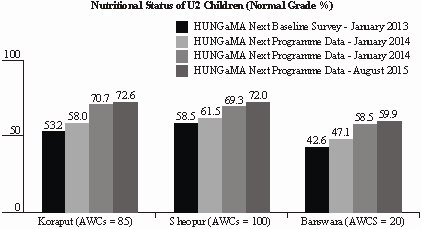
roject HUNGaMA Next is now in the third year of its interventions, with promising early results. As can be seen in Figure 1, there is a significant and steady increase in the number of children who are in the normal grade of nutrition, i.e. the green zone. Anganwadi centres in the Koraput block have seen the most improvement on nutrition status (weight-for-age) of under-two children that saw HUNGaMA Next interventions.
|
FIGURE 1 |
|
|
|
FIGURE 2 |
|
|
T
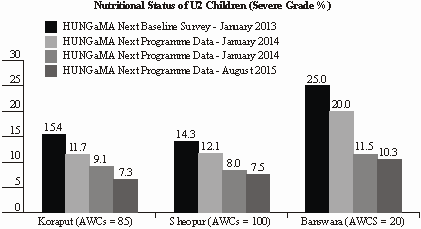
he steady reduction of children in the severe underweight grade in all three locations is shown in Figure 2. AWCs in Koraput showed the most improvement with lowest severe grade percentage in August 2015. Though the numbers are not the lowest for Banswara, in terms of quantum drop in severe grade in the last two years, its anganwadi centres have taken a significant stride forward. Given the baseline survey numbers, anganwadi centres in each block, and encouraging trends of HUNGaMA Next interventions, Banswara might need more attention in the future while interventions in Koraput and Sheopur will positively impact large number of children.
T
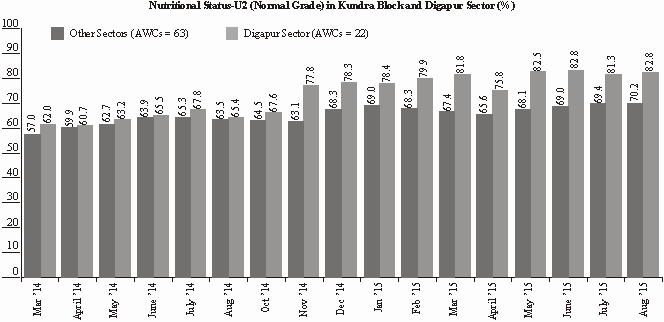
he good results of HUNGaMA Next interventions are illustrated in the Figure 3. The nutrition scenario for below 2-year children in Digapur sector of Kundura block in Koraput district is highlighted here. The anganwadi centres in this sector have very few children in moderate and severe grade of underweight, compared to the block as a whole. In Digapur sector, one sees close to 80% children in normal grade of nutrition.
|
FIGURE 3 |
|
|
I
n absolute numbers, it can be seen that only 26 out of 244 children in the 0-2 age group were in the moderate (yellow) category while only 16 fell in the severe underweight category in the month of August 2015. The results in Digapur sector gives an idea that it is indeed possible to take most of the children to the ‘green’ zone, and this achievement can be held steady for a sustained period of time. This would be a true realization of the project objective of creating a template that demonstrates not only reduction in child malnutrition but making it close to zero.|
TABLE 2 Nutrition Status by Anganwadi Centre (AWC) |
||||
|
Indicators |
Kundura |
Sheopur |
||
|
Jun’14 |
July’15 |
Jun’14 |
July’15 |
|
|
Total Number of Anganwadi Centres (Old AWCs) |
83 |
83 |
94 |
97 |
|
AWCs with Zero malnutrition |
4 |
10 |
6 |
8 |
|
AWCs with more than 90 percent Normal children |
7 |
14 |
8 |
15 |
|
AWCs with more than 85 percent Normal children |
11 |
21 |
10 |
21 |
|
AWCs with more than 75 percent Normal children |
26 |
42 |
21 |
49 |
|
AWCs with Zero Severe Underweight Children |
28 |
38 |
22 |
43 |
Similar to the improving trend seen in the Digapur sector, Table 2 shows that between June 2014 and July 2015, the overall prevalence of underweight among children below two in Kundura and Sheopur significantly decreased. In fact, the number of anganwadi centres with more than 90% children in normal grade doubled from 7 to 14 in Kundura and 8 to 15 in Sheopur.