The ‘Lagaan’ approach
SATISH B. AGNIHOTRI
FOR eliminating malnutrition, it is important to have healthy mothers, best indicated by the percentage of adolescent girls with body mass index of above 18. The mother’s weight gain during pregnancy is the next important parameter followed by the incidence of low birth weight (LBW) or the per cent of LBW babies. Once this is taken care of, the nutritional status of the child in the first six months is important, which is indicated with exclusive breast-feeding (like an opening batsman).
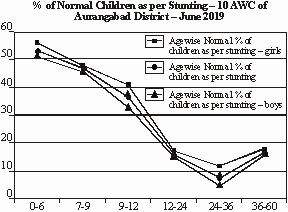
Usually, nutritional status of children in the 0-6 month age group in most cases is not a cause of concern; the trouble begins in the 7-36 month age group. Children in the age groups 7-12, 13-24 and 25-36 months usually show a decline in the nutritional status. There is a mild recovery in the 37-72 month age group, but it is not enough to compensate the decline in the 7-36 month age group. This trend is explicitly brought out by sample data from Maharashtra. As an illustration, Table 1 shows this trend for Aurangabad district.
This pattern can best be described as a ‘collapse of the middle order’ in cricketing parlance. As mentioned earlier, the batting performance of the team also depends on the condition of the outfield – immunization coverage, extent of open defecation and the like. To elaborate therefore, first, while chasing a given nutritional target, the performance in the ‘middle order’, i.e., 7-36, months is the most important component. For, if it gets right, then the chances of growth faltering in the 37-72 month age group are small. Intervention strategies for the 0-36 month age group would consist of (i) nearly complete coverage, (ii) 90% or above weighing efficiency, (iii) timely reporting of the nutritional status, (iv) preventive measures like de-worming and immunization calibrated remedial measures, (v) sanitation measures and, (vi) special attention and measures for specific groups. Third party audits and incentivizing good performance would also hasten the process of positive interventions having the desired impact.
Second, step one needs to be backed up by a better score by the openers, i.e. a better nutritional status in the 0-6 month age group, mainly contingent upon; (i) exclusive breast feeding, (ii) timely immunization, (iii) infection free environment, and (iv) special measures for the low birth weight (LBW).
|
TABLE 1 |
|
|
|
Illustration showing a downward trend when there is a nutritional dip in the 7-36 month age bracket. |
Third, a better opening partnership will also be enabled by fewer LBWs (leg before wicket). In other words, fewer incidents of low birth Weight make for a more enabling environment for the partnership to work well. For this, it is important to first map the LBW incidents and decide on areas that need interventions. Important elements for this are (i) adequate weight gain by the mother, (ii) antenatal check-ups in time, (iii) tetanus injections to mother, and (iv) identification of high-risk mothers. Fourth, if there is low incidence of BMI, i.e. below 18 among adolescent girls, and a higher age at the first pregnancy, it is equivalent to winning the toss. Last and most important, a good convergence and teamwork between departments and ministries can make the win sweet and easy.
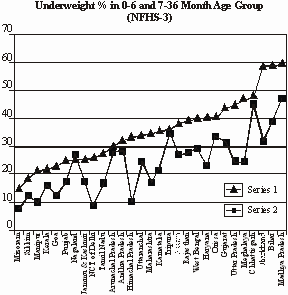
Table 2 below (darker shading reflecting the poorest nutritional indicators) based on the National Family Health Survey-3 (NFHS) parameters bring out the relevant issues for various states. It can be seen that our best bet is to get the 6-36 age group right, for even if the cohort in the -9 (period of conception) to +6 month age group performs well, a collapse of the middle order through infection, growth faltering and inappropriate feeding practices can bring all our efforts to a naught. On the other hand, even if the feeder source shows a poorer performance, getting rid of severe and moderate malnutrition may still be possible.
|
TABLE 2 Key Child Nutrition Indicators |
|||||||||
|
State |
Girls aged15-19 years with BMI<18.5% |
Low-birth weight (less than 2.5 kg) % |
Underweight (0-6 months) % (-2SD) |
Underweight (7-36 months (-2SD) |
IMR |
U5 MR |
Children under 5 underweight % (-2SD) |
Children under 5 wasted % (-2SD) |
Children under 5 stunted % (-2SD) |
|
India |
46.8 |
21.5 |
30.5 |
42.9 |
57.0 |
74.2 |
42.5 |
19.8 |
48.0 |
|
Mizoram |
14.7 |
7.6 |
7.9 |
15.6 |
34.1 |
52.9 |
19.9 |
9.0 |
39.8 |
|
Sikkim |
18.4 |
10.3 |
13.0 |
18.5 |
33.7 |
40.1 |
19.7 |
9.7 |
38.3 |
|
Manipur |
19.3 |
13.1 |
10.1 |
21.9 |
29.7 |
41.9 |
22.1 |
9.0 |
35.6 |
|
Kerala |
36.2 |
16.1 |
16.2 |
22.3 |
15.3 |
16.3 |
22.9 |
15.9 |
24.5 |
|
Goa |
48.1 |
22.2 |
12.6 |
22.6 |
15.3 |
20.3 |
25.0 |
14.1 |
25.6 |
|
Punjab |
39.2 |
27.7 |
17.5 |
25.3 |
41.7 |
52.0 |
24.9 |
9.2 |
36.7 |
|
NCT of Delhi |
32.2 |
26.5 |
26.9 |
25.7 |
39.8 |
46.7 |
26.1 |
15.4 |
42.2 |
|
J&K |
35.7 |
19.4 |
17.4 |
25.9 |
44.7 |
51.2 |
25.6 |
14.8 |
35.0 |
|
Nagaland |
24.6 |
11.0 |
8.7 |
26.3 |
38.3 |
64.7 |
25.2 |
13.3 |
38.8 |
|
Tamil Nadu |
47.9 |
17.2 |
17.4 |
27.7 |
30.4 |
35.5 |
29.8 |
22.2 |
30.9 |
|
Andhra Pradesh |
44.7 |
19.4 |
28.4 |
30.4 |
53.5 |
63.2 |
32.5 |
12.2 |
42.7 |
|
Uttaranchal |
42.9 |
24.5 |
28.4 |
32.5 |
41.9 |
56.8 |
38.0 |
18.8 |
44.4 |
|
Arunachal Pradesh |
20.6 |
14.1 |
10.2 |
33.6 |
60.7 |
87.7 |
32.5 |
15.3 |
43.3 |
|
Maharashtra |
52.1 |
22.1 |
24.6 |
34.4 |
37.5 |
46.7 |
37.0 |
16.5 |
46.3 |
|
Himachal Pradesh |
53.6 |
24.8 |
17.6 |
34.9 |
36.1 |
41.5 |
36.5 |
19.3 |
38.6 |
|
Karnataka |
51.4 |
18.7 |
21.5 |
35.3 |
43.2 |
54.7 |
37.6 |
17.6 |
43.7 |
|
Tripura |
41.9 |
27.3 |
35.5 |
36.2 |
51.5 |
59.2 |
39.6 |
24.6 |
35.7 |
|
Assam |
41.9 |
19.4 |
27.4 |
38.4 |
66.1 |
85.0 |
36.4 |
13.7 |
46.5 |
|
West Bengal |
49.6 |
22.9 |
27.9 |
39.7 |
48.0 |
59.6 |
38.7 |
16.9 |
44.6 |
|
Haryana |
45.8 |
32.7 |
29.3 |
40.6 |
41.7 |
52.3 |
39.6 |
19.1 |
45.7 |
|
Rajasthan |
48.7 |
27.5 |
23.1 |
40.9 |
65.3 |
85.4 |
39.9 |
20.4 |
43.7 |
|
Odisha |
44.9 |
20.6 |
33.5 |
41.0 |
64.7 |
90.6 |
40.7 |
19.5 |
45.0 |
|
Uttar Pradesh |
42.4 |
25.1 |
31.6 |
44.6 |
72.7 |
96.4 |
42.4 |
14.9 |
56.8 |
|
Gujara |
54.3 |
22.0 |
24.8 |
45.1 |
49.7 |
60.9 |
44.6 |
18.7 |
51.7 |
|
Meghalaya |
16.0 |
18.0 |
24.4 |
47.3 |
44.6 |
70.5 |
48.8 |
30.7 |
55.1 |
|
Chhattisgarh |
51.6 |
17.5 |
45.5 |
48.9 |
78.0 |
90.3 |
47.1 |
19.5 |
53.9 |
|
Jharkhand |
47.8 |
19.1 |
32.0 |
58.9 |
68.7 |
93.0 |
56.5 |
32.3 |
49.8 |
|
Bihar |
52.2 |
27.6 |
39.4 |
59.0 |
61.7 |
84.8 |
55.9 |
27.1 |
56.6 |
|
Madhya Pradesh |
47.4 |
23.4 |
47,2 |
60.2 |
69.3 |
94.2 |
60.0 |
35.50 |
50.0 |
The table clearly brings out that better nutritional status in 0-36 months has been achieved even where adolescent BMI and LBW are unsatisfactory, e.g. Goa, Punjab and Himachal. On the other hand, the advantage of satisfactory birth weight (Chhattisgarh, Jharkhand, Meghalaya and Gujarat) or better nutritional status in the 0-6 months (Rajasthan, Gujarat, Arunachal Pradesh) have been squandered away in the later months in some states. But nutritional status in the 7-36 months more or less exactly matches that in the 0-36 months. This is the ‘middle order’ that can be and should be strengthened. Even if it were possible to hold the level of nutritional status to that of the 0-6 month age group, half the battle would be won.
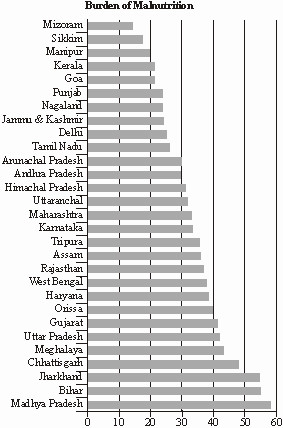
It is necessary to project the burden of malnutrition contributed by each state in absolute numbers. Improvement in nutritional status of children in a state like Uttar Pradesh, which contributes a larger proportion to the 0-36 month age group population, will have a much larger impact than a similar reduction in, say, a state like Manipur. This is not to distract from the importance of reducing malnutrition in Manipur, but to put the burden of the problem in the right perspective. It is, therefore, not enough to make a league table in terms of percent of undernourished children (Table 3) but the relative weight of the burden exerted by each state as in Table 4. While going through individual state numbers, it is clear that three states – Uttar Pradesh, Bihar and Madhya Pradesh – account for 46% of the malnourished children. Maharashtra, Rajasthan, West Bengal and Gujarat add another 24% while the four southern states contribute close to 12%.
|
TABLE 3 |
|
|
The target for states having better nutritional numbers should be ‘malnutrition free state’ by the end of a decided target period. It is also possible to locate the first ‘Ernakulam’ (the first district with 100% literacy) in the state of Kerala to fire one’s imagination. It could be Sikkim with less than 5000 children to attend to, or even Goa at the state level. In most states, it is possible to locate the leading district – closest to the destination of becoming a malnutrition free district.
|
TABLE 4 |
|
|
The above exercise needs to be carried out separately for 0-6 months and for the 7-36 months, given the major dip in nutritional status in the latter group. Likewise, a similar exercise is needed for the incidence of the LBW too. The NFHS data or the DLHS 4 (district level household survey) data can be used for this purpose. It will be helpful in communicating with states in a novel way indicating the nature and magnitude of the problem they need to address and the achievements they have made so far. Apart from fostering healthy competition among them, viable solutions could be deliberated on at various regional levels instead of the ‘one size fits all’ approach that central planning entails.
Along with this, it is also necessary to disaggregate various data at the NSSO (National Sample Survey Organization) platform. There are 88 NSSO regions and it is seen that for the infant mortality rate (IMR) data, there are striking variations within a state itself, across different regions. The four stereotypes: (i) low IMR rapid reduction, (ii) low IMR sluggish reduction/stagnation, (iii) high IMR – rapid reduction and (iv) high IMR – sluggish reduction would need four different approaches. The same would hold for malnutrition as well. It is important to bring the NFHS, DLHS and the NSSO data (and similarly other available data) together at the 88 NSSO region platforms for use in research, policy and action. This could be the urgent research agenda.
This approach will allow for making a beginning without having to wait for either the EFC (expenditure finance committee) budget or the rolling out of the Nutrition Mission. If the focus is on the malnourished child now is when we must begin. The concluding analogy: one needs to improve the overall run rate; moving very slowly towards achieving the target with a slow run rate may cost the lives of many children.