Improving drinking water services
SIDDHARTH V. PATEL
GUJARAT has diverse geological, hydrological, climatic and soil conditions, all of which impact on the status of surface and groundwater resources in the state. A large part of the state can be classified as a scarcity prone area. The distribution pattern of rainfall in the state ranges from over 2000 mm in the Dangs in South Gujarat to about 200 mm in Kutch. In the past 75 years, several years were declared to be drought years. Considering that the state faces frequent droughts, rendering water sources non-functional for a few months, several water resource management initiatives have been taken up, including artificial recharge, revival of traditional bodies and catchment protection (for diversion of excess run-off water to the sources).
|
Tribal district |
14 districts |
|
Taluka |
43 talukas |
|
Villages |
5210 |
|
Area |
31,642 sq kms |
|
Total population |
89.96 lakh |
|
Scheduled Tribe population |
74.81 lakh |
|
Tribal population (%) |
83.16% |
According to the Committee on World Food Security-2012, ‘Food and nutrition security exists when all people at all times have physical, social and economic access to food, which is safe and consumed in sufficient quantity and quality to meet their dietary needs and food preferences, and is supported by an environment of adequate sanitation, health services and care, allowing for a healthy and active life.’
|
|
|
|
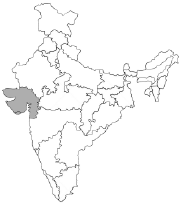
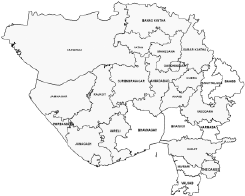
Map of India with Gujarat state highlighted (left); Map of Gujarat with its districts (right). |
|
The Scheduled Tribe population residing in Gujarat, according to the Census of India, 2011, was 74.81 lakh.
Most of them reside in far-flung scattered hamlets (falias) and a large number meet their livelihood needs by collecting and consuming forest produce and selling roots and non-timber products. A second source of income is agro products such as paddy, minor cereals and pulses. For water, their main sources are hand pumps, open wells and streams. The drudgery experienced by women and girl children while fetching and managing water is a big challenge in the tribal areas that not only adversely impact health, nutrition, hygiene, sanitation, but also education because of low school attendance. According to the Department for International Development (DFID), there is strong evidence that a lack of access to water significantly impacts women as they carry two-thirds of the burden for water collection. Significant time savings are associated with water, sanitation and hygiene (WASH) improvements – time that can be used to work in the fields to improve household food security. Reducing women’s time and energy in domestic chores is necessary to free up time for adequate childcare and nutrition.
P
roper water and sanitation facilities are crucial and remain a prerequisite for improving the quality of life of communities. Safe drinking water and proper sanitation and hygiene practices are critical for survival in all stages of an emergency, since people are particularly susceptible to illness and death from waterborne diseases. Women and children are specially at risk because not only do they comprise the largest percentage of the poorest of the poor, and are a majority in rural areas, urban slums and displaced populations, but in many cultures men get priority in the distribution of limited food and drinking water. Mainstreaming gender concerns in water and sanitation interventions is, therefore, important for fair and equitable distribution.The institutional set-up for unbundling Gujarat’s water supply and sewerage board through short-term hiring of human resources to ensuring safe water for health and happiness of people has been divided into three institutions. Gujarat Water Infrastructure Limited (GWIL) – a company registered under the Indian Companies Act (headed at state level by a chairman and managing director). GWIL is involved in bulk water transmission across the state to the specific water supply headworks being operated by the Gujarat Water Supply and Sewerage Board (GWSSB).
The GWSSB is constituted through an act of the Government of Gujarat (headed at state level by the chairman, head of department – member secretary), and is involved in the implementation and management of regional water supply schemes, filtration, chlorination and treatment for providing safe water and also the water distribution up to village/habitation level and water supply to towns.
W
ater and Sanitation Management Organization (WASMO), is an autonomous organization established in 2002-03, registered under Indian Society Act (headed at state level by a chief executive officer). WASMO was created as a special purpose vehicle (in 2003) under the water supply department primarily for taking forward the reform initiatives by enabling and empowering village level institutions (gram panchayats and village water and sanitation committees) through day-to-day hand-holding, technical guidance and ensuring sufficient financial resources for implementating the water supply schemes.The problems related to water scarcity are numerous and perennial – like the drying up of sources, recurrent droughts, repeated failure of tube wells, poor water quality and the need for re-drilling in water scarce areas specially in a drought prone summer, along with the drudgery of fetching from long distance, mass migration of human and cattle, water borne diseases and open defecation. These are the characteristics of Gujarat’s water scarcity.
When these characteristics are coupled with specific tribal problems, it increases the risk of water scarcity vis-a-vis food security. In WASMO’s experience, the tribal areas face many internal disputes relating to village communities, making it difficult to ensure the practice of community participation. In the absence of community participation, eliciting contributions from the community, an important step towards building ownership of resources, becomes difficult. There is a general apathy shown by pani samitis (water committees) towards completion of schemes. Moreover, post-programme support for maintaining the institutional framework of the paani samitis remains limited, which in turn aggravates the situation. In addition, accessibility remains a problem due to the difficult geographical locations in tribal areas.
I
n Gujarat, village habitations are typically organized on the basis of caste. In tribal areas, since habitations are far flung and dispersed, using the village as a unit for planning the water supply system often fails to meet the needs of all groups. Individual households/habitations thus need to be considered as the unit for coverage and multi-village schemes implemented for maximum coverage of affected habitations by strengthening of local sources and convergence with other departments.The primary goal of WASMO is to ensure safe drinking water supply to all tribal habitations. While extending this water supply to more than 25% tribal households within five years, the goal is to create a system for regular water quality monitoring and surveillance.
For this, putting in place a community managed water distribution system in every habitation for household connectivity has been the key strategy and intervention of WASMO. The community, at its discretion, decides the operation and management arrangements. To overcome the challenge of poor sustainability of WASH in the areas, a water tariff is levied. Since no technical system can run and function without maintenance of its components, with the help of government schemes, training of local youth to maintain the machinery has been built into the operations. It was soon realized that the overall operation and management of the water supply system could be affected if the requisite behavioural change doesn’t compliment it. This could become a bottleneck for the sustainability of the water system and adversely affect WASH of the tribal households.
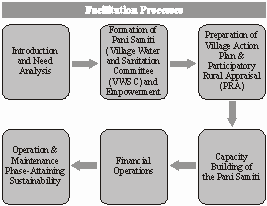
To strengthen sustainability, WASMO provides facilitation to the village community for planning, implementation, and operation and maintenance of a community managed intra-village water distribution system. Extensive social mobilization and information, education and communication (IEC) activities have been facilitated for creating awareness for safe water through water quality surveillance. The innovations created by WASMO have always given priority to utilizing the traditional knowledge base through partnerships with the community, NGOs, self-help groups and dairy cooperatives. This helps to bridge the existing knowledge gap among communities on water resource management, water conservation, safe drinking water, hygiene and sanitation issues, leading to the creation of a manpower pool along with a strong knowledge base on water and sanitation.
O
ne of the key interventions is improving drinking water security through a combination of local and bulk water supply systems and village level infrastructure. In addition, encouraging communities to adopt best practices on local water resource management, including rainwater harvesting along with empowering women and ensuring their participation in the whole process is a pivotal process in ensuring access to WASH services.
|
|
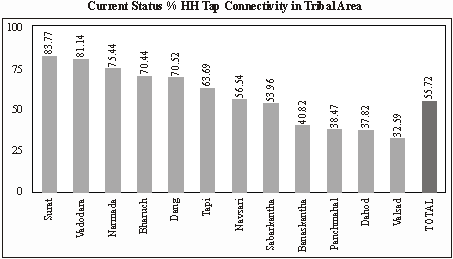
100% tap connectivity in tribal areas – Tribal communities live in scattered habitations that normally consist of 10-20 households. The scattered habitation along with undulating terrain makes the multi-village rural water supply scheme technically and financial unviable. Through a geo-hydrological study, every household has been connected with a piped water system. The directives from the chief secretary for ensuring 100% tap connectivity in tribal areas met with success, in part because of additions to the budget of the tribal department. A Rs 40 crore allocation was made to WASMO for being the primary facilitator of village water supply schemes through paani samitis in tribal areas; additionally, it was given a special grant in lieu of a waiver of community contributions in these areas.
In areas where the regional water schemes seemed less feasible for addressing the needs of the tribal population, besides the house-hold tap water systems, WASMO also established mini-pipe water schemes, rooftop rainwater harvesting structures (adopted in hilly terrain), individual schemes managed by the community, solar pumping machinery and SAMEEP hand pumps.
Information, Education and Communication (IEC) remains an effective tool for changing people’s perception. Hence continuous, intensive and focused awareness generation activities have been conducted at the community level for information dissemination and skill upgradation at various stages of implementation. At the village level, a variety of traditional folk forms popular in the region were used.
A
considerable emphasis has been laid on community involvement and ownership for addressing the sustainability of the water security, systems and processes. Efforts have been made to create alternative sources for better quantity and improved quality of water, either seasonally or perennially (piped water through the transfer of water from RWSS or local sources), collection and storage of rain water within accessible distance of its place of use, and water harvesting using various innovative techniques for recharging existing schemes. Sources have been developed on the basis of water budgeting in villages (100 litres per head).
|
|
In general, tribal communities and village level institutions lack the skill sets to carry out specialized functions which may be technical and/or managerial; hence capacity building on various aspects has been conducted by WASMO. The capacity building initiatives, specially on technical aspects and linkages with supply chain for procurement of material/manpower, have resulted in smoother operations and better management of the water supply systems. Ensuring that members of the village water and sanitation committees are elected through a village general assembly (gram sabha) is a good stepping-stone to the entire process.
A number of myths were broken during implementation – that communities are incapable of assuming responsibilities or that villagers are unwilling to contribute. Also that gram panchayats are unable to implement construction projects and maintain fiscal discipline and transparency. Through the programme, gram panchayats, after capacity building, fully contributed to establishing the systems and implementing schemes. Villagers willingly paid for the water supply system, understanding the reality that water is neither a free commodity and nor is it exclusively the responsibility of the government.
Rigorous awareness generation activities helped to resolve many conflicts while promoting the importance of water. The biggest myth to be broken related to the prejudice of a conservative society about women. Overall, the entire process has not only ensured the development of faith in the community cutting across caste/economic barriers, gender issues, but also in sustainability of water.