The Maharashtra nutrition mission
VANDANA KRISHNA
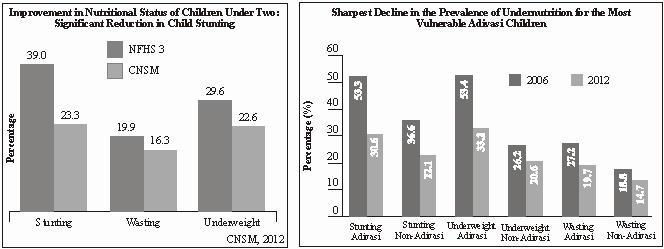
OVER the past decade Maharashtra has experienced a considerable decline in the overall level of early childhood stunting. In 2012, the Government of Maharashtra commissioned a state-wide survey to assess progress made since 2006 and identify priority areas for future policy and programme action. The survey was conducted by the International Institute for Population Sciences. Comparing data from the 2012 survey with data from the 2005-06 National Family Health Survey III reveals that the state experienced a decline in stunting in children under-2 from 39 per cent in 2006 to 23 per cent in 2012 (a 2.5 percentage point annual mean decline).
Maharashtra’s population is 112.4 million, out of which 9.35% (10.5 million) are Scheduled Tribes representing 47 tribes and living across 15 districts. Three of these tribes are identified as particularly vulnerable tribal groups (PVTGs) in seven districts, and they form 12.5% of the PVTG population in the country. An integrated tribal development programme (ITDP) is implemented in 24 locations (with >50% tribal population) along with a comprehensive Tribal Development Plan to cover 48 most vulnerable blocks.
|
|
|
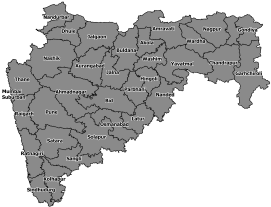
Map of Maharashtra. |
From the fiscal standpoint, considering unutilized funds and large year-end savings in tribal budgets, prima facie the Maharashtra government does not seem to have any scarcity of funds. But the hidden issues remain: skewed budget priorities (e.g. spending on large dams rather than on small irrigation projects), unrealistic ICDS targets aiming at ‘universal’ coverage with prescribed calorie and protein norms, thin and even spread of ICDS food budget and hence its ineffectiveness, unrealistic cost norms, supplier driven procurement, rigid structure of the scheme with a top down approach, no allowance for local innovation in food, the lack of budgets for specific initiatives such as community mobilization, training and IEC, high degree of centralization of decision making, no involvement of the local community or gram panchayats in running the anganwadi, and governance issues at various levels.
M
uch of the tribal budget goes towards infrastructure development such as road construction, but there is barely enough budget for the maintenance of those assets, or for human development. The issue of undernutrition is primarily viewed as a problem of hunger and food distribution (and not as a problem of improper feeding practices, superstition and lack of awareness), and continues to be dealt with through supplementary feeding and subsidized distribution systems. There is also no effort to link nutrition to improved agriculture, land development, water conservation, hygiene and sanitation or cropping patterns.There exist schemes for providing food security that started off with good intentions, but which ended up providing negative incentives. The Khawati Karz Yojana is one such scheme with inbuilt negative incentives: double food rations given to the family of a malnourished child. Unless a family has a malnourished (severely underweight) child, it does not get the benefit of double rations. The lure of this incentive is such that poor tribal families are willing to keep their child underweight for fear of losing these rations.
The overall nutrition strategy adopts a top-down welfare approach rather than an empowerment one. The government is ‘the giver’ and the tribal population the ‘beneficiary’. There is thus no empowerment of the community and a ‘dependency syndrome’ has become entrenched in the tribal mind-set. Tribals’ entitlements mostly remain on paper due to various factors such as corruption, vacancies, delays in release of funds, lack of ID proof or land title, among others.
T
here are other major gaps in addressing the issue of food and nutrition security. Current cropping patterns and a neglect of water harvesting and irrigation is such that tribal people are widely dependent on one crop per year though it is possible to take two or even three crops in a year, which would lead to better dietary diversity. There is no focus on ensuring availability of milk/eggs/animal protein/local nutritious foods for children and pregnant or nursing mothers. Every summer there is an absolute scarcity of green leafy vegetables in the tribal areas but there is no attempt to promote the cultivation of vegetables or millets.When it comes to preventive health strategies, not enough attention is paid to counselling for nutrition or related issues such as early and frequent pregnancies. Most tribal women are already underweight and anaemic; frequent pregnancies further lead to the vicious cycle of malnutrition. It is not uncommon to see a pregnant woman nursing two infants simultaneously, or mother-in-law and daughter-in-law both nursing infants. Contraceptives like oral pills may not be available with ASHA workers but even if they were, they are not authorized to give it without a medical prescription.
Maharashtra has around 1100 Ashram schools (residential schools which impart education up to the secondary level to tribal children) but they do not provide relevant life skills training to adolescents. The language of instruction is Marathi whereas tribal children are brought up on their own local dialect. There is almost no integration with mainstream schooling and their teachers form a separate cadre from that of the education department.
T
he ICDS is the only scheme, which is broadly seen as being responsible for addressing malnutrition among tribal children. But ICDS functionaries are often too preoccupied with routine ICDS work such as preschool education, filling registers and reports and preparing food bills. Most anganwadi services focus on the three to six years age group. There is now ample evidence to show that in order to check malnutrition, particularly chronic hunger and stunting, the focus should be on the ‘-9 to 24 months’ period. But the ICDS is not designed for this objective.The above scenario points to the need to have a distinct Nutrition Mission that would focus exclusively on the issue of reducing the incidence of malnutrition. Also, the ICDS is constrained by a limited supplementary nutrition budget (Rs 5 per child per day), which tends to create an unrealistic dependence on this meagre amount to feed the child, ignoring the more important role of the family and the caregivers. On an average, if a child needs 1200 calories per day, the anganwadi provides only 400 calories; 800 calories must come from home.
A Nutrition Mission can bring the focus back to the role of the family. In the routine work of ICDS, counselling of mothers in proper child caring and feeding practices gets neglected. Given the current priorities of ICDS, at present this seems impracticable.
Maharashtra has been addressing the malnutrition question for some time in a concerted manner through the Nutrition Mission. A senior dedicated IAS officer heads the mission along with a committed team of officers on deputation or on contract. The mission team constantly conducts ‘fact finding’ field visits, that are complemented by district and block level meetings. Close interaction with and guidance given to field functionaries has motivated them to take proactive steps within their area of control. The focus has been on improving coverage of ICDS, weighing and grading of all children in front of the community, increasing awareness about growth monitoring and IYCN, designing better MIS and tracking systems, designing and implementing the VCDC scheme, and community mobilization. Regular training programmes on child care and nutrition are conducted through Unicef funding. The ‘10 essential nutrition interventions’ have been popularized.
T
he mission developed the Village Child Development Centre (VCDC) scheme which focuses on community based management of SAM and MAM (severe and moderate wasting). This scheme was funded by NRHM. A 3-tier model of VCDCs, CTCs (Child Treatment Centres) and NRCs (Nutrition Rehabilitation Centres) was developed for community and facility based management of severely malnourished children. For identification of SAM and MAM children weight-to-height measurements are taken in addition to MUAC (mid-upper arm circumference). Thousands of SAM and MAM children were identified and treated in 30-day camps under VCDC using nutrient dense local recipes. This model contributed to substantial reduction in wasting and child mortality. NRHM contributed about Rs 8 to 18 crore annually towards VCDCs till about 2014. Anganwadi workers were responsible for screening malnourished children and treating them in VCDCs.
|
|
A number of other local initiatives flourished through community participation and the commitment of individual officers and workers. These include home based VCDC for home based management of wasted and underweight children, developing ISO or ‘model anganwadis’, ‘muthhi bhar dhanya’ or donation of foodgrains by the village community, celebrating ‘half yearly’ birthdays, ‘maher’ or feeding pregnant women through community contributions.
T
he Nutrition Survey (CNSM-2012) conducted by the Indian Institute for Population Sciences (IIPS), Mumbai, showed encouraging improvements in the nutritional status of children in Maharashtra, particularly in the incidence of stunting in children below two years of age.Large scale Infant and Young Child Nutrition (IYCN) training is one of the key factors that led to substantial reduction in stunting, which occurs due to chronic undernutrition.
Major improvements are also visible in maternal health through better MCTS (maternal and child tracking system), improved ANC care, higher institutional deliveries, implementation of Janani and Shishu Suraksha Karyakram, free transport and food, among others.
T
he future action plan includes implementation of the new APJ Abdul Kalam Amrut Aahaar Yojana in tribal areas to provide an additional wholesome meal to pregnant and lactating women daily during the last trimester of pregnancy and three months of lactation; a proposal for setting up of a Tribal Mission for convergence in the areas of health, nutrition, agriculture, WASH (water, sanitation and hygiene), education and so on; interventions at Ashram schools by training adolescents in life skills through the Nutrition Mission; implementing VCDC through ICDS by providing nutrient dense food to acutely malnourished children, capacity building and IEC in nutrition in 125 low HDI blocks through the state ‘Human Development Commissioner’ office, developing kitchen gardens with technical support from Reliance Foundation in selected tribal blocks; implementing a state wide nutrition campaign, forging partnerships under CSR, providing eggs/ bananas to children in anganwadis, and training panchayati raj members and SHGs in nutrition.