More questions than answers
DAVID ABRAHAM
WHAT criteria can we use to evaluate fashion in 2016? And specifically, how does one critique the work of the Indian fashion designer today? Do we subject it to the established fashion constructs evolved over the years in the West? Can we ignore our own history of clothing? How do we interpret the term ‘silhouette’ in relation to draped lengths of unstitched fabric? Should India’s climate, its unique culture and religious practices, generate an independent fashion construct for the Indian designer? For instance, through what lens can we evaluate an anarkali, a lehenga or a salwar kameez in the context of fashion and trends?
In India, fashion is now one of the most visible signs of social change. Fashion is identity. In the rapid social churn today, it can also be a disguise. Our choices in clothing communicate status, bank balance and aspiration. The young Indian hanging out in the neighbourhood mall demonstrates evolving interpretations of modernity in urban India. Traditional Indian clothing is also being assessed through the lens of modernity as the wearing of traditional Indian classics is reinterpreted and finds new meanings. One case in point being khadi, so fraught with symbolism earlier, is now also viewed through the prism of ‘fashion’, making it much more than just a metaphor for India’s freedom movement and the political class.
F
or the average consumer, the retail explosion in urban India has provided exciting clothing alternatives at all price points. New employment opportunities and the large-scale movement of the young to urban environments have created armies of suited professionals manning offices, aircraft and hotels at ease with multiple clothing identities. This is the playing field where India’s fashion story is unfolding. Fashion choices are influenced by popular and social media, as well as by trends set in Bollywood and the local mall. Here the unique mix of a mini dress, a baseball cap and a salwar kameez rub against each other, with the same consumer switching and often juxtaposing contrary identities with ease. Western trends are accepted and embraced, and then reinterpreted to avoid conflict with local cultural mores. A short dress can become a kurta when worn with leggings. Identity can also be subverted with a keen understanding and manipulation of fashion codes which allows a small town resident to reinvent herself as a big city sophisticate.When the Government of India set the ball rolling in the ’80s with the establishment of the first fashion design institute, using an education template based on New York’s Fashion Institute of Technology, we saw the emergence of India’s first formally trained fashion professionals. The rise of this new profession created a new discourse on clothing. Within the newly imported discipline, the initial parameters for evaluation were based on western fashion and clothing history and practice. This sometimes led to questions of authenticity and confusion over appropriateness and relevance.
French terms such as haute couture and prêt-à-porter with their accompanying semantics were unquestioningly adopted, despite the fact that much of high-end Indian clothing was traditionally made to order using elaborate hand skills (i.e., couture) and mass-manufactured ready-to-wear clothing was a relatively recent phenomenon.
The Indian fashion calendar, to fall in line with the international trade structure, organized itself into ‘seasons’ – spring/summer and autumn/winter. Spring and autumn are seasons unfamiliar to much of a country where the monsoon is often the most important annual seasonal event. Later, fashion seasons followed in the West, such as ‘holiday’ and ‘resort’, were also added to the vocabulary, both largely meaningless in the Indian context where religious festivals and vacations are unrelated to the western calendar.
T
he opening up of the economy led to international media houses launching leading fashion magazines in India. Based on templates developed for western fashion markets, they follow the international calendar of seasonal fashion as well as trend directions based on western constructs. Their editorial voice is split between servicing the demands of the western fashion luxury and cosmetics brands that largely contribute to their advertising budgets, and in trying to articulate an independent understanding that can reflect the extraordinary changes in contemporary popular culture. The Indian designer industry, a poor relative, cannot afford to spend enough advertising rupees to influence a more critical engagement with Indian fashion. Dialogues between western and Indian fashion constructs can sometimes be incoherent when editorial coverage attempts to reconcile what in essence are opposing viewpoints.The western fashion media itself, due to the marginal role Indian fashion plays in the international marketplace, as well as sheer economics, has shown an absence of critical engagement with Indian fashion, though this is slowly changing with a few Indian designers beginning to increase their engagement with western markets. With an inadequate understanding of the cultural specifics, however, design is often evaluated through the prism of exotic otherness.
Subjected to contrary and sometimes contradictory points of view, the Indian designer sometimes suffers from an identity crisis when clothing that is designed for the Indian market is sought to be evaluated against western fashion criteria.
T
raditional clothing and bridal wear form the largest market for the Indian designer. The most powerful lobby in the Indian fashion industry, the bridal industry, supports some of India’s most important designers and has grown exponentially. Extravagant traditional and modern clothing for a trousseaux is designed to meet the requirements of specific religious and social rituals, which has created a strong design identity unfettered by aesthetic compromise. Though ideas can also be freely borrowed, this precise focus on very specific requirements creates a coherent design narrative.|
|
Traditionally before the advent of digital media and live streaming, fashion trends were predicted much in advance in collusion with the retailer, the media, and the manufacturer. Manufacturers have been the most heavily invested in the creation of seasonal fashion calendars in order to plan production cycles over the long term. While this arrangement still uneasily holds, the cycles keep shortening as the digital revolution continues to subvert traditional structures. The democratization of tastemakers; local, cultural and religious influences; and the emergence of decentralized digital communities are all creating new demands on identity. |
|
|
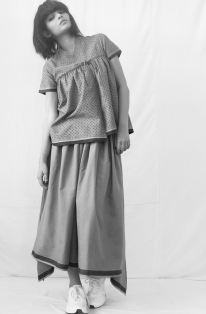
Dhoti Collection SS15. |
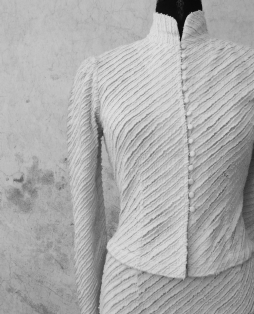
Khadi Collection. |
|
|
|
|
|
|
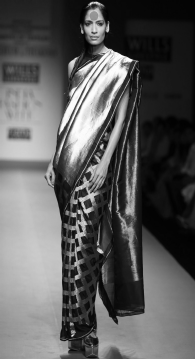
Autumn Winter 2013-14, Brocade Sari from Benaras Exclusive for A&T. |
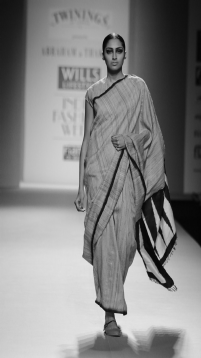
AW14-15 AIFW, Tussar Ikat Sari. |
Kurta, Salwar and Dupatta Look, AW15. |
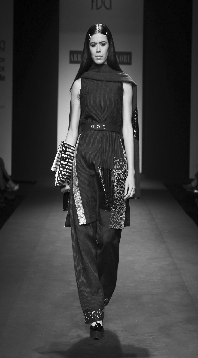
Now more than two decades old, the Indian fashion narrative is attempting to resolve some of the dichotomies it faces. A new generation of designers is beginning to communicate alternative narratives at the Indian fashion week. Though still largely trapped within a seasonal structure that mimics the western calendar, the fashion weeks have provided a platform for a fresh design aesthetic which is searching for relevant answers to some of the questions facing Indian fashion. A new generation has moved away from bridal wear and is attempting to establish a modern Indian fashion aesthetic for everyday clothing situated squarely in a retail reality that spans a tailor in Lajpat Nagar and H&M. The sari is one example of this reinvention. Still worn widely across the country, it lost its place within the modern ‘fashion’ lexicon, but has now been championed repeatedly on the fashion catwalk and found a new relevance and a new customer with innovative treatments. Each season, on the runway, traditional apparel such as kurtas, lehengas, anarkalis and their variants is redesigned and re-proportioned with inventiveness in differing presentations. Many of these ideas and influences spill over to high street shops, acknowledging the important trickle-down effect of high fashion. These fresh, evolving definitions of fashion enrich its vocabulary.
S
imultaneously, on the other hand, the successful inroads made by western high street fashion brands has also brought a mix of international fashion trends into the conversation. Rather than dilute, these trends enrich the vocabulary as new clothing styles are adopted and re-purposed to suit the Indian urban reality. As styles are adopted a new backstory emerges and connotations change, resulting in a new relevance. And as contexts change, we need to question notions of authenticity. Fashions of the ’60s, such as bell-bottoms, tie-dye and the mini for example, have different connotations in India. While socialist India in the ’60s did not in any way reflect the lifestyle revolutions of the West, the Hindi films of the ’60s provided an alternative set of references to a young consumer. Just as the salwar kameez may partly owe its origins to the introduction of Central Asian apparel to India centuries ago, new ideas and concepts in fashion can only enrich the existing conversation.The fashion world today is in a state of uncertainty with the slow collapse of established hierarchies due to the Internet, e-commerce and social media. This is as good a time as any to prompt further discussion and debate, and to examine whether a more regional, or culturally specific, fashion construct is relevant. As the hierarchies of manufacture, retail and marketing begin to collapse due to the digital revolution, fashion communication is no longer dictated by monolithic lobbies and now lies in the hands of anyone with a point of view and a smartphone. Images travel instantaneously and trends emerge from streets around the world. E-commerce also encourages consumption freed of geography. Consumer wants are evolving rapidly. Decentralization creates trends that are born on street corners and the corridors of malls, which have more influence than the fashion catwalks around the world.
S
o to conclude, more questions. Going ahead, do we see fashion becoming more culture and region specific? More localized and more decentralized, even as it is increasingly plugged into the digital universe? Can arguments on merit still be confined to old tropes of East versus West? Should we create new definitions and constructs? And can we accept that, when power lies in a smartphone image, the rules will keep changing? How can we continue our engagement and dependence on a western-centric fashion universe, looking for validity, even as the West grows increasingly dependent on the purchasing power of the newly developing markets in Asia and the Far East and starts to cater to regional trends?