Industry malfunction
DEVAIAH BOPANNA
Prologue: I am to the Indian fashion industry what Indian fashion industry is to Indians – an outsider, here to offer my ten cents on the Indian fashion industry as an average Indian. And like most average Indians, I have strong opinions and impractical solutions for all problems. So, Indian fashion industry, here goes: You guys have big egos, do cocaine backstage, fornicate in groups of three or more and are mostly homosexuals. Chill. That’s what Madhur Bhandarkar thinks about you. Not me, thankfully. However, with this article, I might make more sense than Bhandarkar. And that could sting a bit. Take what I say with a pinch of salt, dash of lime and a few shots of tequila.
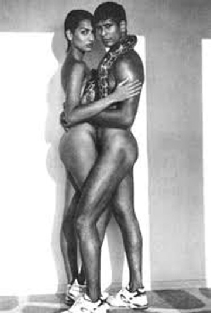
‘When one person is badly dressed, it’s a fashion faux pas. But when everybody decides to dress funny, it’s the trend of the season’ – the ’90s. I grew up in the ’90s, when it was cool to pair ones formal trousers and sports shoes with a shirt that looked like a rainbow had thrown up all over it. Hairy chests swelled with unnecessary pride. Unruly moustaches were in and Govinda was a heart throb. Yes, we had hit rock bottom. It’s not surprising then that the coolest thing to have come out of the ’90s was Madhu Sapre and Milind Soman’s ‘controversial’ ad for Tuff shoes. It was all sorts of awesome only because they were butt-naked, and not clad in the so-called coolness that was the ’90s.
India has come a long way since the ‘what the f... were you thinking’ days of the ’90s. We, the FTV (or MTV, depending on the child lock settings of your TV sets) generation, were the first brand conscious generation to drive the change in this country. We got India out of the torrid ’90s, put Govinda and yellow trousers out of work, and kept a tab on the global trends. Also, we were the first (and thankfully, the last) generation to pronounce lingerie as ling-arre.
But, sadly, the Indian fashion industry did not have any role to play in India finding its fashion sense post the ’90s. Markets opened up. The Internet sauntered in. Gigantic global brands made their forays into India and before we knew it, boom! They had our attention, loyalties and wallets. It’s been close to 20 years now, and nothing has changed.
W
ell, as an outsider, I just can’t comprehend the hype surrounding the Indian fashion industry. Think about it. For all the disproportionate attention and coverage you receive, you haven’t produced a single home-grown fashion label that has captured the imagination of the urban Indian like the way global brands have and not a single label out of India that has gone on to become a massive global player in the world of fashion.|
|
|
Milind Soman Tuff shoes ad. |
|
|
|
|
Controversial Baby ad UCB. |
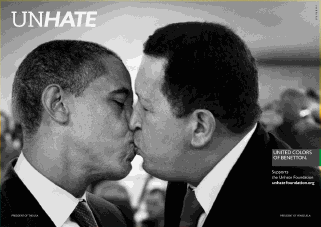
UCB unHate ad. |
After all these years, you have not been able to give the Levi’s, Zaras, Benettons and the FCUKs of the world, a run for their money. Sure enough, you have brands, but even they pretend like they’re not yours. Allen Solly. Louis Philippe. Van Heusen. John Players. Peter England. You are the very opposite of Brad Pitt and Angelina Jolie – non-white folks trying to adopt and bring up white babies.
Y
ou must be the most celebrated, yet least deserving, bunch of people in the creative arts industry in India. Every other creative industry in India has produced a global superstar. Art has M.F. Husain. Music has Rehman. Cinema has Satyajit Ray, Mira Nair, Shekhar Kapur and Priyanka Chopra. Literature has Tagore, Arundhati Roy and Jhumpa Lahiri, to name a few, who transcended boundaries and cultures with their work in a language that is not native to them. Of course, you can always argue that Rushdie got famous because of the fatwa. So then, get yourself a fatwa. How difficult is it?
C
ontrary to popular perception, Rushdie had to slog for it; he needed to painfully string together a bunch of mundane words to form explosive enough sentences in order to piss off a cleric. While you have blasphemy served to you on a platter: Women, skin and no hijab. Enough for ten fatwas to catapult you into global superstardom. Youngsters the world over love rebellious, edgy fashion brands. Ask Benetton, if you want. They manufacture more controversies than clothes.Agreed, it’s not always about the work. Branding and marketing go a long way in making your creations desirable. But the field of marketing is not alien to you, either. You have marketed your industry perfectly; now if only you could have marketed your brands like that. The fashion weeks could have served as the perfect platform for you to create and market that elusive, exciting fashion label to the world. Instead you turned your fashion weeks into surrogate advertising fests for Blender’s Pride and Wills. Come on, the most famous thing to come out of your fraternity after a year’s work can’t be a freaking calendar for a beer company.
|
|
|
Govinda. |
If that wasn’t enough, you just let Bollywood hijack your fashion weeks. Who walked the ramp made more news than what set the ramp on fire. You allowed yourself to be usually represented by some has-been actress wearing a skintight dress, holding her breath in, struggling to balance herself in six-inch heels while broadcasting to the world, ‘Fashion is all about wearing what’s comfortable.’
P
eople who consume fashion are an illogical lot. If the cabbie doesn’t return their change, a hashtag #Uber Drivers Are Cheats will begin to trend. But the same folks will gladly cough up 4,000 bucks for a pair of jeans and flaunt the damn price tag with panache. Some of them even wake up at the crack of dawn to go to a Jack & Jones outlet during a sale, fight their way into the store to pay vulgar amounts of money for a tee that says ‘Jack & Jones’ on it. In fact, if they don’t overpay for their clothes, they feel miserable about their lives. They will be judged by friends and their self-confidence will take a beating. It’s weird. But therein lies the greatest business opportunity of all time – the only set of customers who is thrilled to bits to pay inflated amounts for products that don’t cost much. Really, it can’t get more inviting than that. The only thing standing between you and a big label is the insecurity of human beings. You’re home if you make them feel like crap. Still, it’s not incentive enough for you to create a Superdry or Calvin Klein out of India.I can’t for the life of me imagine what’s stopping you from putting yourself on the world map. We are one of the worldwide hubs for textile manufacturing. Tommy, Levi’s, GAP and plenty others are mass-produced in India. We have the infrastructure, we have the labour, but we don’t have a damn label. So then, is it the funds? You are part of the start-up generation. Venture capitalists are on the prowl for the next global brand out of India. Every Tom, Dick, Harry and Rahul Yadav gets funded these days. If you have an idea, people will throw a million dollars at you. And if you don’t, they’ll throw a hundred million dollars. It’s that easy. You are blessed with the easiest elevator pitch. Clothes. Everyone wears them. And everyone wants to overpay for them. In fact, it’s the only place venture capitalists look at people the way people otherwise look at venture capitalists: dumb people burning up money on stupid things.
I
am sorry to say this, but for an industry that prides itself on making people look good, you come out looking quite stupid. So, it’s time to introspect. Time to pull out and look at the bigger picture. But for you to pull out, you have to burst the very bubble you’re living in. You need to give yourself a dressing down before you start dressing up others.