Exhibiting fashion: India in London
DIVIA PATEL
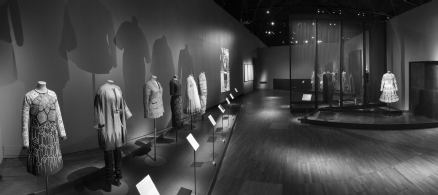
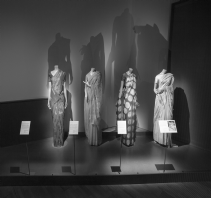
LONDON’S Victoria and Albert Museum showcased a display of contemporary fashion from India from 3 October 2015 to 10 January 2016. It was a major component of ‘The Fabric of India’ exhibition, which celebrated handmade textiles spanning the third century CE to the present day, welcoming over 1,10,000 visitors. With responsibility for curating the story of Indian fabric from the time of swadeshi (the Freedom Struggle) to the present, I spent time between 2010-2015 with a range of textile experts, designers, journalists, educators and those in the field, and it is from this vantage point that I give these observations.
As a curator I had a duty to grapple with the very basic but fundamental questions the public would ask and provide them with informed, well researched responses. With regards to contemporary fashion, these were, of course, the ones for which there is no simple answer. What is Indian fashion? What makes it unique? Why should the world be interested in it? As with all V&A exhibitions, there is a rigorous process behind developing the narrative, which involves many stakeholders beyond the curators themselves. From initial discussions it was clear that from the outsider’s point of view, Indian fashion was perceived as being confusing, too patterned and with excessive ornamentation; very ethnic, and too much of the ‘same-same’. I was determined to show that these perceptions were somewhat narrow and that Indian fashion was a force of great creativity. I wished to highlight the enormous skill and knowledge base India has in its designers and artisans, whilst remaining within the context of the ‘handmade’ criteria of the exhibition.
|
|
|
|
© V&A Museum. |
© V&A Museum. |
What I found was a vast body of designers currently practising, ranging from the established to the emergent, but with very few who could be identified as having a signature style or aesthetic. Those that have stood the test of time (which from my perspective was five years or more) include Abraham and Thakore, Abu Jani, Sandeep Khosla, Rajesh Pratap Singh, Manish Arora, Sabyasachi Mukherjee, Sanjay Garg, Aneeth Arora and Rahul Mishra. While they are not alone, there are not many more designers to add to that list. I did wonder why there wasn’t more experimentation and originality.
Then I read a great article by Aneeth Arora in which she responded to the criticism and questioning of why her clothes were ‘so expensive’. She talked the reader through the steps involved in creating pieces that take time and investment; the need for research and experimentation in materials and techniques; the need to pay fair wages and to be responsible for the artisans and workers who help make the brand – all factors that the consumer is unaware of or takes for granted.
1 The gap between expected and true cost, as well as the values associated with high quality products, is little understood, the concept and indeed the need for designers to spend time researching and developing is never mentioned. It is, however, a message that should be better conveyed to the consumer, leading in turn to a better appreciation of the craftsman’s skills of weaving, dyeing, printing, embellishment, pattern-cutting and tailoring. India has a Ministry of Textiles and Fashion Design Council which could do much to promote this in a more innovative and sustained way.The wedding and social occasion industry is undeniably a major story in the Indian fashion narrative, being the most visible and the most lucrative, firmly associated with many established designers. There seems to be an unseemly competition in outdoing each other in grand statements of ornateness and expense. I am reminded of a comment made by Ritu Beri and quoted in Hindol Sengupta’s book Ramp Up: The Business of Indian Fashion, ‘If you put lehengas made by all Indian designers on one rack and remove the labels you won’t be able to tell one from the other.’
2 I did not want this to become the marker by which Indian fashion is known around the world and, therefore, included just one wedding outfit in the exhibition. Designed by Sabyasachi Mukherjee, it was an example of incredible craftsmanship and innovative juxtapositions of techniques and fabrics. Not only was this a signature piece by the designer, but it also introduced the topic of the copy market.
|
|
|
|
|
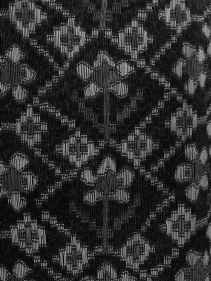
Detail from a skirt by Rimzim Dadu. |
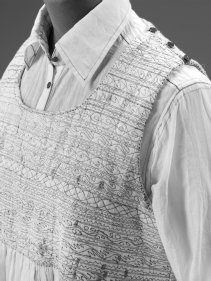
Detail from an outfit by Pero. |
Detail from outfit by Rahul Mishra. |
That wedding outfits by a top name designer are copied and available in Delhi’s Chandni Chowk or Kinari Market is a well known reality; however copying is not unique to India, it is an economic process the world over. Seeing similar designs often in highly distorted versions made in cheaper fabrics, poorly finished and badly tailored, available to a section of the population that is never going to be able to afford ‘the real thing’, is not as shocking as seeing it happen at the higher end of the market.
A
t a wedding fair in London featuring designers from India, I saw versions of the Sabyasachi chintz look being sold by other designers who had clearly ‘borrowed’ that aesthetic, and these were selling at not-so-cheap prices. The Pero style, with soft cottons and loose fitting silhouettes, is to be seen in shops across India and while these unstructured silhouettes are not owned by Aneeth Arora’s label, the use of Jamdani borders in a particular way or different coloured seaming and buttonhole treatment or a particular layering of fabrics is clearly ‘borrowed’. This type of ‘borrowing’ makes Indian fashion seem ‘same-same’ and confusing rather than unique and interesting.
I
was searching for an alternative model to the fashion cycle and I questioned whether India needed to follow the pattern of seasonal shows that are so relentless for all concerned from the designer to the artisans and the others along the chain. There seemed to be a struggle on all sides about meeting tight deadlines for handwoven, natural-dyed, printed, embellished fabrics and yet nowhere was I getting a sense that any of this was making a viable business. Revisiting some old texts on artisan-designer relationships I was reminded of an article by Meeta and Sunny on their work with the block-printers of Kaladera, Rajasthan, and though this wasn’t high fashion, it was an example of small-scale sustainability.3 Without pushing the Gandhian idea of small-scale production as a full and workable alternative, I wonder if there is something within that concept that can offer a better, more humane way forward, perhaps feeding into the slow-fashion movement and demonstrating that India can lead the way?It was imperative for the exhibition to include a section on the continued impact that India makes on global fashion and, in keeping with the handmade theme, I choose to explore the story of how high-end designers in the West have their embroidery done in India. It was by far the section that took the longest to secure pieces for display, because though it is a well known process the majority of the industry is complicit in keeping it out of public knowledge. Having spoken to numerous suppliers of embroideries, I had first-hand evidence of the practice. However, few western brands are willing to admit to it in the open for fear it will upset their brand image. Embroideries supplied as piece goods are worked into garments elsewhere which cuts out the need to include ‘Made in India’ on the label. Perhaps India should call for a label that says ‘Embellished in India’ or ‘Crafted in India’.
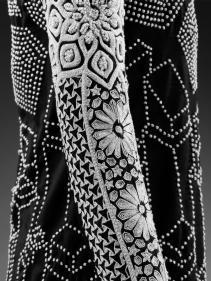
The penultimate section of the exhibition explored the work of Indian designers who are experimenting with new textures, a fresh aesthetic and western silhouettes that have a national and international appeal. For me the pieces chosen were intended to challenge expectations and broaden the perception of fashion design and craftsmanship from India and its uniqueness. I wanted the audience to take away a sense of immense creativity and give them a reason to take note of the individuality of these designers. Success or recognition in the West was not projected as an imperative; rather it was the confidence of the designers in their work that was the intended message.
O
ne final thought – my greatest desire through the exhibition making process was a need for more books, more research material, more scholarship and more archives. Where are the written stories of India’s great designers and studios, why do so few designers keep a record of their shows and the pieces they produce, why is so little written on the history of dress and fashion? What happened in the 1940s-’50-’60s? Thinking of the abundance of books on western dress and fashion through the ages, I craved the luxury of libraries that I could immerse myself in and while there are some great writers out there and some important texts this is still a nascent field which deserves some serious documentation.
* Divia Patel is the author of Indian Contemporary Design: Fashion, Graphics, Interiors. Roli Books/Victoria & Albert, 2014. She co-curated the V&A’s exhibition, The Fabric of India (2015-16).
Footnotes:
1. http://www.livemint.com/Leisure/ZF9Qx 6ySsfNcnCK5ppmvQK/Aneeth-Arora-Making-of-the-price-tag.html
2. Hindol Sengupta, Ramp-Up: The Business of Indian Fashion. Pearson Education, 2008, p. 48.
3. Laila Tyabji (ed.), ‘Threads and Voices: Behind the Indian Textile Tradition’, Marg 58(4), June 2007.