Disruptive Indian fashion: a global conversation
PHYLLIDA JAY
DISRUPTING the fashion system is a topic of hot debate in international fashion. Disruptive responses to a ‘broken fashion system’ include catwalk shows offering buy-it-now models of commerce, seasonless collections and the live streaming of shows that bypass conventional fashion season schedules and hierarchies of access. These disruptive business strategies highlight the accelerating pace of fashion production, where brands must negotiate consumer ennui driven by the immediacy of social media and fast fashion. These, however, are forms of disruption that attempt to tweak the system but, in disregarding fashion’s social and environmental costs, fail to truly challenge the status quo. True disruptive innovation must seek to question fundamental aspects of social and economic inequality and explore how artisanal craft, the mainstay of luxury fashion, can engender disruptive responses to fast fashion and social inequality.
Disruptive innovation for fashion is evident in the very different ways that Indian designers approach traditional crafts, drawing on a rich Gandhian legacy of thought on the morality of cloth, its production and consumption. India is often vaunted as the poster child for globalization, with the promise of riches and a democratic dividend of a young population in the sights of domestic and international brands alike. Yet, not everyone benefits; some thrive whilst others are left behind. It was the fundamental idea of ‘the good of all’ that drove Gandhi’s vision of an economically self-sufficient nation. Gandhi, with his intention of rejecting western modes of dress and the imposition of Manchester imports that all but destroyed India’s indigenous cotton industry, saw through clothing the way to bring style and ethics together in the form of a homegrown industry. In this sense he was the original fashion disruptor.
T
he key way disruptive innovation in Indian fashion is proposed is through traditional crafts, in particular handloom weaving and surface embellishment techniques. Craft advocates speak of ‘slow fashion’, involving artisanal based production and lead times that challenge the speed and scale of fast fashion. Designers Abraham and Thakore work with handloom weavers and show only once a year at Fashion Week, insisting that lead times required for their textile development with artisans do not accommodate twice-yearly showings. Craft advocates call upon an indigenous, textile based tradition of Indian dress where cloth is an integral part of religious ritual, cosmological belief and daily life, proposing an alternative consumer value system. Designers including Sanjay Garg, Anavila, Gaurav Jai Gupta and Soumitra Mondal work with traditions of wrapping in Indian dress (notably the sari) as part of passionate debates regarding Indian versus western dress histories. They also seek to challenge the hegemony of western fashion brands, promoting artisanal skills as a form of homegrown luxury. Sabyasachi is an especially vocal advocate of this approach: positioning himself as an ‘intellectually aspirational global super-brand’ is a core part of his business strategy.|
|
|
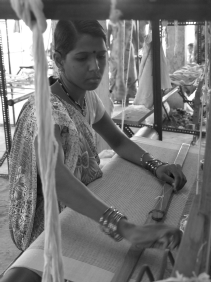
Weaving khadi at the Gudi Mudi project, WomenWeave, Maheshwar, Madhya Pradesh, 2010. India has an unparalleled heritage of handwoven textiles which could form the core of India's role in disruptive approaches to the current global fashion system. |
B
y promoting handloom textiles, many designers also seek to disrupt the hegemony of Bollywood as a form of aspiration and influence, and they often advocate aesthetic minimalism in contrast to the blinged-out representations of Indian style in movies. In this sense they also draw on other non-western textile and design pedagogies which reject excessive ornamentation, notably those of Japan that sent shock waves through the fashion system in the 1970s and ’80s. Japanese designers disrupted perceptions of fashion through radical design propositions based on the rejection of surface ornamentation and visible displays of wealth, as well as challenging conventions of gendered dressing. For a fashion era dominated by an excess of 1980s designers such as Lacroix and Versace, Japanese design was shocking, provocative and radical.A design language of the now requires responsiveness to pressing societal issues as well as capturing the zeitgeist in its style. If we consider the contribution of Japanese designers in disrupting international fashion, what could be India’s distinctive, disruptive role for a fashion system in flux?
Part of the answer lies in Indian craft’s long history of being coveted, adopted, copied and assimilated into western design and consumer markets. The various histories of chintz, toile de jouy and Kashmir shawls all attest to the lure of Indian goods and their role in creating a new consumer culture in Europe and the Americas.
This complex network of trade accelerated in the 18th century into a full-scale consumer revolution, afforded by the possibilities opened up by the new material culture of exotic foreign goods. A similar intensity of change in reconfigurations of the global economy has seen a new consumer revolution (in tandem with the growth of digital media) explode post-millennium. The mass availability of fast fashion is now a global phenomenon in which India plays a key role as export producer and as a source of aesthetic inspiration (and increasingly as a consumer market itself). But this interweaving of Indian artisanal skills into international fashion also means that craft skills are often lost in supply chains that drive down costs and quality.
|
|
|
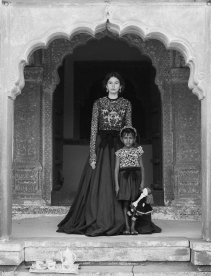
Sabyasachi ethnic formal wear photographed by Aneev Rao for Marie Claire India. October 2012. Stylist Pearl Shah. |
I
ndia must forge a different design path, strategically negotiating its historic associations with colour, adornment and exotic luxury. But it must do so whilst also challenging a set of historical dichotomies that position India as the exotic other: a provider of raw materials, export labour and exotic cultural garnish, whilst Europe manages the lucrative design end of the supply chain. Europe, after all, is still where most luxury brands with international reach are from. Furthermore, even though India has its own thriving domestic retail market, it is a bitter fact that consumers will often be more happy to pay ten (or more) times the price for a mass-produced garment with a big name foreign brand logo, than for a painstakingly handwoven kurta. As a designer once wryly remarked to me, sometimes it seems that her designs need to be sold in Europe before customers at home in India would perceive greater value in them.|
|
|
Rahul Mishra AW-16 styled with Gucci AW-16 at Colette, Paris, in July 2016. |
F
or its part, the Indian government has recently vociferously promoted the idea of ‘Made in India’, aiming to promote the subcontinent as a centre of manufacturing excellence. Yet, much of the government run crafts industry languishes under mountains of bureaucracy and a lack of connect between ethics, aesthetics and product offerings for highly sophisticated, segmented global fashion markets. For a ‘Made in India’ initiative that would truly help the craft sector, the government could think more in terms of disruptive innovation and the distinctive role India can play in a global fashion system. Where ‘Made in Italy’ or ‘Made in France’ is a mark of quality rooted in centuries of artisanal traditions, why can’t ‘Made in India’ achieve a similar cachet?
M
ore joined-up initiatives between designers, crafts people, the Fashion Design Council of India and the government need to channel the millions of rupees that are spent in the name of craft revival into projects that create sustainable, desirable products with staying power in international markets, not more one-off shows whose shelf life seems to be no longer than a few newspaper reports glorifying the designers and show-stoppers in breathless Page 3 prose the day after. More designers, and artisans themselves, need to be supported in showcasing their work at international centres such as Paris to create the kind of profile and value that could really put Indian craft on the map.Rightly or wrongly, Paris remains (for now) an important cultural marker of success. Not least for those Indian designers whose work does not chime with the all-dominant commercial market for ethnic bridal wear in India; other markets in Europe, America and increasingly across South Asia remain important ones to broach.
R
ecently in Paris at the influential concept store, Colette, a row of mannequins that anchor the upper level’s visual display was styled with a combination of Rahul Mishra’s RTW FW-16 porcelain inspired embroideries and Alessandro Michele’s romantic confections for Gucci, the latter clearly inspired by Indian chintz and chinoiserie. It felt timely, a small but seismic shift here in the city where the heart of couture continues to beat; a centre of the continuity of artisanship amidst a churning global fashion industry. Side by side was a storied Italian luxury label reinventing itself and an emerging young designer from India breaking through the glass ceiling of western fashion commerce. Both were drawing on the visual legacies of centuries of trade and cultural exchange between Asia and Europe, their juxtaposition not just highlighting the way that Indian aesthetics and artisanship have influenced global fashion, but also how Indian design can become a disruptive fashion force in its own right.|
|
|
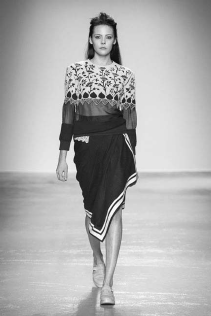
Rahul Mishra RTW FW-16, Paris. |
At the intersection of Indian and international fashion, Mishra’s work articulates how India can forge a distinctive voice globally, reshaping the way that Indian craft is understood. His signature design-led approach to craft involves complex tessellated embroideries, and figurative representations of flora and fauna that materialize his philosophy of sustainable luxury. Mishra incorporates handloom textiles alongside highly technical fabrications, including stiff biodegradable neo-prene, and advanced laser-cutting techniques. In this way he pushes past the blind fetishization of ‘by-hand’ skills, and acknowledges their place alongside cutting edge technology.
Mishra is one of the designers reinventing the aesthetic of traditional Indian crafts, in particular transforming the high embellishment aesthetic associated with ethnic bridal and formal wear. Whilst bridal wear has a thriving market in India and lucrative West Asian and NRI markets, for Indian designers whose focus extends beyond its opulent parameters, international markets in Europe, Australia and America remain important ones to break into. Mishra’s aesthetic reinvention of these traditional craft skills is centred on reinvigorating the livelihoods of artisans and ensuring their skills earn them a viable, profitable future.
Disruptive innovation forms an ongoing set of debates and design practices in Indian fashion, reflecting the systemic issues unique to this thriving non-western fashion centre. These forms of disruption highlight the role of fashion as a complex set of relationships between economy, society, aspiration, production and consumption and offer thought-provoking examples of how to navigate a fashion industry in flux.
* Phyllida Jay is the author of Fashion India. Thames and Hudson/Roli Books, 2015.