Fashion in the time of malaria
SHOBHAA DE
TERRIBLE confession: I do not take fashion seriously. Let me rephrase that: I do not take ‘being fashionable’ seriously. Worse, I find an obsession with fashion utterly depressing. Fortunately for me, fashion does not take me seriously either. I happily say I am neither a fashionista nor a fashion victim. I am me! And the only ‘brand’ I am loyal to is my instinct. I genuinely believe fashion is not about clothes. It is not even about how you wear them. Fashion is about how you live your life. Any fool with money can walk into a fancy store and ask the tight-assed manager (they are all tight-assed) for the ‘latest’. The latest is never the best. In fact, it could be the absolute worst. Take the wretched anarkali – which reduced women to moving ‘tamboos’ overnight. The anarkali was by far Indian fashion’s most vicious revenge on the unsuspecting. I am not sure which designer to hold guilty for this monstrous trend. Whoever you are – you know I am talking about you. Go hide!
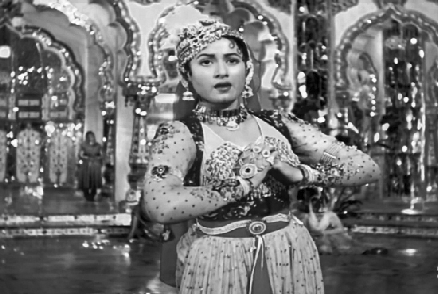
What do I have against the anarkali? For starters, the name. Just because Madhubala wore a flowy something in Mughal-e-Azam in which she played the role of the doomed Anarkali, did an unimaginative designer with extra fabric lying around with his darzi, have to inflict this abomination on us? If the original Anarkali was doomed, did an entire generation of desi fashionistas have to share her fate?
|
|
|
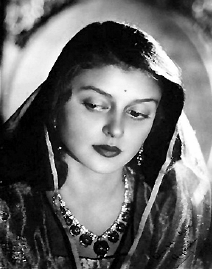
Gayatri Devi. |
Indian fashion is a strange beast. It has neither a poonch (tail), nor a mooh (face). It has grown into some sort of a freak with no connection to anything remotely resembling our reality. If you shut your eyes and utter those words ‘Indian fashion’ – what do you see? Be honest – you see lehengas and more lehengas. That’s it. In other words, you see brides. And that’s where Indian Fashion begins and ends – with trousseaux. No bridal wear would automatically mean no fashion designers.
When I shut my eyes and think ‘Indian fashion’ – who do I see? Just one person – Gayatri Devi. That’s it. So many moons later, not a single individual has been able to displace her from the pedestal. The picture of a beautiful Indian princess is forever associated with Gayatri Devi. Her pearls-and-chiffon image is permanently etched in our imagination. She exuded an easy, classy elegance, stripped of fuss and embodying the ‘less is more’ philosophy seamlessly. Gayatri Devi, now and forever, will remain the ultimate fashion icon from India, epitomizing elegance and class for generations to come. Countless clones have fallen by the wayside trying to mimic the legend’s innate sense of style... refinement...allure. If Princess Grace of Monaco immortalized the cashmere twinset and pearls vision of European royalty, our Gayatri Devi did the same for the simple six yards of gossamer fabric worn with flawless but utterly discreet Basra pearls. The paradox being, all this was happening at a time when India was having an intense love affair with austerity and socialist thinking!
C
ut to the comparatively recent past. I am thinking of the time, a decade or two ago, when there really were no fashion designers in India. Only tailors with happy scissors! I am still loyal to the Masterji at Smart and Hollywood, who continues to stitch my cholis. And the occasional caftan. He is the third-generation masterji I am dealing with. I remember his grandfather very well.
|
|
|
|
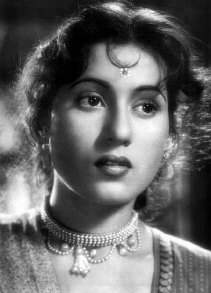
Madhubala. |
Madhubala in an anarkali. |
The location of the tailoring establishment has not changed even though the iconic heritage property (Esplanade Mansion) is about to collapse. This is where Jeannie Naoroji’s ‘girls’ had to show up for fittings. It was Smart and Hollywood or Madame Pompadour’s at the Taj Mahal Palace Hotel. Both these ladies were formidable (Madame Pompadour passed away a few years ago; Jeannie is a glorious 84) and intimidating. But they knew their job – which was to create a theatrical experience that combined music and dance with fashionable outfits presented in dramatic, themed sequences. Madame Pompadour ran an elegant salon in the Taj itself. Her clothes were designed for memsaabs – the expatriate community to which she and her husband belonged. She used raw silk and embroideries for her snobby salon shows, staged exclusively for guests of the luxury hotel. We called her ‘Ma’am’. Her name was Catherine Courtney. Everybody called Jeannie by her first name.
T
he two popular women’s magazines at the time were Eve’s Weekly and Femina. I did several fashion and jewellery shoots for them and got to know the editors – Gulshan Ewing and Vimla Patil, respectively – quite well. Some of the shoots were truly imaginative and spectacular, given the limited budgets and the price of camera film. (Photographers counted each frame!) We were expected to style ourselves, apply our own make-up and fix our hair. Most of the time we wore our own accessories. Despite that, or perhaps because of it, those fledgling steps into the world of glamour, fashion and gloss, created a heightened awareness of the enormous potential India possessed to make a mark on the global scene. We had centuries of a supremely advanced textile legacy just waiting to be exploited. Our weavers with their golden hands created magic on their traditional looms. Our embroidery skills were – and are – unsurpassed. Our indigo dyeing techniques, our ikat, paithani, pochampalli, upada, phulkari, jamdani, baluchari and patola, just to name a few, continue to mesmerize connoisseurs. We could have positioned ourselves in the topmost rung of international fashion. But we blew it.
F
ashion in India was never taken seriously. It was considered frivolous – a preoccupation of the elite; not seen as an industry at all. The mentality of those directly involved with it was to have some fun, and perhaps make a little money on the side. We never outgrew the boutique mindset, and are still stuck in it.Back then instead of converting the family’s spare garage into an improvised studio or tailoring shop, wealthy socialites opened stylish stores in five-star hotels and sold garments to other wealthy socialites. Parmeshwar Godrej’s Dancing Silks at the Oberoi Hotel in Mumbai was one of the first glitzy outlets to retail flirty, sexy outfits that caused quite a storm. There was Sunita Pitamber retailing faux jadau under the Dagina brand. Her showroom was in the Taj Mahal Palace Hotel. As was Burlington’s, driven by the chic Gabi Kapoor, and catering to foreigners in search of exotic brocade bandhgalas, maharajah turbans and Banarasi silk gowns. Today’s big-name desi fashion designers have made much more money than the pioneers, and retail from swanky stores across India, plus a few in international cities like Dubai. They have established their brands successfully, but apart from Anita Dongre, nobody else has scaled up sufficiently to compete aggressively in the global fashion space. It took Ritu Kumar forty years of diligence and hard work to run her business across multiple stores. Manish Arora kicked off his career with enormous promise, but where is he today? Rohit Bal remains fashion’s darling to his fawning fans. But he too did not leverage his brand when he needed to.
S
ince most top designers prefer to stick to handcrafted, customized clothes, it is difficult for them to cater to the mass market without serious investors to back them. Our fashion, such as it is, remains strictly couture – worn by the privileged few, and copied within days by garment manufacturers peddling knock-offs. Piracy is India’s speciality – in fashion, music, books and films. There is no business model worth talking about to support all the young talent mushrooming across India, despite the odds. For every one Masaba, there are hundreds of failures.Bollywood, meanwhile, has consistently shaped its own fashion revolution. Back in the ’60s and ’70s, beautiful stars crafted a whole new fashion vocabulary by reinventing the saree and salwar-kameez to fit the silver screen which had recently switched to colour. The excess and gaudiness of those movie costumes have to be understood in the context of the big thrill generated by watching movies on 70mm vibgyor coloured screens. Bollywood has always believed in the power of excess – thank God! From the voluptuous Vyjayanthimala to curvy Mumtaz, from the straggly, uneven Sadhana fringe to Sharmila Tagore’s bold bikini, our heroines were demonstrating how experimental and confident they were in projecting themselves. Without stylists to throw clothes at them, and only Bhanu Athaiya to provide aesthetic guidelines, the film industry came up with its own unique trends that revolutionized the way India dressed. Who can forget Rajesh Khanna’s guru shirt or Dev Anand’s scarves and caps?
T
here was a generation of originals who arrived a little later and redefined fashion in our crazy, amazing films – Zeenat Aman, for example, who broke the saree-salwar stranglehold and brought in a more relaxed, westernized fashion sensibility, particularly after her hippie turn in Hare Rama, Hare Krishna. Today’s generation maybe more out there, with far less inhibitions when it comes to pushing the fashion envelope, but there are no real originals. Unfortunately, commerce and endorsements dictate Bollywood’s taste, and I am waiting for someone to dramatically change the rules. Personally, I have a great deal of respect for what is derisively called ‘The Bollywood School of Fashion’. At least it wasn’t derivative and ‘me too’. It evolved organically and influenced fans across the length and breadth of India.This was indigenous fashion – ‘our’ fashion – for better or worse. I wouldn’t sneer. I reserve my sneers for copycat and conceited fashion designers of today, who lift entire collections from international ramps and preen ridiculously for a largely ignorant media. Once the big fashion brands came into India, out went our own fashion tribe, unable to cope with the aggressive, foreign competition. The question became: copy or create? It was much easier to copy! Apart from our wedding lehengawallas and wallis, fashion is dead for now.
B
ollywood has surrendered meekly to the pressure of brands thrusting fancy frocks on the stars in return for magazine covers and lucrative product placements. Nobody wears anything but gauzy gowns on the red carpet these days. What started in Cannes should have stayed in Cannes. Unfortunately, it didn’t! Most of the heroines look like plastic clones of one another – dressed in depressingly similar clothes. What Manish Malhotra launched a few decades ago, with his foray into Bollywood, is the only real ‘influence’ one can successfully track and document as being authentic. One can mock the sequins and pastels he popularized, but how good the girls looked – and continue to look – wearing Manish?As for me, fashion is tied to my hormones. I wear what I wear depending on my hormonal levels and mood swings on that particular day. If the look works, I thank my hormones. If it doesn’t, I blame them. I enjoy flirting with fashion on my own terms. When all else fails, my advice is: oil your hair, get into a faded caftan, climb into bed and read erotica. Sure as hell beats being a slave to some fancy frock.