Everybody wants to clothe the world
WENDELL RODRICKS
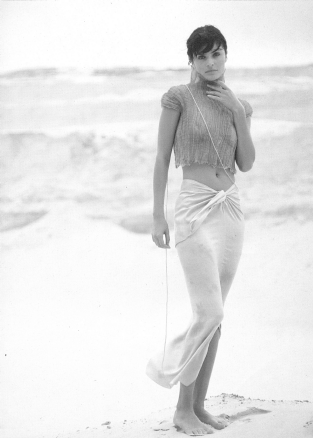
IN 1995, IGEDO Dusseldorf invited me as the first ever Indian designer to open what was, at the time, the world’s largest garment fair. Like a lamb led to slaughter, and with no one to seek advice from, I landed in Dusseldorf where supermodel Helena Christensen, in my resort wear collection shot by Mario Testino, seemed to grace every billboard in that cold, windy city. It was my first taste of international exposure, when I figured out what ‘they’ wanted from us Indians, what we were ‘supposed to deliver’ and what the world ‘wanted from India’. They did not want ‘typical’ Indian garments they said, and when I quizzed them on why they chose a minimalist designer like me over so many other worthy compatriots, they replied – ‘We don’t want costumes; clothing the world can wear is what we are looking for.’ This had a deep impact on me, which is why I shied away from the Indian wedding market right from the outset and aspired to voice an international expression rooted in an Indian ethos.
Twenty-one years later, I recall distinctly the lessons I learnt from IGEDO. The biggest was not to follow the West but to have them follow us – to India. Our vast country with a 6,000-year-old clothing legacy is a cultural textile emporium no other country in the world can match. The ground reality, though, was vastly different and very disappointing. International buyers at the time had no notion or idea of what Indian designer clothing was all about. They saw India as a source of cheap labour and wanted ‘us’ to toe the line with ‘their’ designs. Our unique culture of crafts and artisans was ignored. Also ignored was the fine finishing and quality of silk weaving, dyeing and printing. It was at IGEDO that I realized that we had to put India out there in terms of clothing, culture, artisanship: ‘our’ version.
F
ast forward to India taking centre stage, away from being just a cheap source of labour to becoming a growing market for foreign labels. By the late ’90s, international brands began to see the vast business potential that India had become. They began with licensed garments wholly owned by Indian labels and then moved on to subsidiary joint ventures with an Indian majority. Later came the franchisee or distributor and, finally, joint ventures with minority Indian ownership. This strategy of foreign labels in India (with India keen to cooperate at all levels) is due to the fact that the Indian clothing market was valued at $45 billion in December 2015 and is poised to leap to $200 billion in 2025.When one reverses the statistics of Indian clothing sold to the world, the figures are dismal. On 29 June 2016, Mayank Jain wrote in scroll.in that due to mills shutting down and no new jobs being created, countries like Bangladesh and Vietnam have beaten India in the exports game. In the present financial year, Indian textile exports grew a mere 8% compared to 12% for Bangladesh and 14% for Vietnam. The ringing of alarm bells caused the present Modi government to unveil a special package for the industry in late June 2016. Expecting to create one crore new jobs in three years and aspiring to bring in a whopping Rs 74,000 crore investment, the plan is to adopt new measures that overhaul labour laws, provide subsidy for garment manufacturers, upgrade technology and expand this sector.
|
|
|
|
Goa Spa Collection, PAPP. |
Goa Spa Collection, PAPP . |
That last word ‘sector’ is telling. Though the ministry may be called the Ministry of Textiles, the textile industry is not recognized as an ‘industry’ by those in power. In this ironic dichotomy of non-recognition, as part of an industry, among other injustices, designers must pay more taxes and fashion shows must pay entertainment tax. Even student graduation shows are treated as ‘entertainment’ and levied with this tax. Ridiculous!
The new Minister of Textiles would do well to grant industry status to the fashion business for many reasons. The international market is not looking at India just for the fashionable entry of a new breed of designers who are wooing the world with their avantgarde narratives on ramps in Paris, Milan, New York and London. The world is awaking to the entire Indian aesthetic, from designed products to architecture, interiors and art installations.
W
e have the advantage of attracting present-day buyers who want to tap into the new India. We can recycle better with our labour force, create eco-friendly fabrics with relative ease and grow fibres that are organic and sustainable. These are unique selling points in the world of fashion retailers, who have their eyes set on a growing market for responsible garments produced ethically.India needs to realize its potential to cater to the world’s notions of desirability. The exotic stays exotic as long as it is not mass-produced. We need not pander to fashion appetites for a current trend that lasts for just a single season; instead, we need to create the classic and desirable garment which qualifies as a collectible like the Chanel jacket, an enduring object of desire for almost a century.
|
|
|
|
Helena Christensen photographed by Mario Testino. |
Helena Christensen photographed by Mario Testino. |
By supplying in bulk, we reduce our artisans’ value and condemn them to the ‘cheap labour’ slot. Our aim should be to create and position Indian objects, clothing included, as luxury goods. To address and reinforce the perception that luxury should be rare and desirable, which is what most of our clothes and textiles are in reality. Today fine Indian textiles like muslin, pashmina, Madras checks, ikat wovens and Lucknowi chikankari are reduced to merchandise which can be cheaply sourced. This is a deplorable situation and it needs to change. From being the most wanted textiles of antiquity right until the 1800s, Indian textiles have now lost their lustre to cheap overproduction and low value dollar sourcing.
The real impact of Indian fashion will be felt if the makers of Indian textiles and fashion carefully consider all this. Weavers need to be paid fair wages and their work should command top dollar. Dyers and printers who create masterpieces should be encouraged to adopt contemporary and new technologies. Embroiderers should evolve their motifs alongside fashion designers to create new interpretations the modern buyer can relate to. The vast repertory of Indian clothing should be mined as the treasure house of patterns and styles it is.
I
nternational women’s fashion has merely seven garments to play with: the blouse, skirt, trouser, jacket, frock, cocktail dress and evening gown. And look how they play them season after season, reinventing, recolouring and repackaging the same basic designs over and over again. In India, every state has a wealth of local textiles and garment styles. We do little to classify them and reproduce them for international wearability to a global audience.The worst thing would be for us to blindly follow the West like China and Japan have done, abandoning their traditional garments and assuming the former’s essentially alien clothing styles. India should never go down that path and ignore the 6,000-year-old legacy we’ve inherited. With that in mind, let us not follow the fashion diktats of the world in general, but rather try to convince the world to come to us.
Rewind to IGEDO 1995 and the lessons I learnt which may be a good heads-up for the younger generation of designers to follow. First, create a silhouette that makes everyone sit up and take notice. From a distance, whether on a ramp or at a cocktail soirée, we notice a shape on the body and the play of colour. As we get closer, we see the details, quite like how one awaits a model on the ramp to get nearer for closer scrutiny. It’s then that the fabric, the weave, the dye, the embroidery and the emotion of the garment filter through into our minds. We look for and find the ‘wow’ factor. With that in place, the imperative to own, retail – or even use a garment for an editorial shoot – asserts itself.
Indian garments from afar always create an impact with the varied silhouettes at our disposal. On closer scrutiny, they divulge their rich heritage – the intricate art of the dyer, weaver or embroiderer, details of handmade artisanship in the ensemble and the accessories. The garment ticks all the right boxes. Simplicity and intricacy: these are the wonder of Indian garments.
No question then, that it’s now, in these modern times, for India to clothe the world.
* Wendell Rodricks is the author of The Green Room, Rupa, 2012, and Moda Goa: History and Style, Collins, 2012.