Issues, performance and personality
SANJAY KUMAR, JYOTI MISHRA and VIBHA ATTRI
THERE are two sides to the Bharatiya Janata Party (BJP) led NDA government’s record of performance over the last three years. On one side is the story of a slowdown in economic growth, failure in generating employment opportunities and a deepening crisis in the agriculture sector; the other is a story of a growing feeling of nationalism, in turn fuelling heated debates on intolerance, meat politics and the politics of Hindutva.
Nonetheless, the voting intentions of the people in some recent surveys clearly indicate that the BJP continues to be on safe turf so far as the next Lok Sabha election of 2019 is concerned. The question is why despite an economic slowdown and the government’s inability to deliver benefits of the many welfare schemes and services to the people, is there no commensurate decline in the BJP’s popularity? Modi’s popularity too has remained intact even though his government has clearly not done enough to create jobs, check inflation, and improve the condition of farmers.
There is little doubt that issues relating to the performance of the government and leadership have always mattered in Indian elections; equally that even otherwise popular governments have lost voters’ trust on the ground of non-performance on issues which were important to the people. That is why in the current scenario where people do not have a positive perception of the performance of the BJP-led NDA government, it is intriguing that they are nevertheless willing to give it another chance in the next election and continue to support Narendra Modi as the next prime minister.
This anomaly should force one to ask why despite not getting a positive assessment on the performance front, the prospects of BJP’s victory remain bright. Is it that the party’s strategy of foregrounding other issues like nationalism and promoting a Hindutva agenda is silently consolidating its Hindu vote bank and thus shoring up its chances? For instance, one can see a clear shift in the party’s agenda from the phase of the 2014 elections where it followed an expansion process and tried to reach out to people other than its traditional voters by contesting on the issue of development, governance and corruption. But three years down the road, it appears that the party is once again returning to its core agenda of ‘Hindutva’.
In the 2014 Lok Sabha elections, price rise, corruption, lack of development and unemployment were prominent issues in the mind of voters. The BJP did not miss out on this opportunity to cash in on the voters disappointment with the incumbent government and focused its electoral campaign on these issues. During the campaign, in his various speeches, Narendra Modi promised to usher in ‘acche din’ and development. Though the idea of acche din was an abstract one, yet most of the voters associated it with economic well-being of the people. Most voters believed that acche din for them was development (15%) and increased employment opportunities (13%). Others understood it as eradicating corruption (6%) and poverty reduction (5%).
T
o what extent has Modi succeeded in his promise? Thirty seven per cent said that their household’s financial condition had improved over the last three years, whereas 45% believed that it has remained the same. A smaller number, one in every six (16%) felt that their condition had deteriorated. Notably these figures are not very different from those that were recorded during Manmohan Singh’s tenure; in fact they are a little worse. Similarly, concerns about unemployment have increased three-fold over the past three years, from 7% during the 2014 Lok Sabha election to 21% currently. Thirty four per cent voters stated that employment opportunities had decreased in the country over the last three years, whereas 23% stated the job opportunities had increased. A similar study that was conducted in 2013 (when UPA II was in power), showed that some 29% of the respondents believed that employment opportunities had increased.It is not surprising that Congress voters are more critical about the government’s failure to create jobs for the youth; more surprising is that even those who voted for the parties which allied with the BJP during the 2014 Lok Sabha election too are critical about government performance on this front. The data suggest that 45% of the voters of BJP allies believe that employment opportunities have decreased; this is 11 percentage points higher than the average figure of 34% reported during the current NDA tenure. Even though the NDA government has launched the Skill India scheme to generate employment by providing training to the youth, as many as one-third of the households were not even aware about it, and only 6% of the households had availed the benefits of that scheme, percentages which are comparatively lower among the youth from poor and lower class households.
T
he rural sector too has been afflicted by the employment crisis, with farmers bearing the major burden. In the Mood of the Nation Study (MOTN 2017), 49% of the farmers stated that the government had done a bad job in addressing their issues. The people in general were also very critical about government’s handling of the farmers’ issue despite its initiative to provide crop security to farmers by introducing the Pradhan Mantri Fasal Bima Yojana.Though launched with much fanfare, the policy has yet to filter down to the various corners of the country; a quarter of the farmers have not even heard about the scheme and among those who were aware, only one in every ten (10%) has availed its benefits. Also, the beneficiaries are mainly big and medium farmers; small and landless farmers are yet to see any benefits. Little surprise that they are far more critical about the government on this issue. This disappointment with the government on its handling of the farmers issues cuts across voters of all political parties though the proportion is lower amongst BJP voters. Nevertheless, one notes that 63% of the voters are of the opinion that Modi has succeeded in bringing acche din.
On various other development schemes as well, opinion on the performance of the government during the last three years remains divided. Though some schemes seem to have benefited a large number of people, many others have not yielded the desired results. For instance, many respondents claimed to benefit from the Jan Dhan and the Ujjwala (free gas connection to poor households) schemes, but the number of those who claimed to have received the benefit of Gram Jyoti Yojana (Rural Electrification Scheme) was much lower. Two out of five respondents said that they have availed the benefits of Jan Dhan scheme and opened a bank account; and one-fifth of the households claimed to avail the benefit of Ujjwala Yojana within a short period of one year.
From a low 20% of the Indian poor having a LPG connection in 2009, the figure rose to 38% in 2014 and now stands at 45%, a seven point increase in the numbers of Indian poor who have LPG connections in less than three years. It is worth noting that during the five years of the second term of the UPA government, there was an 18 percentage point increase in LPG connections while the number has only increased by seven percentage points (though in three years) despite so much fanfare about this policy.
T
he one issue which most adversely affected the UPA government was corruption; in fact it was a game changer for the BJP during the 2014 elections. In order to demonstrate his commitment to fighting corruption, Prime Minister Narendra Modi took the drastic step of demonetization – replacing the old five hundred and thousand rupees notes with new ones. People faced considerable difficulty in exchaging their currency or in withdrawing money from their own accounts due to restrictions on the frequency and amount of money that one could withdraw. But in spite of such problems, the measure surprisingly received enormous support from the common people. The survey findings suggest that as many as 44% supported the move and considered it a good policy, while only 16% people expressed an opinion against this move. Thirty three per cent people extended limited support to the policy; they believed that while it was a good move, its implementation was poor. A majority of the voters believed that the Modi government had done a good job in tackling the problem of black money; 30%, however, were critical of the government’s handling.
T
he BJP contested in 2014 by raising mass appeal issues like price rise, corruption, unemployment and development. It prioritized these issues in its manifesto and sidelined its traditional Hindutva agenda of cow protection, uniform civil code and building the Ram temple. This may have been an important reason why voters who traditionally did not adhere to its ideology also voted for the party. But ever since it has come to power, the BJP’s hidden agenda of Hindutva seems to have taken centre stage. The government every now and then takes up issues such as banning trading in animals for slaughter, interfering in marriage laws of minorities and extolling their idea of nationalism.On 23 May 2017, the central government passed an ordinance to ban the sale of cows and buffalos for slaughter at animal markets. Prior to this, a few incidents of violent mob lynching of Muslims and Dalits (both communities traditionally engaged in animal trading) over mere suspicion of cow meat consumption or cow smuggling had been reported in many states. Even though many critics saw this as a ban on personal food choice, the study indicates that the decision to ban beef consumption enjoys widespread support among the masses. Over 63% supported the beef ban (both cow and buffalo), while 9% favoured a ban on only cow meat. One of five respondents felt that there should not be any legal restrictions on what one eats. But there is a strong religious divide on this issue. Most Muslims and Christians do not support a legal ban on beef eating because it is a part of their food habits.
T
he recent Supreme Court judgment (23 August 2017) might also help the BJP further consolidate its support base, especially amongst less conservative Muslims and Muslim women since the party has supported reform in the system of triple talaq, a customary process of divorce in the community. Survey findings clearly indicate people’s opposition to this practice. Only one in five voters favoured the practice of triple talaq, whereas over half of them rejected it. Nevertheless, two out of five Muslims were either non-committal or supported this practice. A clear divide can also be seen between Muslim men and women, with men more likely to agree (47%) than women (35%) with the practice of triple talaq.The BJP has consistently supported a uniform civil code which requires the framing of common laws to govern marriage and property rights across all religions. But, not too many people support this proposal, especially among Muslim voters. However, Hindu voters are increasingly showing a soft corner for the BJP’s Hindutva politics and tilting towards a right ideology. Even Hindu voters of non-BJP parties are positively inclined on these issues.
Perhaps, the BJP’s agenda of nationalism is reflective of an over-arching phenomenon which consolidates Hindu voters for the BJP, even though there is considerable debate and dissension over the kind of nationalism the BJP is projecting. While some feel that nationalism is important and the party is raising it in the interest of the country, others argue that the issue is being raised by the party merely to deflect people’s attention from its governance failures. Overall, a little more than one-third of the voters believe that nationalism is a genuine concern and this opinion is stronger among BJP voters whereas voters of other parties are more likely to believe that the BJP is raising this issue primarily to cover up its various failures. It is, however, undeniable that a Hindu consolidation can be observed on this issue across all parties. The BJP, hence, has been successful in consolidating Hindu voters which can only benefit it in the next Lok Sabha election.
D
uring the past three years, when assessing the performance of the NDA government, what seems to have most tilted opinion in its favour is the overall appreciation of Narendra Modi as the prime minister more than the work done by the NDA government. Findings of the study indicate that 63% people are satisfied with the current national government to varying degrees (16% fully and 47% somewhat). Slightly higher satisfaction (24% fully satisfied) with UPA I in year 2006 after two and half years of being in power, resulted in the government getting re-elected in 2009; but a reduced satisfaction (16% fully satisfied) in 2011 after UPA II had been in power for slightly more than two years, eventually resulted in its defeat in 2014.These findings pose a puzzle: when similar satisfaction levels resulted in the defeat of the previous UPA government, why do the BJP’s chances of re-election appear so high? Does the explanation for this possibly lie in the rising popularity of Modi which is further buttressing the BJP’s prospects in the next election?
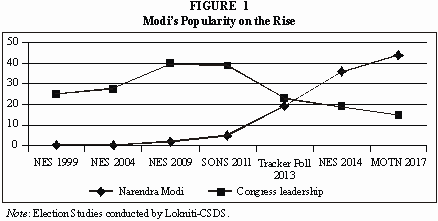
Narendra Modi’s personality has so far proved to be a major asset, a real vote puller for the BJP. He currently enjoys a 34 percentage points lead over the next most mentioned name, Rahul Gandhi, who is preferred by only 10% of the respondents. If we look at the past elections, it is clear how Modi has made a strong position for himself in recent times. Time series data on prime ministerial preferences show that from being supported by just 2% of the voters in the 2009 Lok Sabha elections, in 2014 Modi was preferred as the PM candidate by as many as 36%. It does appear that even if there are some question marks about the performance of the NDA government, the BJP still remains a popular choice due to the strong leadership of Narendra Modi as prime minister.
I
n the current context, a sizeable proportion of people in India make their voting decision on the basis of leadership, and this certainly places the BJP way ahead of the Congress and other regional political parties. Modi clearly remains the front runner as there appears no alternative that seems interested or capable to give him a tough fight. Evidently, Modi has a clear shot at repeating his success in 2019.The findings of the study indicate that Narendra Modi’s popularity is still on a high; as many as 44% voters prefer him as the prime minister even after next elections. Not only does Modi not face any opposition from leaders of other parties, he also faces no discernable challenge from within his own party. He is also becoming more acceptable in states where the BJP has not been traditionally present. Interestingly in Odisha, where elections are due next year (2018), three of five voters preferred Modi as the PM of the country. Overall, his popularity has risen in the eastern states of India.
|
|
S
tudies during the 2014 Lok Sabha election indicated that Modi was able to pull votes for the BJP due to his personal popularity. Even now, Modi is more popular than his government. Two in every three voters appear satisfied with the performance of Narendra Modi as prime minister over the last three years. This satisfaction level is much higher when we compare this with the performance of Manmohan Singh as prime minister for both his tenures over the same span of time. The reason for Modi’s popularity is because of his leadership qualities in administration and policy decisions. Those who favour him highlight personal qualities like honesty, oratory skill, hardworking nature and experience. Since the issue of leadership is certain to dominate the election of 2019, it appears that the BJP is likely to have a huge advantage over the Congress.Not only is the BJP’s popularity on the rise, but more importantly this popularity is not limited to its core supporters. The party is making inroads amongst the social sections which traditionally were less likely to vote for it. In other words, it is expanding its social base by incorporating marginal caste groups, poor and rural voters. In a recent book, Tariq Thachil discuses how the BJP, which conventionally caters to the interests of the elites, managed to make inroads amongst the poor, dalits and adivasis without losing its core constituencies. Moreover, its support amongst the traditional voters has further strengthened. Even as the BJP continues to fare well amongst the rich and middle classes, it has witnessed an increase of 7% and 8% amongst the poor and lower classes respectively compared to the 2014 Lok Sabha election. The party is also gaining greater acceptance among the socially marginal sections of society. A sizeable numbers of Muslims have indicated their desire to vote for the BJP if elections were to be held tomorrow; the figures are eight percentage points higher than Muslims who voted for the BJP in 2014. The party has also made major gains amongst the dalits, upper OBC, and adivasis.
T
raditionally the BJP was seen as an urban based party, but in 2014 it received significant votes from the rural areas too. In the rural constituencies, the BJP’s vote share increased by nine percentage points from the 2014 election, even as the percentage of its vote share in urban constituencies went up by only 3%. The BJP thus is not only expanding its support base amongst social groups, but also doing so geographically. The party which earlier enjoyed marginal support in East and South India has now significantly increased its vote share in these zones.Issues, performance and personality (leadership) clearly affect electoral outcomes and determine the fate of governments. However, sometimes one aspect overshadows the others. The non-performance of the Congress party pushed voters to look for other available options. The BJP, under the strong leadership of Narendra Modi, prioritized mass issues like price rise, corruption, unemployment and development and successfully provided a good alternative for the voters. Three years after coming to power, it now appears that the party has side-lined these issues and the agenda of Hindutava has taken centre stage. Nevertheless, the party’s support is intact and it continues to be well placed for the next Lok Sabha elections even though the voters are not very satisfied with the performance of the government. In fact, the party’s popularity is no longer confined to its core constituency; rather it is making inroads amongst those sections which traditionally were less likely to vote for it. This has a lot to do with Modi. He is the glue keeping the party’s support intact. The absence of a strong leader from the opposition has further added to his aura. At this juncture no candidate from the opposition is in a position to give Modi a tough fight.
References:
Norman Nie, Sidney Verba and John R. Petrocik, The Changing American Voter. Harvard University Press, Cambridge, 1976.
Praveen Rai, ‘Issues in General Election 2009’, Economic and Political Weekly 44(39), 2009, pp. 80-82.
Sandeep Shastri and Reetika Syal, ‘Leadership in Context: Impact of Leadership in the 2014 Lok Sabha Elections’, Economic and Political Weekly 49(39), 2014, pp. 77-81.
Sandeep Shastri, ‘Leadership at the State Level Mattered’, Economic and Political Weekly 44(39), 2009, pp. 88-91.
K.C. Suri and K.K. Kailash, ‘Welfare Benefits and Vote Choice’, The Hindu, 25 June 2014.
Tariq Thachil, Elite Parties, Poor Voters: How Social Services Win Votes in India. Cambridge University Press, New York, 2014.