Finding ways to creatively dissent
NICOLAS DE ZAMARÓCZY
WHAT causes some types of political protests to be more effective than others? Drawing on the legacies of Mahatma Gandhi and Dr. Martin Luther King, Jr., I argue that a key attribute of successful protest movements is that they involve creative and novel protest tactics. In other words, successful activism requires changing the repertoire of contention – the set of actions most individuals in society recognize qua protest tactics.
I consider some of the ways in which Gandhi, King, and their allies innovated with protest tactics historically, before turning to an analysis of protest tactics used by the American Left today. Finding that there is arguably an absence of creative dissent in contemporary American protests in the physical world, I then assess the emerging debate on the effectiveness of digital activism. I close by suggesting that despite the criticisms, digital activism has the potential to help contribute to a more just, equitable, and non-violent future for everyone, in keeping with the legacies of Gandhi and King.
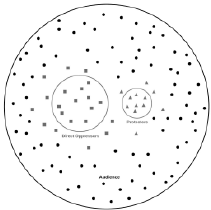
The Indian independence movement and the American civil rights movement arguably confronted an identical structural problem. In both cases, we can think of interactions between three sets of actors: the small, highly motivated group of protesters who sought to end the profound inequalities they perceived in society (the ‘protesters’); the medium-sized group of individuals who greatly benefited from those inequalities and who fought hard to keep them in place (the ‘direct oppressors’); and the bulk of society who also benefited in various ways from the existing status quo but who could be persuaded to withdraw their support from the unequal system (the ‘audience’). See Figure 1 in the previous page for a schematic representation of the challenge facing the protestors in both cases.
|
FIGURE 1 A Schematic Representation of the Challenge of Persuading Audiences |
|
|
I
n the Indian independence cause, the protesters were members and leaders of the Indian National Congress and other similar groups. The direct oppressors were British imperialists in both India and the United Kingdom who fervently resisted granting India independence (as well as some Indians who benefited greatly from the colonial set-up). And the audience was the bulk of British society, who were almost certainly benefiting in some fashion from imperialism but who could perhaps be persuaded to withdraw their support from the British imperial project in India.In the case of the American civil rights movement of the 1960s, the protesters were activists across the American South loosely confederated into organizations such as the Student Non-Violent Coordinating Committee, the Congress of Racial Equality, and the National Association for the Advancement of Coloured People. Direct oppressors included the white Americans who most benefited from racial inequalities, most of whom (but not all) were also located in the South. And the audience was the rest of white America, all of whom benefited from the racist hierarchy of white over black, but who could be made sufficiently aware of the profound inequalities and violence inherent in this system to withdraw their support.
But how could the protesters attract the attention of their target audiences? Those who benefit from a profoundly unequal system tend to avoid thinking about it, if only for reasons of cognitive dissonance. The protesters needed to overcome this resistance, secure the attention of their audiences, convince them of the violent inequalities present in their societies, and demonstrate that the issues were not likely to ‘go away on their own’.
I
n both the cases of the Indian independence movement and the American civil rights movement, the protesters ultimately proved successful by combining savvy media courtship with innovative, powerful and non-violent protest techniques. In one of his last published pieces, Dr. King wrote at length about the importance for black protesters to become ‘creative dissenters’ (‘creative’ appears nine times in the essay). This notion of breaking down the apathy of the audience via the popularization of novel forms of political protest was central to the missions of both Mahatma Gandhi and Dr. King. Today, sociologists refer to the same idea with the term ‘the repertoire of contention’. This concept, first developed by Charles Tilly, asks the question: how do you recognize a given action as a form of political protest? How do you know if something you see is a political protest or not?
W
hile this may seem like an easy question, it is not always. For instance, I recall an evening when I was studying abroad in Buenos Aires during my university years. I was in my host family’s apartment when suddenly a terrible racket could be heard in the street below. I looked out of the window and saw a long procession of people walking along banging on pots as loud as they could. ‘What in the world was this?’, I thought to myself. My host family could tell that I was very confused, and they told me that this was a cacerolazo, a form of grassroots political protest common in Latin America where people try to direct attention to a political issue by, at a set time, collectively making as much noise as they can using household objects.|
|
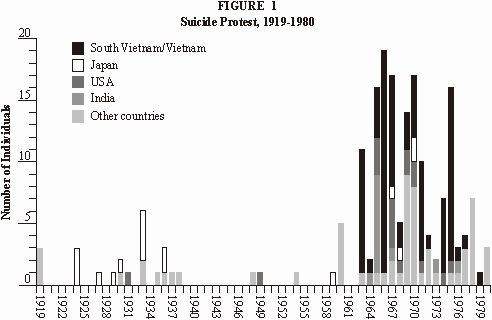
A much more chilling example is given in the chart below from the work of sociologist Michael Biggs. It shows how suicide began catching on as a form of political protest in the early 1960s. In particular, self-immolation was pioneered as a protest tactic by Buddhist monks against the draconian South Vietnamese government, and has stayed in the worldwide repertoire of contention so forcefully that even in 2010, when Mohamed Bouazizi wished to make a statement about economic injustice in Tunisia, he chose the immediately recognizable form of setting himself on fire, thereby helping to ignite the Arab Spring.
I
am bringing up this concept of the repertoire of contention in order to draw attention to the ability of both Mahatma Gandhi and Dr. King to popularize dramatic new forms of political protest. Both leaders were very good at recognizing protest innovations that other activists were deploying, scaling them up to the size of entire movements, and smartly capitalizing on the media attention those protest innovations drew.In the case of Gandhi, for instance, while he was not the first to use fasting as a form of political protest, he did more than anyone else in history to cement its place in the global repertoire of contention. Part of the tactics power stemmed precisely from the fact that while fasting had a longstanding history in India, it was relatively less well known to the British public. As Tim Pratt and James Vernon note in an excellent scholarly article, the tactic’s novelty led to significant media coverage in the United Kingdom but also to a great deal of initial confusion:
‘[The] fasts were received in Britain with a mixture of detachment, skepticism, bewilderment, concern, and hostility – a mixture that varied predictably from newspaper to newspaper [...] The majority of the press ridiculed Gandhi, depicting his fast as wilful suicide, the act of a fanatic doing as much to hinder settlement as to help it in a desperate attempt to deflect criticism of his own political failings onto the Government of India. [...] Even within the more generous readings of Gandhi’s fast in the British press, there remained a studied refusal either to grant it a heroic dimension or to acknowledge the difference of India’s politics of hunger. In their determination to reduce the fast to a contest between the colonial administration and its unruly subject, the British press largely preferred to dismiss Gandhi’s freakishness and fanaticism than engage with his distinctly un-British conception of the political.’
1
O
ver time, however, the tactics potency began to make itself felt. By 1941, as rumours circulated that Gandhi was preparing to undertake yet another fast, a senior British civil servant overseeing Indian affairs wrote, ‘We have to admit that the peculiar atmosphere surrounding this extraordinary individual and the importance attached, both here and abroad to his physical survival are determining factors in our policy.’Consider as well the creativity inherent in Gandhi’s injunction to his followers that they stop wearing any British manufactured clothes and instead have their garments made out of khadi that they had spun themselves. This way of thinking and doing helpfully rendered the immense politico-economic problem of India’s forced deindustrialization at a scale that felt tractable to individuals; it also provided ordinary Indian nationalists with a unique, concrete action that allowed them to proudly and non-violently demonstrate their commitment to the cause.
Today, while hunger strikes very much remain a part of the repertoire of contention, both in India and abroad, the protest tactic of making one’s own clothes seems to have fallen out of the repertoire of contention. Consumer culture and changes to supply chains have changed how Indians protest, but this should not take away from how dramatic and novel the swadeshi movement was in the subcontinent during the first half of the 20th century.
Powerful new forms of political protest were also deployed during the American Civil Rights movement. The most iconic of these was the sit in, whereby activists would enter busy whites-only restaurants during the lunch hour and sit down at tables, peacefully preventing the restaurants from serving other customers. Typically the police would eventually be called in and arrest the protesters. The practice of staging sit ins emerged organically in several different cities, often led by students and other young adults. As a way of drawing attention to the exclusion of black people from public places, and as a way of publicly but peacefully rejecting the status quo, it was a brilliant innovation in the repertoire of contention.
T
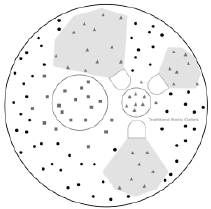
he famous ‘freedom rides’ – whereby mixed groups of both blacks and whites would deliberately ignore rules about segregated seating on buses in the deep South – worked along similar principles: announcing the group’s plans in advance to maximize media and popular attention; deliberately but non-violently placing one’s body in harm’s way (racist white mobs would often be waiting at the stations along a given bus’s route to attack the riders); protesting in public and semi-public places which were easily accessible; and targeting the pocketbooks of white owned companies (Greyhound drivers often refused to show up to work during a scheduled Freedom Ride, forcing the company to close during those periods).In summary, then, both Gandhi and King believed that if the majority of the audience repeatedly witnessed deeply motivated and self-sacrificing activists engaging in novel forms of protest, they could be persuaded to withdraw their support from the imperialist and racist structures that characterized their worlds. In order for these novel forms of activism to be witnessed, however, they would have to be disseminated widely by powerful media outlets – like newspaper broadsheets in Gandhi’s day or the evening news offered by the CBS, ABC, and NBC networks during the 1960s and ’70s. These two key elements – innovative protest tactics and sustained attention from traditional media out-lets – undergirded the model of activism that Gandhi, King, and their allies used to successfully enact normative and social changes throughout the 20th century, and are represented in Figure 2 below. But does that model of activism still hold true today?
|
FIGURE 2 A Schematic Representation of Protest Activism in the Gandhi and King Eras |
|
|
G
andhi and King both believed that the hearts and minds of prospective audiences could be altered for the better. In light of that belief, I would like to turn to the contemporary United States, a country sorely in need of dramatic social, political and economic transformation. Is the contemporary American left continuing in the traditions of Gandhi and King?This question involves carefully analyzing both the tactics used in, and the media attention received by, the protests of progressive activists in America today. Let us consider each of these elements in turn. What is the current state of the American repertoire of contention? Are novel, creative forms of political protest helping to re-shape the contemporary United States?
T
o answer these questions, we can start by looking at an April 2018 Washington Post-Kaiser Family Foundation poll which asked a random sample of 1,850 Americans about their involvement in classic forms of protest like organized demonstrations and marches. Overall, 20% of those surveyed reported having attended a political protest over the past two years. If true, this would be a quite large and significant figure, but it is perhaps an overestimation. A different count based on collating media reports about protest attendance figures suggests that only 1.2%-2.8% of the American population attended an organized political protest in 2017 (this significantly lower number is also supported by analyses of social media date).The Washington Post poll also found that about 18% of Americans explicitly identify as activists (with more on the left using that term than on the right). But it is when these figures are put together that one arrives at the survey’s most interesting finding, which is that less than half of the self-described activists in the survey have attended a protest rally over the past two years. Needless to say, this was during a period of high tension in American political history, when partisans on both sides of the American political divide had a lot to be frustrated and angry about. So what then does contemporary American activism consist of? If the protest march of yesteryear seems to be generating diminishing returns, what has replaced it?
A
rguably, not much. There does not seem to be a great deal of novelty in America’s present repertoire of contention. While the United States does have active protest movements focused on a range of issues – racial equality, gun violence, rights for indigenous peoples, gender equality, climate change – many of the protest tactics they employ were first pioneered back during the 1960s. For instance, the decision by Black Lives Matters (BLM) activists to shut down highways in major American cities in dozens of incidents between 2014 and 2016 by marching onto them and physically blocking them echoes the famous walk across Edmund Pettus Bridge in Selma, Alabama that Dr. King and other civil rights activists conducted in 1965. In a modern take on the sit in, activists for various causes have also taken to chaining themselves together and then sitting down in streets to block traffic, which can only resume once police have sawed through the lockbox devices the protesters employ.Elsewhere, activists during the 2011-2012 Occupy Movement and the 2016-2017 Standing Rock protests set up permanent protest encampments in contested spaces to raise awareness of their causes and resist governmental power. But this tactic was also used by Dr. King and his allies much earlier as part of the Poor People’s Campaign, which saw 3000 protesters occupy large portions of the National Mall in Washington, D.C. during the spring of 1968 (only to end prematurely with the assassinations of Dr. King and Robert Kennedy).
Even the recent controversy surrounding professional American football players kneeling during performances of the American national anthem harkens back to Tommie Smith and John Carlos raising their clenched fists in the air as a symbol of black power during the 1968 Summer Olympics in Mexico City. All in all, then, many of the protest tactics currently being used by the American left have lost some of their sheen and sparkle over the intervening decades. There seems to be relatively little creativity in the current physical repertoire of contention used in the United States.
At the same time, the small handful of powerful media outlets that had set the tenor of national conversations in America during the civil rights era have seen significant reductions in their importance and market share. Total daily newspaper circulation in America, for instance, has plummeted since its high of 63.1 million daily newspapers in 1973. According to the Pew Research Center, in 2017 daily newspaper circulation was less than half of that, at only 30.9 million.
A
s a result of both of these trends, self-proclaimed ‘hactivists’ have instead sought to take their activism online, beginning to develop a so-called ‘digital repertoire of contention’. This new repertoire includes digital versions of previous off-line activities that can now easily reach audiences in the millions – such as sharing political messages, organizing boycotts, naming and shaming repressors, signing petitions, and donating to political causes. At the same time, however, there has been a desire to go a step further and develop uniquely online forms of protests. As one early online activist put it in 2002: ‘We’ve learned from Gandhi certain gestures for the streets that are now ingrained in us. What do we do? We march, we sit. But we can also create other protocols that will be understood just as simply, a certain notion of electronic civil disobedience.’Accordingly, the digital repertoire of contention has since grown to accommodate a range of uniquely digital protest tactics, such as: virtual sit ins; hacking websites to leak secret information (‘doxing’); using denial of service attacks to shut down websites; redirecting web traffic to new destinations; and developing ‘electronic monuments’, among others.
But are these online forms of activism sufficiently novel and effective enough that they meet the bar set by Gandhi and King, namely that the protest tactics should cause the bystanders in the audience to change their attitudes towards the structural violence inherent in their societies?
T
here is currently a raging intellectual debate about the utility of online efforts to produce progressive social change. In one corner, you can find individuals like the Belarussian public intellectual Evgeny Morozov and the American essayist Malcom Gladwell, who are dubious about the efficacy of digital activism and who highlight the ways in which repressive groups can use online platforms to further their own ends. Let’s call them the ‘digital pessimists’. In the other corner, you can find a handful of young, up-and-coming academics such as Pablo Barberá (at the London School of Economics) and Zachary Steinert-Threlkeld (at the University of California, Los Angeles), who attempt to empirically unpack the conditions under which online activism proves successful. Let’s call them the ‘digital optimists’.Gladwell wrote a very skeptical piece for the New Yorker in 2010, which opens with a moving recap of how exactly young African Americans in 1960 began the sit ins that convulsed the American South. He contrasts that period of ‘real activism’ with the present day, which he argues has a great deal more noise and confusion but much less meaningful action. His main point is that there is a difference between so-called ‘strong ties’ – actual real-world bonds that arise from deep friendships between people – and ‘weak ties’ – the shallow connections, often digital, that link mere acquaintances.
S
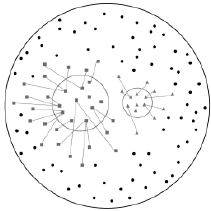
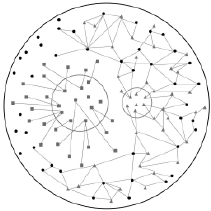
uccessful protest movements like the American civil rights campaign, Gladwell insists, depend on strong ties, and these are very few and far between on the Internet: ‘[Digital activism] is simply a form of organizing which favours the weak-tie connections that give us access to information over the strong-tie connections that help us persevere in the face of danger. It shifts our energies from organizations that promote strategic and disciplined activity and toward those which promote resilience and adaptability. It makes it easier for activists to express themselves, and harder for that expression to have any impact.’Returning for a moment to the structural problem activists face presented at the opening of this article, Gladwell and the other digital skeptics argue that the new online repertoire of contention is ineffective, as illustrated by Figure 3. The amplifying role traditional media outlets could play in the pre-digital era no longer holds, and instead, protesters and oppressors alike seek to directly influence the audience. But as there are by definition more oppressors than activists, and given the ineffectiveness of most online protest tactics, most social protest movements these days are destined to fail, the digital pessimists conclude.
Digital optimists such as Barberá and Steinert-Threlkeld accept many of the same starting points as digital pessimists: first, that there is a marked difference between strong and weak ties; and second, that successful protest movements require a core group of protesters who are willing to take huge risks, and who are held together by strong ties. But digital optimists use the methods of network analysis to demonstrate that if enough weak ties are activated, the resulting spread of the protesters’ message can have a massive impact on the audience’s attitudes, as shown in Figure 4.
F
or instance, in a study of the Gezi Park protests that took place in Istanbul in 2013, Barberá and his co-authors find that while highly committed handfuls of activists constituted the heart of the protests, their ability to reach large numbers of observers and affect overall public opinion depended on getting peripheral users to echo their messages:‘Our findings suggest that peripheral users in online protest networks may be as important in expanding the reach of messages as the highly committed minority at the core. […] Peripheral users possess potentially valuable mobilization resources that greatly increase the number of online individuals who are exposed to protest messages initiated by core participants. […] Protestors at the core of this network – a large proportion of whom were actual protesters on the ground, as evidenced by the location of the messages they shared on Twitter – would have had a much harder time reaching such a large online audience without the critical periphery of low-activity users.’
P
eripheral users are of course less committed to the cause than hard core activists; their efforts may merely consist of re-tweeting messages or changing their Facebook profile pictures. But the power of peripheral users lies in their numbers; their aggregate contribution to the spread of protest messages is comparable in magnitude to that of core participants (as shown in Figure 3):‘[O]ur findings demonstrate that relatively low commitment participants – who are often derided as feel-good activists or "slacktivists" – are potentially very important as a collective. By expanding the audience of messages sent by the committed minority, the periphery can amplify the core voices and actions, and thus provide a way for larger numbers of online citizens to be exposed to news and information about the protest, even (or especially) in the absence of mass media coverage.’
|
FIGURE 3 A Schematic Representation of Contemporary Protest Tactics According to Digital Pessimists |
FIGURE 4 A Schematic Representation of Present Day Protest Tactics According to Digital Optimists |
|
|
|
A separate study by Steinert-Threlkeld confirms the same broad findings based on an analysis of real-world demonstrations in 16 countries during the 2010 Arab Spring. He also concludes that Twitter users on the periphery of protest networks were a major determinant of whether the uprisings were successful or not, suggesting that effective digital activism today is to some extent a numbers game, one that the new digital repertoire of contention may be helping with.
A
s with all intellectual debates, the truth probably lies between the extreme positions staked out by both the digital pessimists and the digital optimists. (Precisely such a middle ground stance can be seen in Zeynep Tufekci’s recent big-picture take on digital activism.) But what would Mahatma Gandhi and Dr. King have made of all this? It’s difficult to know, of course, but I think there are at least two parts of their legacies that very much speak to how we as moral citizens should act in an increasingly digital world. First, given the massive increase in the availability of information, none of us can afford to be bystanders anymore. Second, there is a need for us to conceptualize the growing multitude of progressive causes as actually all going hand in hand.As barriers to disseminating information have lowered with increased digitalization, the need for individuals to become informed citizens of their various communities – local, national, global – is greater than ever. It was quite possible, even likely, to be a British woman in 1935 and not have an opinion about the British presence in India. It was even possible to be a white American living in Chicago in 1965 and not have much knowledge about the segregation practices of the deep South. It was precisely because of this accumulation of uneasy ignorance that Gandhi, King, and their allies experimented with novel forms of political protest, so that uninformed members of the audience would take cognizance of the injustices they were fighting.
We today in 2018 no longer have a right to claim ignorance. And it is worth remembering that in his speeches, Dr. King directed the most withering and scathing of his remarks not against active repressors, but rather towards ‘white moderates’ who stood by idly as moral outrages festered. As he famously remarked, ‘History will have to record that the greatest tragedy of this period of social transition was not the strident clamour of the bad people, but the appalling silence of the good people.’
F
or some, though, the problem with acting morally in a digital age is not that they are uniformed about the various forms of violence that mar our world, but rather that there are so many pressing needs – so many urgent problems that must be addressed right away – that individuals become overwhelmed and struggle to prioritize. Sometimes this results from different identity groups all vying with one another to monopolize the limelight. Sometimes it arises from the tone of breathless outrage common to social media activism, which constantly clamours for us to Stop the Killings in Syria Now; Combat Climate Change Today; Save the White Rhino; End the Lynchings of Muslims; Punish the Child Rapists; Help the Farmers in Maharashtra; etc. To be sure, all of these are worthy causes, but a true progressive in the vein of Gandhi and King should ponder how these different types of structural inequities interact with and reinforce one another. Indeed, throughout their political careers, both Gandhi and King took pains to show how seemingly different social movements were actually interconnected. For Gandhi, this included demonstrating how better relations between nations, between genders, between religious communities, between castes, and between humans and animals could all grow out of the same personal commitment to truth (satyagraha).During the year prior to his assassination, King sought to make a similar point, arguing that racism, economic inequality, and militarism all went hand in hand in American society. Accordingly, seeking to truly end racism also implied campaigning for a guaranteed basic income; campaigning for the end of the American military involvement in Vietnam necessitated addressing racial inequality at home. Therefore, the legacies of Gandhi and King call us not to become overwhelmed and defeatist in the face of the many problems plaguing our world, but instead to examine how thinking holistically about racism, sexism, environmentalism, homophobia, ableism, ageism, neo-colonialism, and other social ills leads to much smarter and better targeted initiatives.
O
verall, the main message of Mahatma Gandhi and Dr. King is one of cautious optimism about our collective ability to engender social change today. For all of its well known faults and shortcomings, digital activism allows political messages to be seen by more people more quickly than at previous points in history. It was the firm belief of Gandhi and King that if you performed activism in novel and creative ways in front of a large enough audience, and if your message resonated morally, you could change the trajectory of entire nations, opening the way for a more just, equitable and non-violent future.
* I am grateful to Tom Cook, Sean Bala and Kathleen Modrowski for helpful comments on this essay.
Footnote:
1. Tim Pratt and James Vernon, ‘"Appeal from this fiery bad…": The Colonial Politics of Gandhi’s Fasts and their Metropolitan Reception’, Journal of British Studies 44(1), January 2005, pp. 92-114.