Do we need genders?
RONALD DE SOUSA
‘[T]he end goal of feminist revolution must be, unlike that of the first feminist movement, not just the elimination of male privilege but of the sex distinction itself.’
– Shulamith Firestone, 1972
A little over four years ago, The Indian Supreme Court recognized transgender persons as a ‘third gender’. A number of other jurisdictions, including California, Australia and Germany, have also allowed individuals to classify themselves as neither male nor female on official documents such as passports. What is the rationale for such a measure? Is it a good idea?
In this essay, I shall be primarily concerned with the personal and socio-political consequences of two observations. The first is that while the distinction between men and women is largely taken for granted, individuals frequently experience their own identity as failing to fit in comfortably with the expectations associated with the gender to which they were assigned at birth. The second is that the increasing frequency of this phenomenon is paradoxical: in view of the notable relaxation of the normative standards imposed on men and women in recent decades, it might be expected that individuals would feel correspondingly less constrained, and gender dysphoria should become a thing of the past.
Why then is it that we are, on the contrary, witnessing what some are tempted to describe as an epidemic of gender dysphoria?
1 I shall conclude that the recognition of an alternative to Woman and Man is counterproductive. It would be best, even if it seems currently utopian, to eliminate altogether the very category of gender.
T
he existence of a ‘third option’ conceals many subtleties and raises many questions. All cultures classify the vast majority of persons unhesitatingly as male or female, man or woman. It follows that the very existence of the third option, usually phrased as ‘X’ or ‘neither M nor F’, underlines the very inequality it is intended to mitigate. For it suggests that while men and women are seen positively as members of ‘opposite sexes’ each of which is defined by common properties, those who fit the third option are defined only by what they are not.That third option is highly heterogeneous. It includes ‘transgender’ persons whose original biological sex is not in question, but who have chosen to live as a member of the other traditional gender. Some of these, but not all, have undergone a physical intervention, either chemical or surgical, to reconfigure their anatomy and physiology. These persons were first commonly designated as ‘transsexuals’, but they are now more commonly said to be ‘transgender’ or simply ‘trans’.
2 The category also includes ‘intersex’ persons, a group heterogeneous in its own right, sharing only the fact that their sexual organs, internal, external or both, have developed in a way that deviated from the typical pattern from any of several different causes.3Intersex status can stem from an exceptional chromosomal pattern, with an additional or missing X or Y; it can also result from a deviation, at some stage, from a complex cascade of developmental processes that typically produce ‘normal’ males and females. That process leads from chromosome type, to fetal and adolescent hormone production, to the organism’s capacity to respond to these hormones, to the formation of functioning gonads and genitalia. The resulting ‘intersex’ configurations can come about in different ways. Some individuals are affected by Androgeny Insensitivity Syndrome (AIS): despite their possession of an XY chromosome pair, their fetal hormones fail to trigger masculinization, and they develop a female instead of a male anatomy. Individuals suffering from Andro-Genital Syndrome (AGS) endure a converse anomaly: they are chromosomally female individuals who are exposed to unusually high levels of fetal androgens and hence develop male anatomy.
T
he great diversity of cases characterized as ‘intersex’ once moved Anne Fausto-Sterling to argue that, from the biological point of view, sex forms a continuum from so-called ‘normal’ males to normal females. Along this continuum, she suggested, if only ‘tongue in cheek’,4 that we should distinguish at least five distinct sexes. In addition to males and females, these would comprise full hermaphrodites, endowed with both male and female internal reproductive organs – both testes and ovaries – as well as ‘ferms’ and ‘merms’, whose organs include, respectively, both some well formed female or well formed male gonads, and some partly developed anatomical features typical of the other sex.The diversity of developmental paths just illustrated makes it particularly problematic to assume, as is often done, that the categories of gender are merely psycho-social consequences of a dichotomous category of biological sex. Fausto-Sterling herself conceded that multiplying sexes on the basis of variations in the configuration of genitalia is unhelpful: for all purposes but the mechanics of reproduction, what matters to our personal and public lives is gender, not sex.
5 But what exactly constitutes gender? That question is much disputed. What concerns me here is a question less often asked: why should gender matter? Why should it be of more interest to classify people on the basis of gender than on any other arbitrary basis such as size, or skin colour?
O
n the nature of gender as distinct from sex, one can distinguish, roughly speaking, two opposing positions. Label them ‘conservative’ and ‘progressive’, just for convenient reference. The conservative position sees gender as rooted in a biological fact. It regards the difference in reproductive roles of males and females, beginning with the undeniable dimorphism of the tiny male and relatively huge female gametes, as effectively determining appropriate social roles through the cascade of processes constituting normal development. Despite differences among cultures in the specific ways these roles are differentiated, all are implementations of differences that have their ultimate origins in biology.The progressive view regards gender roles as socially constructed, in the negative sense that they are not determined by biology.
6 More positively, gender roles are not merely created by social expectations but ‘performed’ by individuals, who nevertheless experience such performances as mandatory.7 They are felt as such because the prevalent ideology represents certain ways of being – social roles, personality, behaviour, emotional dispositions, and attitudes, notably attitudes to sexuality – as required by nature.
G
iven the vast differences between conceptions of masculinity and femininity taken for granted in different cultures, we can be pretty confident that any such assumption of naturalness is false. The appeal to nature, however, lies at the root of a long and deeply influential tradition known as Natural Law Theory. This goes back to Thomas Aquinas and further to Aristotle. Both held that we could gain some insight into what ‘nature intended’ by observing what happened ‘always or for the most part’.8 And from Aquinas: ‘the law... is judged in accordance with what happens in general, and not in accordance with what may happen in a particular case’.9 Aquinas went further and inferred that the order thus observed was what God commanded. It seemed to follow that we should regard any person whose anatomical, physiological and psychological properties deviate markedly from the standard type associated with one sex or the other as not only statistically unusual but normatively deviant.This illustrates two features of the still highly influential Natural Law tradition that render it wholly untenable. The first is that it takes for granted that natural types are strictly distinct from one another. That is not the way life works. Biological properties and differences always admit of degrees. As John Dupré has put it, ‘In biology, it appears, distinct kinds are not given to us by nature but rather by our local and limited perspective on nature. So... our natural intuition that men and women are essentially different kinds distinguished by distinct inner natures should be treated with caution.’
10
T
he second problem is that Natural Law commits an odd sort of ‘bait-and-switch’: it begins by claiming to be looking for ‘natural laws’ in the scientific, factual sense, but goes on to claim that the ‘laws’ in question have the status of prescriptive laws, analogous to those enacted by legislation. This is a bit like insisting that the law of gravity needs to be enforced against any dissident who would defy it. It commits the ‘naturalistic fallacy’: the inference from the fact that X is natural, to the conclusion that X must therefore be good.Both these two features of Natural Law theory clash with the fundamental facts of evolution by natural selection. The features ‘selected’ by evolution are just those that happened to favour the replication of the underlying genes. That could, and probably did, include many forms of behaviour that we find entirely reprehensible – rape, genocide and other forms of tribalism – no less than characteristics we approve of, such as cooperation and empathy. What is ‘deviant’ in a purely factual, statistical sense is not necessarily either better or worse than what is prevalent. In fact, it is obvious on the briefest reflection that every modification of an ancestral genome that brought us closer to being human must necessarily have been exceptional. We are all descended from millions of freaks, or deviants. Essentialism – the view that certain characteristics are necessary and sufficient for an item to belong to a given kind – is essentially incompatible with evolution, whether it is applied to species or to genders.
H
istorically, deviance in matters of sex, both as behaviour, such as sexual practices or orientation, or as gender, has tended first to be taken as moral, religious or political. At that stage, the deviant subject is deemed immoral, sinful, or criminal. Later, in a move intended to be ‘progressive’, the deviant behaviour or trait is seen as not sinful but pathological, on the model of a disease or disability. Such a sequence of attitudes is just what has unfolded regarding homosexuality. Until last month (as I write) in India, and as recently as half a century ago in Britain, North America, and elsewhere, homosexuality was a crime. For this crime, Oscar Wilde and Alan Turing, among innumerable others, were made to suffer imprisonment, chemical castration, social ostracism, or death.In the 1960s in England and elsewhere homosexuality ceased to be a crime but came to be classified as a mental disorder. Only in 1973 was it removed from the DSM or Diagnostic and Statistical Manual of Mental Disorders of the American Psychiatric Association.
11 Since then, with a rapidity that would have been quite unpredictable half a century ago, it has become recognized as simply a variant sexual orientation, with over twenty-five countries currently recognizing marriage between persons of the same sex.In the democratic West, non-conformism in gender is now stuck somewhere between the first, moralistic stage, and the second, medicalizing one. Laws against cross-dressing widely used to repress any form of gender non-conformism lasted into the 20th century.
12 Nowadays, whether or not it is sanctioned by law, discrimination against gender-queer persons is still widely practiced. And ‘gender dysphoria’ remains listed in the DSM V – the 5th edition of the Diagnostic and Statistical Manual – which specifies, however, that it is not necessarily in itself a disorder unless it produces significant distress.13
O
ne aspect of the conservative position has quite recently gained considerable prominence: resistance to the demand for additional pronouns. This is partly as a result of the sudden popularity of YouTube videos by University of Toronto psychologist Jordan Peterson. In the past couple of years, Peterson’s videos and lectures have drawn a large and profitable following. He first attracted controversy when he objected to a law designed to add trans-gender and gender-non-conforming persons to the list of those protected from discrimination. Existing law previously extended such protection to race, ethnicity, sex, and sexual orientation.Peterson framed his argument in terms of ‘free speech’: while conceding that the state might have an interest in forbidding certain extreme forms of hate speech, he insisted that the new law crossed a line that would inevitably lead to fascism. This was because the new law did not merely ban offensive speech, but mandated some forms of speech, specifically the use of non-gendered pronouns. In protest, Peterson insisted on his refusal to use non-standard pronouns, while affecting to believe that his stance might result in the loss of his professorship or even jail.
14 Peterson has also published a best-selling book about how to protect your life from chaos. In that book chaos is associated with the Feminine Principle, while Order is associated with the Masculine.15
I
n numerous YouTube video lectures, Peterson argued that sex and gender are by nature ‘binary categories’. In some, he went as far as to deny the actual existence of ‘non-binary’ persons. A brief sample of his rhetoric on these topics can be found in a four-minute presentation made available by TV Ontario entitled ‘Gender for Ever’.16 In this video, Peterson espouses something very much like Aristotle’s and Aquinas’ emphasis on the normality of the statistically frequent: ‘We know that not every man or woman must exhibit a trait for it to be descriptive of masculinity or femininity: it’s enough that it’s typical of the majority.’In another video, Peterson lists a number of personality traits associated with masculinity: ‘ambitious, self-reliant, tough’; in contrast, femininity connotes ‘loving, unselfish, and kind’. Gender roles, he avers, ‘are virtuous… ideals to aspire to’. He asserts that ‘in the natural world, shaped by billions of years of evolution, such differences are real, and deep’. Moreover, he continues in the same video, ‘such virtues cannot be developed without specialization’. He invokes the – widely debunked
17 – ‘rule’ that it takes ten thousand hours to acquire a skill, and concludes that being a girl or being a boy are skills that must be learned at the cost of diligent practice.18
T
he incoherence is striking. If gender had indeed been ‘shaped by billions of years of evolution’ (actually sexual reproduction dates from only 1.2 billion years ago), surely that should have spared us the extra ten thousand hours of laborious effort. Leaving that aside, Peterson’s claim is a fair expression of gender essentialism: the view that there is an essential difference between the sexes, and that having one or the other essence is itself part and parcel of the essence of being human. Essentialism regards the differences between masculine and feminine paradigms as belonging to the essential nature of men and women.In addition, Peterson’s position clearly commits the fallacy of ‘bait-and-switch’ that mars the basic principle of Natural Law theory. It adds, to a claim about the facts of nature, a normative requirement for any given individual to conform. His position is thus reminiscent of the indignant response made by certain religious writers to Fausto-Sterling’s original proposal to recognize five sexes: ‘It is maddening’, says the text of a New York Times advertisement paid for by the Catholic League for Religious and Civil Rights, ‘to listen to discussions of "five genders" when every sane person knows there are but two sexes, both of which are rooted in nature.’
19 It nicely illustrates the conservative position’s roots in the tradition of Natural Law, including its commitment to essentialism in respect of sex and gender.
I
n addition to the problems with essentialism already mentioned, support for the biological underpinnings of gender is thin at best. This should be obvious to the unaided eye of common sense, given the sheer cultural diversity in gender roles found around the globe, as well as the changes these roles have undergone – at least in some parts of the world – over the last century or two. In addition, as we shall see below, scientific research into sex differences has been driven by a priori assumptions of women’s inferiority even while claiming to find it in the outcome of investigation.20 Nevertheless, concerns about alternative genders have sparked an increasingly active conversation that cuts across issues of biology. Regardless of the origins of sex differences, what is the basis for gender differences?The relationship between the two conversations poses a puzzle. We have surely witnessed, in the past century or so, an accelerated relaxation of the social expectations and conventions driving gender norms. Why then, just as social roles have become less constraining than ever before, should an increasing number of individuals find themselves unbearably oppressed by those gender expectations? Transgender persons have always existed in the West as well as in India. But the incidence of ‘gender dysphoria’ has suddenly become subject to widespread chatter in public discourse and social media. Perhaps this illustrates the maxim that revolutions occur not when tyranny is at its worst but when it begins to reform. ‘No one attempts what is impossible; they will not attempt to overthrow a tyranny, if they are powerless.’
21 The tyranny of gender having showed signs of weakening, those oppressed by it are seizing their chance to revolt.
W
hat exactly is the tyranny of gender? We can distinguish two forms. The first pertains to the norms of masculinity and femininity to which men and women are enjoined respectively to conform. For the majority, such conformity is effortless. For some, however, it does not come naturally. But can that phrase make sense? If gender norms result from social conditioning, can it be that an individual who feels oppressed by them is wired up, by nature, so as not to fit in? The paradox stems from the implication that while gender stereotypes are socially constructed, resistance to them comes directly from nature. If so, at least some patterns of gender expression must, after all, be conditioned by nature rather than nurture. From which it would follow that gender does, after all, supervene on biology. But if what it supervenes on is not biological sex characteristics, what can it be?That inference to a ‘natural’ factor could be only provisional, of course, given the problems that have plagued attempts to distinguish nature from nurture. The ways in which an infant’s self-perception can be influenced are subtle and elusive. Observations intended to discern a baby’s untutored choice of toys – one of the more robust sex differences observed even among nonhuman primates
22 – are notoriously subject to the influence of cues unconsciously emitted by experimenters with prior knowledge of each baby’s sex. It is difficult in practice to insulate experimenters from that knowledge, if only because they require permission from parents, who are usually highly aware of their babies’ sex.23The second tyranny of gender is ‘second-order’. It consists in the insistence that gender and sex are both ‘binary’. The first-order norm requires a man to be masculine and a woman to be feminine; the second-order norm is that one must be one or the other. There is no third option.
I
f that is true, the second-order constraint is one that an intersex person by definition cannot meet. That seems to commit the defender of the conservative position to the claim that intersex people are not quite human. That, one hopes, should make even conservatives uncomfortable. For those, much more common, whose biological sex is not equivocal but who feel that neither gender fits their nature, the problem remains acute. Such persons feel that presenting themselves to the world as embodying one or the other gender would be equally inauthentic. At best, it is mere pretending; at worst, it is downright impossible to achieve. What comfort is there for them?Masculinity and femininity present themselves as more or less coherent ideals. They differ among cultures, but each culture tends to regard them as just reflecting nature. In Plato’s Meno, when Socrates asks for a definition of virtue, Meno helpfully gives him not one but ‘a swarm’: ‘The virtue of a man [is to] know how to administer the state, and in the administration of it to benefit his friends and harm his enemies; and he must also be careful not to suffer harm himself. A woman’s virtue... is to order her house, and keep what is indoors, and obey her husband.’
24 These definitions would be endorsed by many of our less enlightened contemporaries. Their durability is attested by the way they have left their mark in a number of linguistic quirks. An honest man is one who does not steal or cheat; an honest woman is one who abstains from sex with anyone but her spouse. In French, a péripatétitien is an Aristotelian philosopher, in recognition of the story that participants in Aristotle’s seminars would debate while strolling; a péripatétitienne, however, is not a female follower of the Academy but what was also once called in English a ‘street walker’.
U
ntil fairly recently, being actively and exclusively interested in women as potential sexual partners was part of the ‘masculine’ package; being exclusively (but only mildly) interested in men as sexual partners was part of the feminine. The proviso that her interest be ‘mild’ was itself, however, historically unusual. In the third book of his Metamorphoses, Ovid relates the tale of the judgment rendered by Tiresias, who had been both man and woman. Woman’s pleasure in sex, he reported, is far greater than man’s. Many cultures have feared the insatiable, devouring character of female sexuality, as is cruelly attested by the need felt by some to tame it by the genital mutilation of pubescent girls.
W
here homosexuality is no longer reviled as ‘against nature’, heterosexual orientation has almost completely ceased to be regarded as part of the standard gender package. But the imperative normativity of the rest of the package has remained relatively intact. As a recent article in the Economist notes, it is still as difficult to recruit men to the profession of nursing as it is women to that of an engineer. And it has become common knowledge that the profession of ‘computing’ ceased to be typically identified with women only when it became lucrative and prestigious (see the 2016 movie Hidden Figures).The acceptance of homosexuals has done nothing to undermine the respectability of heterosexual orientation. One might therefore hope, in an irenic spirit of optimism, that other features of the once obligatory stereotypes of masculinity and femininity might gradually become optional. Perhaps this is too much to hope for, notably if one is inclined to think that gender norms will obey the general Law of Conservation of Moralization once put forward by Steven Pinker
25: everyone needs a constant number of things for which they can reproach themselves and others. So even if they no longer find it shocking for a woman to be an aggressive CEO or lead an orchestra26 they will find it all the more bizarre to find a man who is a homemaker.An apocryphal legend has it that Queen Victoria didn’t think lesbianism conceivable, which is why it was left out of her government’s law criminalizing sodomy. ‘Boston marriages’ illustrated the possibility that people could accept lesbian couples in the early 20th century. The greater acceptance of lesbian couples may appear to support the claim that the norm against homosexuality was applied more stringently to men than to women.
B
ut this marks no exception to the rule of male dominance. For the popularity of lesbian porn among heterosexual men might argue that men, who enforced the norms, regarded lesbians as just another form of titillation for themselves. Similarly, the apparently less stringent norms of feminine compared to masculine dress codes may seem to signal an exception to the general rule that norms imposed on females are more stringent. Again, however, it may be seen as just another manifestations of the superior importance of men. Their norms matter more because men matter more. Both phenomena illustrate the general rule that if there is one standard that standard is always the masculine. It is therefore more acceptable for women to move closer to it that it is for men to move further away.27Nevertheless, as one gender stereotype after another is removed from the list of essential and exclusive ones, one can hope for a world in which they will all have become optional, matters of personal choice. In such a world, where no one is constrained to adopt any particular cluster of traits, regardless of their past association with gender, it is difficult to see why any individual should experience gender dysphoria.
N
o such world will come about, of course, if the conservative position proves to be correct. The conservative view might be vindicated by scientific research that conclusively identified biological factors as the main causes of gender differences. To achieve such a vindication has been the goal of much research on ‘sex differences’. Unfortunately for the conservative view, however, both the findings and the relevance of that research give us ample reason to ignore it.Angela Saini shows how, in the early years of the 20th century, research into the relevance of hormones to sex and gender began with the assumption that androgens produced masculine qualities and estrogen produced feminine qualities. By the 1920s, however, this line of thought was undermined by the discovery that both androgens and estrogens were found in both sexes. ‘In 1934, the German-born gynecologist Bernhard Zondek, while studying stallion urine, reported... that a male horse’s testes turned out to be one of the richest sources of estrogen ever found.’
28More recently, Rebecca Jordan-Young has laid bare the remarkable fact that scientists purporting to trace the origins of gender differences in structural and hormonal differences in the fetal brain never bothered to inquire seriously into the nature of masculinity and femininity. Instead, they plucked their definitions out of the thin air of prejudice: ‘nearly all scientists conducting brain organization research treat masculinity and femininity as commonsense ideas that don’t require explicit definitions’.
29
W
hat is even more shocking, the set of assumptions about female sexuality most common in research conducted after 1980 differed radically, without any explicit acknowledgement of change, from those taken for granted in research conducted before 1980. In the later period, under the influence of various changes in the predominant North American culture, several features previously labelled as characteristically masculine came to be labelled as feminine (though tellingly none of the marks of femininity migrated to the list of masculine ones.30In the earlier studies, for example, ‘Feminine sexuality… is romantic, dependent, receptive, slow to waken, and only weakly physical… Not… an end in itself but as a means for fulfilling desires for love and motherhood. Masculine sexuality was a mirror image of their feminine model: active and energetic, initiating, dominant, penetrating, frequent, intense, and genitally focused… its own end, unsentimental and undiluted by romance.’
31Characteristics that later migrated from the list of masculine to the list of feminine markers: ‘in particular, masturbation, genital arousal, and sex with multiple partners came to be understood as "commonsense" features of feminine sexuality, even though these had earlier been read as clear signs of masculinity’.
32 To add to the confusion that not all studies make the same assumption about the relation between masculinity and femininity. Some adopt a ‘bipolar model’, in which masculinity and femininity are simply opposite poles in a single dimension: a high score on one is identical with a low score on the other. Other studies assume an ‘orthogonal model’, such as that originally suggested by Sandra Bem in her pioneering studies of gender and androgyny several decades ago.33The orthogonal model allows for ‘androgyny’: if masculinity and femininity are not simply complementary, a person can be high on both scales, or low in both.
34 All this means that many ‘results’ obtained before and after that pivot were rendered mutually irrelevant by equivocation.35
F
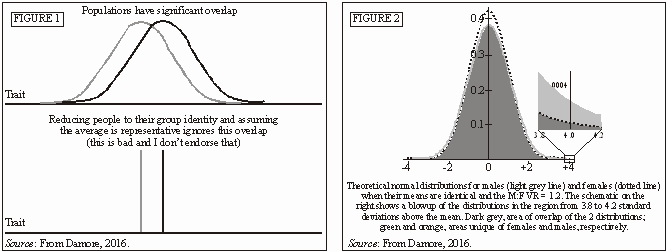
or all practical purposes involving the treatment of individual persons, there is an important additional reason for ignoring research on sex differences. Differences in abilities or temperament revealed by comparisons between men and women are statistical. In practice, that means one of two kinds of differences between populations of men and women; but it means virtually nothing for any individual members of those populations. The first kind of statistical difference pertains to averages: the bell curves describing the distribution of some trait show a displacement of their averages, notably of their mode (the region in which the largest numbers of subjects displaying the trait are to be found).|
|
|
Source : From Haidt and Stevens, 2017. |
Where there is such a displacement, in all traits except those strictly involving physiological aspects of reproduction, but including sexual identity and sexual orientation, there is always a large area of overlap. This varies depending on the trait in question; but on cognitive performance of various sorts women and men tend to be less than one standard deviation apart. That means that the vast majority of men and women are in the area of overlap. In other words, in respect of any trait in which men and women differ statistically, there will almost certainly be some woman who is more masculine than a given man; conversely, for any woman, there will almost certainly be some man that rates more highly on a given measure of femininity.
36
T
he second way in which sex differences may show up in the shape of the curve. This is manifested, for example, in the greater number of one sex that figures the extreme tails of the curve. Significantly, however, on some of the dimensions that display the greatest discrepancies, the extent of those discrepancies has dramatically diminished. Melissa Hines notes, in particular, that ‘[f]or the SAT Mathematics, the sex ratio among those scoring at the upper extreme has declined from 13 boys to one girl in 1982 to 2.8 boys to one girl more recently’.37 More generally, as mentioned above, masculine traits have remained relatively constant in men, while women have tended to become less feminine.38
I
n short, while the extent and nature of sex differences and their origins in fetal development are still much debated,39 it is quite clear that no inference about any individual’s characteristics can be drawn from their gender.In a number of his video lectures, Peterson has characterized his quarrel with ‘leftists’ as a struggle between individualism and collectivism. The group, regarded as akin to the archetype of the female, is superseded by the ‘divine individual’, who is of necessity male.
40 Setting aside the renewed insistence on mythical archetypes of maleness and femaleness, this seems to sit uneasily with Peterson’s warnings against feminism as a form of ‘group identity politics’. For surely feminism in general is best interpreted as the simple slogan that a person’s gender should entail no consequences for that person’s choice of activities, personal style, or public career. Even if every sex difference detected by comparisons of brain structure, hormonal activity, or temperaments turned out to have unequivocally biological origins, this could have no direct consequence for any individual. For any given individual of either sex might lie anywhere in the vast area of overlap between the areas occupied by men and women on any particular trait characteristic of masculinity or femininity.
T
hese considerations suggest why it might be a good idea to offer, as the state of California has recently done,41 a ‘third option’ to those people who feel constrained by the necessity of identifying as man or as woman. Conservative opponents of the bill opposed it along expected lines, arguing that Nature, if not God himself, decrees every person to be either male or female, man or woman, on the basis of their possession of penis or vagina. The left welcomed it as a vindication of the rights of every individual to define their own sexual identity.
A
gainst both of these responses, the philosopher Robin Dembroff, writing as ‘one who identifies as gender queer and uses the gender-neutral pronouns they and them’, has argued that measures providing for a third option, despite their good intentions, are misguided.42 Dembroff’s objection is to the very idea of gender as a basis for defining the rights and privileges of individuals in any way whatever. They regard the introduction of a third gender as endorsing precisely what is objectionable about the original binary categories: the idea that the state has a legitimate interest in setting up legal constraints on individuals’ lives on the basis of gender. If we assume that a modern democratic state regards the promotion of equality as important, it is hard to understand why it would be in the public interest to have every citizen labelled as M or F. Adding X for those that fit neither of the first two does not make it more relevant to anything in which the state has any reason to recognize or regulate.To be sure, we need not deny that the physiological differences between males and females may entail different needs and different health risks. That makes it imperative to extend medical research into the special characteristics of females. Biological sex, including intersex status (but not ‘non-binary’ gender), might be relevant to medical questions on the same basis as blood type or allergy. But that sort of information is not generally specified on passports. Keeping track of sex insofar as it might be medically useful would take nothing away from the equality of all individuals’ rights, regardless of their self-presentation. It would acknowledge – or perhaps even pre-empt – some of the objections raised against the claims of transgender women to be recognized as women on the same basis as cis-women
43: from the medical point of view, a ‘trans-man’ is unlikely to share the health risks of other males, and a trans-woman is unlikely to share those of cis-females. Trans persons may be exposed to specific potential risks that would warrant separate investigation, but outside of a medical context it should be irrelevant to any aspect of social life.
R
ebecca Reilly-Cooper has offered a somewhat different line of argument for the elimination of gender. She has singled out the claim that gender should be seen as a continuum, and convincingly explained why, despite its initial attractiveness, that proposed solution serves neither theoretical nor practical purposes.44From the point of view of logic, the main problem is that the term ‘trans-gender’ is defined negatively by opposition to ‘cis-gender’. A transgender person is a person who is not cis-gendered. But if gender is a continuum, then what is a cis-gendered person? A typical cis-man or cis-woman is typically someone who has never questioned the gender identity assigned to them at birth on the basis of their genital anatomy. But that can hardly serve as a definition. It is itself phrased in terms of a negative, unless one can independently identify clusters of traits that are respectively definitive of ‘masculinity’ and ‘femininity’, and deny a person’s right to identify themselves as a ‘woman’ or a ‘man’ if they failed to exhibit the appropriate cluster of traits. In the absence of an appropriate list of defining traits, there is no option but to define a cis-person as one who is not transgender, and conversely. The two terms, then, form a vicious circle of mutual negation, devoid of content.
A
s I have illustrated above, attempts to pin down a set of independently identifiable marks of femininity and masculinity reflect little more than local prejudices prevalent at some particular time and place. This is true not only of ‘commonsense’ conceptions of gender, but of much supposedly scientific research. Scientific investigation of sex differences sometimes begs the question by taking for granted the very stereotypes that later appear as ‘findings’; and the changing nature of those stereotypes and the adoption of incompatible models – bipolar or orthogonal – render meta-analyses virtually meaningless.A major problem with the suggestion that gender is a ‘continuum’ is that conceptions of masculinity and femininity go far beyond the expression of sexuality in behaviour or desire. There is not one spectrum, but a great many. Traits marked as characteristically masculine include being independent, non-emotional, aggressive, tough-skinned, competitive, clumsy, experienced, strong, active, and self-confident. These contrast with being dependent, emotional, passive, sensitive, quiet, graceful, innocent, weak, nurturing, and self-critical, which are marked as feminine. But these clichés merely scratch the surface.
As Sandra Bem showed, the ‘gender schema’ involves ‘a diverse and sprawling network of associations encompassing not only those features directly related to male and female persons, such as anatomy, reproductive function, division of labour, and personality attributes, but also features more remotely or metaphorically related to sex, such as the angularity or roundedness of an abstract shape and the periodicity of the moon. Indeed, there appears to be no other dichotomy in human experience with as many entities assimilated to it as the distinction between male and female.’
45One assumes that everyone can be classified on the basis of their position on a ‘spectrum’, therefore, it seems that both the distance between the extremes of the overall polarity, and the specific mix on the basis of which that distance might be calculated are susceptible of an indefinite variety. In the light of that fact, the categorization of people in terms of gender makes no sense. Its only recognizable purpose is to support otherwise unwarranted discrimination. Such discrimination is explicitly deplored by the United Nations Convention on the Elimination of all Forms of Discrimination Against Women, ratified by 189 states, which aims at ‘the elimination of prejudice and customary and all other practices which are based on the idea of the inferiority or the superiority of either of the sexes or on stereotyped roles for men and women.’
46
T
he status of trans- and inter-sex persons has been the object of fierce debate, in which the claims of gender-queer persons of all types have been attacked from opposite perspectives both by conservatives and radical feminists. Both conservatives and progressives have tended to base their case on essentialist assumptions. Scientific research has also often taken for granted an essentialist view of gender. By contrast, the radical view endorsed by Dembroff and Reilly-Cooper, among others, rejects the essentialist assumption that gender is a binary category grounded in biological sex. For reasons I have tried to make clear, that rejection does not commit us to the view that we should recognize any number – whether one or many – of non-standard genders. With changing attitudes resulting from economic and social changes, gender concepts have become increasingly blurred. Only the strictly biological roles of males and females in the process of reproduction are likely to remain distinct for the near future. Even that may change: technology will undoubtedly come to make it possible for same sex couples to have children by combining their DNA in vitro,47 though it will be some time before that becomes common. Meanwhile, in every other domain, the only rationale for anyone to take gender into account for any practical purpose is to provide a pretext for unjust discrimination.48
T
he alternative, when attempting to decide who is fitting for a certain role or job, or what one might oneself aspire to, is to simply take into account whatever combination of traits are relevant for the matter at hand. The association of any of those traits with gender stereotypes is completely irrelevant, and if ‘man or woman?’ ceased to be the first question asked of anyone on first acquaintance, that association would be easier to ignore. The illusion of utility to the notion of gender is eroding, and it will continue to do so.Once the content of gender ascriptions has withered to nothing, there will be nothing to be dysphoric about. And that, surely, would be unequivocally desirable.
Let me acknowledge the obvious: a world in which we are able to completely ignore gender is not close to being achieved. And as is often the case with proposals that tout an ideal that is rationally motivated but widely seen as utopian, the pursuit of that ideal will require temporary measures that conflict with that ideal itself. Thus, for example, the ideal of a world without nuclear weapons is arguably best pursued by relying on the deterrent force of such weapons, while exploring ways of securing their abolition. Similarly, those who advocate the end of oppressive sexual norms have sometimes been disappointed by the gay rights movement’s subservience to the ideals of monogamous ‘family values’; nevertheless, the progress of gay rights was undoubtedly hastened by the movement’s ability to represent gays as wanting to be ‘just like everyone else’.
S
ubsequently, however, the success of the gay rights movement may in part be responsible for the increasing acceptance of other forms of unconventional sexual choices, including BDSM (bondage, domination, and sadoma-sochism) or ‘kink’ and polyamory. Depending on your point of view, that figured as either a threat or a promise of the movement for equality of sexual orientations. In view of the analogies between the gay rights movement and the movement for transgender and gender queer rights, it may be hoped – or feared – that the proliferation of options in gender identification and expression will gradually lead to their desuetude.The raison d’être of gender has been none other than the justification of a repellent caste system. That system serves no useful purpose, and it would be best for everyone if it were abandoned.
Footnotes:
1. L. Marchiano, ‘Outbreak: On Transgender Teens and Psychic Epidemic’, Psychological Perspectives 60(3), 2017, pp. 345-66.
2. T.M. Bettcher, ‘Trans 101’, in R. Halwani, A. Soble, S. Hoffman and J.M. Held, The Philosophy of Sex: Contemporary Readings (7th edition). Rowman and Littlefield, Lanham, MD, 2017, pp. 119-138.
3. A. Fausto-Sterling, Sexing the Body: Gender Politics and the Construction of Sexuality. Basic Books, New York, 2000.
4. Ibid., p. 78.
5. Ibid., p. 110.
6. ‘It would be rash’, Simone de Beauvoir remarked, ‘to deduce from such an observation [of the contrasting sizes of male and female gametes] that woman’s place is in the home: but there are rash people’. S. de Beauvoir, The Second Sex (H.M. Parshley, trans. and ed.), Bantam, New York, 1952, p. 29.
7. J. Butler, Gender Trouble: Feminism and the Subversion of Identity. Routledge, New York, 1990.
8. Aristotle, The Complete Works: The Revised Oxford Translation (J. Barnes, ed.). Bollingen Series LXXI. Princeton University Press, Princeton, 1984. Met. 1027a20.
9. T. Aquinas, The Summa Theologica of St. Thomas Aquinas, (by Kevin Knight, ed.) (Second and Revised Edition, 1920). New Advent, 2008; (II-ii, Q154, Art. 2).
10. J. Dupré, ‘A Post-Genomic Perspective on Sex and Gender’, in D. Livingstone Smith (ed.), How Biology Shapes Philosophy: New Foundations for Naturalism. Oxford University Press, Cambridge, 2017, p. 321.
11. J. Drescher, ‘Out of DSM: Depathologizing Homosexuality’, Behavioral Science 5, 2015, pp. 565-575.
12. C. Sears, ‘Electric Brilliancy: Cross-Dressing Law and Freak Show Displays in Nineteenth-Century San Francisco’, Women’s Studies Quarterly 36(3-4), 2008, pp.170-187.
13. See https://www.psychiatry.org/patients-families/gender-dysphoria/what-is-gender-dysphoria
14. This interpretation, it should be noted, gained some plausibility from an ill-advised warning letter he received from the university administration, but was vehemently rejected by legal experts; L. Cumming, ‘Are Jordan Peterson’s Claims About Bill C-16 Correct?’, 19 December 2016. Retrieved from https://torontoist.com/2016/12/are-jordan-petersons-claims-about-bill-c-16-correct/
15. J. Peterson, 12 Rules for Life: An Antidote to Chaos. Allen Lane, Toronto, 2018.
16. J. Peterson, ‘Gender For Ever’ (Youtube video), 12 January 2012. Retrieved from https://www.youtube.com/watch?v= QOJaVL7N4G4&t=5s
17. See e.g. https://www.smithsonian-mag. com/smart-news/10000-hour-rule-not-real-180952410/
18. J. Peterson, ‘Beyond Gender?’ (Youtube video). 3 May 2012. Retrieved from https://www.youtube.com/watch?v=rF0_pvPsMaA
19. A. Fausto-Sterling, 2000, op. cit., fn. 4.
20. A. Saini, Inferior: How Science Got Women Wrong, and the New Research That’s Rewriting the Story. Beacon Press, Boston, 2017; R. M. Jordan-Young, Brainstorm: The Flaws in the Science of Sex Differences. Harvard University Press, Cambridge, MA, 2010; C. Fine, Delusions of Gender: How Our Minds, Society, and Neurosexism Create Difference. Jossey-Bass Social and Behavioral Science Series. Norton, New York, 2011.
21. Aristotle, Politics V, 1314a27.
22. G.M. Alexander and M. Hines, ‘Sex Differences in Response to Children’s Toys in Nonhuman Primates (Cercopithecus Aethiops Sabaeus)’, Evolution and Human Behaviour 23(6), 2002, pp. 467-79.
23. A. Saini, 2017, op. cit., fn. 20, pp. 88-90.
24. Plato, Meno (G. Grube, Trans.), in J. M. Cooper (ed.), Complete Works (pp. 870-896). Hackett, Indianapolis, 1997, pp. 71e, 2-4.
25. S. Pinker, ‘The Moral Instinct’, The New York Times Magazine, 13 January 2008.
26. But old attitudes die hard. In an interview, the prominent Russian conductor Yuri Temirkanov proclaimed that a woman conductor is ‘counter to nature’, since ‘the essence of the conductor’s profession is strength. The essence of a woman is weakness’; A. Ross, ‘Women, Gays, and Classical Music’, The New Yorker, 3 October 2013. Retrieved from https://www.newyorker.com/culture/culture-desk/women-gays-and-classical-music
27. K. Donnelly and J. Twenge, ‘Masculine and Feminine Traits on the Bem Sex-Role Inventory, 1993-2012: A Cross-Temporal Meta-Analysis’, Sex Roles 76, 2017, pp. 556-565.
28. A. Saini, 2017, op. cit., fn. 23, p. 34.
29. Jordan-Young, 2010, op. cit., fn. 20; Kindle loc. 1619-1620.
30. Ibid., loc., 1630.
31. Ibid., loc., 1679-82.
32. Ibid., loc., 1686-7.
33. S. Bem, ‘The Measurement of Psychological Androgyny’, Journal of Consulting and Clinical Psychology, 42(2), 1974, pp. 155-62.
34. Jordan-Young, 2010, op. cit., fn. 29; Kindle loc., 1619-1620, op. cit., fn. 29.
35. Jordan-Young, ibid., 2010, see esp. chapters 7 and 8.
36. M. Hines, ‘Sex-Related Variation in Human Behaviour and the Brain’, Trends in Cognitive Sciences 14(10), pp. 448-56, 2010, (Table I).
37. Ibid., p. 450.
38. K. Donnelly and J. Twenge, 2017, op. cit. fn. 27.
39. J. Haidt and S. Stevens, ‘The greater Male Variability Hypothesis: An Addendum to our Post on the Google Memo’. Heterodox Academy, 4 September 2017. Retrieved from http://heterodoxacademy.org/the-google-memo-what-does-the-research-say-about-gender-differences/
40. J. Peterson, ‘Collectivism, Individualism and Western Civilization’, 2016. Retrieved from https://www.youtube.com/watch? v= YnEFt20qe0o
41. The California ‘Gender Recognition Act’ was ‘chaptered’ (i.e. became law) in October 2017. Its intent is ‘to provide three equally recognized gender options on state-issued identification documents.’ See https://leginfo.legislature.ca.gov/faces/billNavClient.xhtml?bill_id=201720180SB179.
42. R. Dembroff, ‘The Non-Binary Gender Trap’, 2018. Retrieved from http://www. nybooks.com/daily/2018/01/30/the-nonbinary-gender-trap/
43. S. Jeffreys, Gender Hurts: A Feminist Analysis of the Politics of Transgenderism. Routledge, London and New York, 2014, ch. 3.
44. R. Reilly-Cooper, ‘Gender is Not a Spectrum’, 2016. Retrieved from https://aeon.co/essays/the-idea-that-gender-is-a-spectrum- is-a-new-gender-prison
45. S. Bem, ‘Gender Schema Theory a Cognitive Account of Sex Typing’, Psychological Review 88(4), 1981, p. 354.
46. CEDAW, 1979, Article 5, cited in S. Jeffreys, 2014, op. cit., fn. 43.
47. See e.g. https://www.nbcnews.com/feature/nbc-out/could-same-sex-couples-soon-conceive-child-both-their-dna-n836876.
48. S. Haslanger, ‘Future Genders? Future Races?’, Philosophic Exchange 34, 2004, pp. 4-27. Retrieved from https://digitalcom-mons. brockport.edu/cgi/viewcontent.cgi? article= 1033&context=phil_ex