Decentralization
in limbo and decline
T.R. RAGHUNANDAN
THE silver jubilee of the coming into effect of the
73rd Amendment was observed in April 2018. The official speeches, after their
perfunctory obeisance to the idea of decentralization, were all about
implementation of priorities set by higher level governments. However, in
reality, nothing has changed; arguably, institutional mechanisms to promote
true democratic decentralization have gotten worse. The devolution of flexible
grants to the Panchayats has marginally improved on
paper, but the actual use is hemmed in by a plethora of conditionalities.
Programmes and schemes continue largely as before, implemented by parallel
structures and their purpose-built user groups. In many states, Panchayat elections continue to be postponed indefinitely,
as states find ways and means of disobeying the Supreme Court’s orders that the
elections should not in any circumstances be delayed.
A consideration of these trends against the background
of theoretical conjecture, clarifies how forces of centralization never really
disappeared and indeed, gained strength over the years. The Balwant
Rai Mehta Committee1 justified the need for decentralization based
on the vast size of the country, the infinite variations that existed across it
and the difficulties of communication and coordination faced. It suggested that
elected bodies be established at the district and subdistrict
levels to supervise and monitor community development programmes. The
imperative for this suggestion was the need to foster more peoples’
participation in the nationally crafted community development programme.
The Ashok Mehta Committee was more focused on
promoting the idea of democratic decentralization as an end in itself. Its
recommendations, which included a two-level system instead of the three levels
suggested by Balwant Rai
Mehta, and the participation of political parties in local government
elections, were in that direction.
These two reports influenced the design of the
democratic decentralization constitutional amendments. Yet even though the 73rd
Amendment referred to devolution, it is this author’s view that its real import
was diluted by admixing ‘devolution’ with other forms of power transfer. A
reading of Article 243G indicates that what was envisaged was a mixed
relationship between higher level and local governments. It is this author’s
view that the ‘multiple option’ language of the 73rd
Amendment gave ample scope for the Union and state governments to modulate and
even reverse democratic devolution.
Has that happened? Indeed, it has, and what’s more,
such trends as we see were predicted by theoreticians in the past. The
economist Jack Waldon observed that if governance is
largely about managing spillover effects, if the
central government could do so effectively through allocating its resources,
then multilevel governments and decentralization are unnecessary and wasteful.
When the above observation was made, the possibility that a central government
could actually, in practice, manage all spillovers in
governance, was a remote possibility.2
That is no
longer the case. With the advent of large-scale e-governance projects and the
possibility of maintaining large databases coupled with the ability to deliver
money directly to people through electronic means, the decision-making on how
local programmes are to be run, has been withdrawn to central levels. We see Waldon’s observations now playing out in practice;
government believes that IT is a means by which nearly all spillover
externalities can be managed, thus marginalizing autonomous local government
interventions. Panchayats and Municipalities are
treated as front offices for large, centrally managed programmes.
Nearly every welfare programme now is dependent upon
central databases. For example, in the past, anti-poverty programmes were
transaction heavy – they involved policy setting at the highest level, in
matters such as beneficiary selection, permitted subsidies, budgetary limits,
the allocation and release of funds and so on. While guidelines stipulated how
to identify and select the poor, their actual selection and the day to day
management of such programmes were left to the states. They in turn delegated
the work to the local governments.
At the ground level, there was a great focus on the
proper conduct of Gram Sabha meetings and ensuring
that the poor had a voice. However, with large databases that can capture a
wealth of information, with unique IDs, facial imaging and fingerprinting, the
spread of decentralized banking and channels for instant transfer of funds, the
government aims to bridge the wide area effects of poverty by delivering cash
subsidies to the poor directly, rapidly and without high transaction costs.
Given that
Jack Waldon’s theoretical conjectures are now playing
out in practice, the fashion in bureaucratic groupthink is to believe that
decentralization delays programme implementation by creating layers of
superfluous decision-making, which the country can ill afford. Decentralized
implementation is considered unnecessary, because higher level governments have
now found ways to reach out to every beneficiary directly. Technology is the
great, benign, solution; never mind if it is also the great centralizer.
Have all problems been solved? Certainly
not, by a long measure. The Aadhar system is
still imperfect, duplicate numbers are issued, fake numbers are detected, and
those without access to the system are left to suffer. Curing such injustice by
adopting a decentralized system of local identification of the eligible through
Gram Sabhas, is considered unfashionable and backward
by the tech savvy, who now rule the roost in
governance.
We also turn our faces away from the fact that IT
governance cannot solve basic problems. The NREGA programme has a well designed
and well running IT enabled management system, which permits the country to
keep track of the hundreds of thousands of works undertaken all over, plus the
wage entitlements of millions of people undertaking manual work under the
programme. But if there is a budget shortfall and bills don’t get paid, IT
cannot rectify that.
Yet, there is discomfort with this centralizing trend
too; politicians are unwilling to openly give up the charade of decentralized
democratic involvement. Even if technology determines decisions, higher level
politicians and bureaucrats wish to keep up the illusion that local people have
assented to what technology determines is best for them. Politically, Gram Sabha meetings cannot be abandoned. They are still
convened, so that people can ’approve’ pre-determined beneficiary lists. In an
ironical demonstration of how technology has triumphed over human decision
making, the whole process is videographed as well. In
conclusion, centralizing forces that were always active,
are now using technology tools for command, control and surveillance, to
successfully robotize Panchayats into implementing
programmes designed from the top.
Even as the space for actual devolution of powers and
responsibilities to the Panchayats has stagnated,
other trends have limited the scope of decentralization. One of these is the
galloping urbanization across India. When the 74th Amendment was considered,
India was still predominantly rural and urban governance had not captured the
financial and policy attention that it has today. But with the
post-liberalization explosion in urban expansion and the lag between urban
population growth and the provision of urban facilities and infrastructure,
urban administration has become increasingly important.
In this
context, the focus ought to have been on strengthening urban decentralization
but given that rural decentralization had gone the agencification
route, it is not surprising that the governance ethos in urban areas has moved
in the same direction. The litany of unfulfilled promises on urban
decentralization aired by a few urban NGOs is easily ignored. The voting
behaviour of the urban public is not influenced by the neglect of people’s
empowerment in urban governance.
Apart from the overall apathy of urban dwellers to
true devolution, there are three reasons why urban decentralization languishes
behind rural decentralization. First, urban structures for functional
devolution and peoples’ participation in governance are starkly weak.
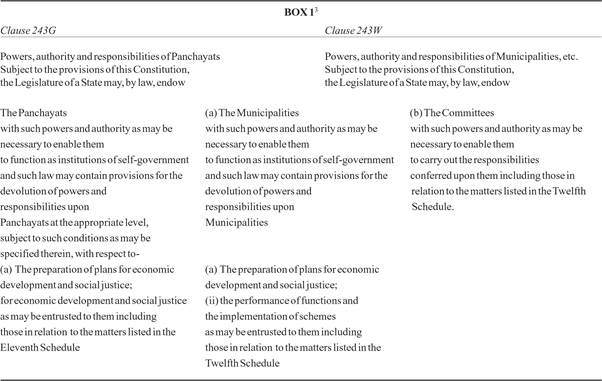
A
deconstruction of the constitutional clauses dealing with functional assignment
to Panchayats and Municipalities (Box 1) reveals that
there are vital differences in the pattern of functional assignments envisaged
in Articles 243G and 243W, dealing with rural and urban devolution respectively.
‘A comparison of the clauses shows that they broadly
contain common provisions. There are however, two vital differences between
them, as described below:
(a) Article 243W makes a separate mention about
the legislature’s powers to endow powers and authority to the Committees.
However, the Committees, unlike the Municipalities are not envisaged to
function as institutions of self-government. (b) A separate mention is
made in Article 243G that the laws devolving powers and responsibilities to the
Panchayats may contain provisions with respect to the
implementation of schemes for ‘economic development and social justice’. These
italicized words are missing in Article 243W; instead, the latter contains the
words ‘the performance of functions’.’4
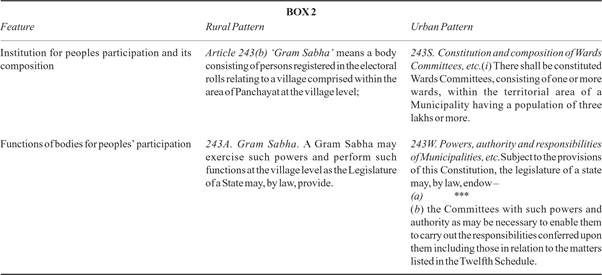
The Constitution also mandates distinctly different
approaches to enable peoples’ participation in urban and rural decentralisation
(Box 2).
In rural
areas, the instrument for peoples’ participation, namely, the Gram Sabha, is defined directly in the Constitution, though the
scope of powers devolved to the Gram Sabhas, is left
for the states to decide. However, in the case of urban participation, there
are four vital lacunae.
First, the
Wards Committees are mandated only for urban local governments whose population
is more than three lakh. Second, even where they are mandatorily to be
constituted, their composition is left to each state to determine by law, as
also the powers and responsibilities that are to be given to them. Third, the
instrument of peoples’ participation in urban areas, namely, the Wards
Committees are not envisaged to be fora for direct
democracy, but is designed as a representative system, with scope for opaque
means of selecting peoples’ representatives. Fourth, the Constitution offers
scope for one wards committees to cover several urban wards whereas, a Gram Sabha in rural areas is mandated for each village.
These lacunae lead to glaring contradictions and
inconsistencies in the participatory rights of citizens depending upon where
they live. While every rural voter is a member of a Gram Sabha,
urban voters do not have any such automatic access to institutions for
participation. Their rights depend upon the law of the state concerned, which
prescribe how wards committees are to be constituted. Furthermore, where a Panchayat comprises of several villages in rural areas,
each village is mandated to have a separate Gram Sabha.
Thus, a Panchayat may have to deal with multiple Gram
Sabhas in States where villages have been clubbed
together to form ‘Group’ Panchayats. However, in
urban areas, Municipalities could have fewer Wards Committees as compared to
its wards. Indeed, it is theoretically possible for only one Wards Committee to
be constituted for an entire Municipality if a state were to be so brazen as to
completely exclude peoples’ participation.
The
disempowerment of citizens is most keenly felt in smaller towns, or large Gram panchayats converted into Town Panchayats.
Where citizens earlier had access to gram sabhas, if
the same villages were constituted into an urban area with a population of less
than 3 lakh, then there is no necessity to have Wards Committees. Indeed, towns
of less than three lakh population have no avenue for peoples’ participation.
Second, the
institutional design of urban service delivery is far more fragmented as
compared to rural areas. There is a lack of alignment of laws that existed
prior to the enactment of the 74th Amendment with the provisions of urban
decentralization constitutional provisions and state laws. Area planning laws
continue to do business as usual, as they did over thirty years back.
Institutions such as Urban Development Authorities continue with the same
powers as they had before the enactment of the 74th Amendment.
The courts have enabled the continuation of pre-74th
Amendment institutional structures by reading down and narrowly interpreting
the constitutional provision that mandates the subordination of previous laws
to the Municipal laws enacted in furtherance of the 74th Amendment. The narrow
interpretation of the Supreme Court in Bondu
Ramaswamy vs. Bangalore Development Authority and
others5 that pre-constitutional amendment institutions that
manage urban land have nothing to do with municipalities, has led to an
explosion of such institutions. A recent example is of the much-touted Smart
City programme, which does not devolve its funds to the Municipalities. States
have been forced to constitute ‘special purpose vehicles’ to ring fence these
grants lest they are tainted by mixing them up with Municipality budgets.
We are as far
away from creating a cohesive legal framework that addresses the imperatives of
decentralization, peoples’ participation and land management, as we were thirty
years back. Taking Bangalore Metropolitan region as an example, there are not
less than eleven independent planning authorities looking at land use planning
overlapping with Urban Local Government functions. There could not be a worse
approach to land use planning. A multiplicity of planning authorities provide
plenty of opportunities for corrupt officials and politicians to band together
and make money from granting permissions, licenses, and land use changes, or
looking the other way when violations happen under their noses.
One of the
biggest problems that ensue from these legislative, political, and thence,
policy shortcomings, is in peri-urban regions, where
urban and rural jurisdictions lie cheek by jowl. As
formally demarcated public areas and private constructions saturate city
centres, their vibrant peripheries are where land transactions are many, where
land classifications are hazy and where economic growth is concentrated.
Furthermore, that vibrant urbanization continues as ribbons along arterial road
and rail networks. Urban facilities line these, seeking the business and other
economic spin offs that heavy road traffic offers. Though such areas require
special attention to ensure proper land zoning and land use, what we see here
is not only a friction between legal systems for local governance, but also of
programmes and funding arrangements, all born out of the differences in
constitutional design.
Third, in many
states, the formal conversion of rural areas into statutory towns lags behind
the phenomenon of actual urbanization. The time lag in
formally recognizing that an area has turned urban, results in a situation
where legal structures and processes for rural governance struggle to handle
urban problems. A case study is that of Kerala, which suffers severely
from this phenomenon, in spite of its relatively better visioned
and structured approach to democratic decentralization.
Kerala’s settlement pattern is unique, comprising for
the most part a continuous spread of habitation. Kerala’s urban population
increased from 18.7% in 1981, surpassing the country average of 25.7%, to 26.4%
in 1991. Urban growth stagnated in the decade from 1991-2001 but grew rapidly
from 25.96% in 2001 to 47.72% in 2011. Kerala in now the third most urbanized
state in the country after Goa and Tamil Nadu and is reckoned by the 2011
census to be the fastest urbanizing state in the country. 19 urban
agglomerations account for 91% of Kerala’s towns and 93.74% of the urban
population. Many urban areas in Kerala, particularly the areas of continuous
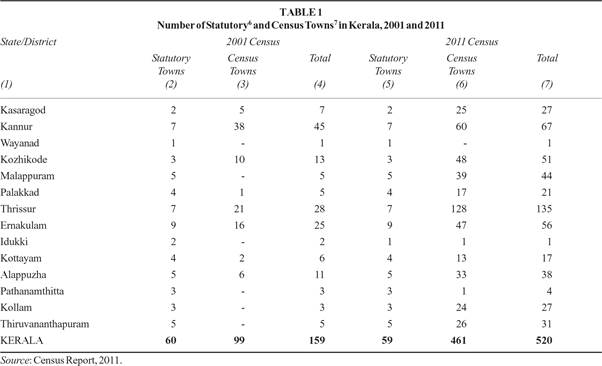
habitation alongside most arterial roads in the state, are still Gram Panchayats in their legal status. There is a wide variance
between the number of Statutory and Census Towns (Table 1). 402 Census Towns
continue to be Gram Panchayats in their legal
constitution.
The response
from governments to problems of urban-rural integrated land use and
socioeconomic planning has been to studiously avoid the constitutional path
prescribed. Articles 243ZE and ZF of the Constitution
mandates the constitution of District Planning Committee in each district, and
a Metropolitan Planning Committee for metropolitan areas, with limited
membership drawn only from the Municipalities and the District Panchayats of that area. These committees are to
‘consolidate’ plans for rural and urban areas into ‘draft’ district plans, which
are then submitted to the government for approval.
Given that the DPC and MPC have a limited role for
state-level ministers and MLAs in the preparation of the district plan, it has
been a non-starter in most states. The Union government took no notice of these
provisions till the Ministry of Panchayati Raj made
the preparation of ‘consolidated’ district plans by the DPCs a precondition for
fund releases under the Backward Regions Grant Fund. Some states duly complied
with these preconditions by hastily constituting DPCs and getting the BRGF plan
alone approved by the DPCs.
One of the early documents that provided some detail
on how DPCs and MPCs should function was the report of the Planning Commission8 on participatory planning. The report
suggested a detailed and logical process for approaching the consolidation of
plans across urban and rural areas. However, these suggestions have been
ignored by states.
We thus have a
dismal record of implementing the constitutional vision of democratic
decentralization. Democracy has not been enhanced in spite of about 32 lakh
peoples representatives elected to them every five years, with great
expectation and fanfare. Local governments remain at best, agents to do the
bidding of higher-level governments, merely providing office spaces for a
rigidly controlled state apparatus comprising of state level officers who
implement programmes determined at the top. Rural decentralization still
exhibits some vestiges of autonomy, because of history and the fact that the
practices of people’s participation are more internalized. However, the
situation is quite the opposite in urban governance, barring some rare
exceptions.
Most reforms in urban governance are not directed
towards transparency in public participation, even the
progress made in transparency is largely in service delivery processes. Thus, municipal reforms focus more on improving the delivery of municipal
services such as certificates, licenses, or cleaning services, but does
not extend to choice of projects and financial transparency at the ward level.
Ward meetings, wherever held, still focus on grievance
redressal, but not on choice of local projects
through involving citizens. There is much tension between new age civil society
actors such as WhatsApp groups and residential
welfare associations, and the representatives on wards committees, who are
usually favourites of the local corporator, and who
cannot be relied upon to raise their voice against the sitting corporator if need be. The situation is worse in peri-urban areas, where local governments are captured by
the rich and influential, who then exploit their elected positions to make
money on land related transactions. It is no wonder that anecdotal information
shows a greater election expenditure by aspirants to
local government elected positions in peri-urban
areas as compared to those living closer to the city centre.
There is not
much that NGOs and other concerned citizens can do at the moment to prevent
this backslide. The prevailing political culture, which leans towards promoting
polarization and divisiveness drowns out a sincere
focus on improving the quality of governance through decentralization. Courts
have been ineffective in promoting decentralization, often suggesting
centralized solutions to problems that ought to be handled by local
governments. They have generally not been swayed by arguments that they ought
to promote decentralization by taking a strict view of governments that violate
their own laws and marginalize local governments. The courts have not even been
able to enforce the regular conduct of elections to local governments as
mandated by the Constitution.
It is easy in such circumstances to give up the battle
to ensure constitutional compliance. Why should concerned citizens lose sleep
if the majority of their fellow citizens are disinterested in which level of
government does what? The tide can be turned only if there is a sufficient
cross-cutting political interest in promoting devolution. That can be achieved
if those who have achieved a modicum of success in improving local governance
by imbibing the spirit of devolution, are encouraged to network with each other
to build enough political pressure across all political parties, in favour of
democratic decentralization.
There is no use any more in attempting to influence disinterested bureaucrats and higher-level politicians and persuade them that the future lies in true devolution and the transfer of power and responsibility downward. Why would they voluntarily curtail their powers and influence? On the other hand, more efforts need to be put into linking municipal and panchayat champions together, so that they realize they are not alone. Forums of politically assertive panchayat and municipal leaders cutting across state boundaries will go a long way in promoting grassroots level support for democratic decentralization.
Footnotes:
1. Contrary to popular perception, the Balwant Rai Mehta Committee, or more precisely, the ‘Team for the Study of the Community Projects and National Extension Service’, chaired by Balwant Rai Mehta in 1957, was not set up to examine the idea of democratic decentralization. Its appointed task was to study how the National Extension Service may be made more efficient and community projects better implemented – it suggested democratic decentralization as the way forward.
2. Paraphrasing and quoting from a blog of mine, at https://accountabilityindia.in/blog/e-governance-and-decentralisation-raghubytes/
3. T. Raghunandan (Principal author), Prof. Debiprasad Mishra (Theme Leader); Theme Report 7, Expenditure Assignment to Panchayats, State of the Panchayats Report 2008-09, An Independent Assessment, Institute of Rural Management Anand, Volume 1, Thematic Reports, pages 234-235
4. Ibid.
5. Civil Appeal No. 4097 of 2010 etc. [2010] 6 S.C.R. 29, judgment dated 5 May 2010 (K.G. Balakrishnan, CJI., R.V. Raveendran and D.K. Jain, JJ.
6. These include Municipal Corporations, Cantonment Boards, Municipalities and Nagar Panchayats.
7. Census Towns are those non-urban areas that are classified, based upon the population, population density and male main working force engaged in non-agricultural activities. Out-growths are areas adjacent and contiguous to statutory towns having all urban facilities, but which do not satisfy the population parameters to be classified as census towns. An Urban Agglomeration is a continuous urban spread constituting a town and its adjoining urban out-growths, or two or more physically contiguous towns together and any adjoining urban out-growths of such towns.
8. Manual for Integrated District Planning, Planning Commission of India, January 2009.